
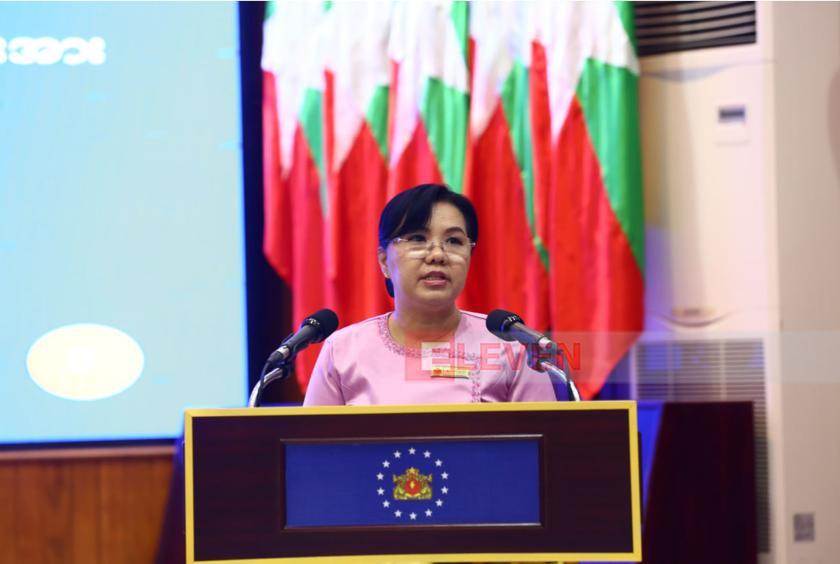
Myanmar Presidential Office spokesperson Dr. Khine Khine Soe said that the success of the Myitsone Dam project would be difficult if local residents do not support it, adding that the President had instructed authorities to seek the views of local communities before moving forward.
She made the remarks during a Presidential Office press briefing held in Nay Pyi Taw on the afternoon of June 30, responding to a reporter's question about public concerns over reports that discussions are being held in Kachin State regarding the possible resumption of the Myitsone Dam project and how the government would address those concerns if the project proceeds.
"Regarding the concerns raised by the public, those concerns are understandable. Just as the public is concerned, the President is also concerned," Dr. Khine Khine Soe said.
She noted that on July 22, 2025, while serving as Acting President, the current President instructed that if local people did not accept or agree with the project, it would be difficult for it to succeed. Therefore, he directed authorities to obtain the opinions of local residents before making further decisions.
According to Dr. Khine Khine Soe, relevant local committees and the Kachin State government subsequently formed a 24-member committee in January 2026 to conduct consultations with local communities on the ground.
"The consultations have been completed, and the results have been compiled. However, we have not yet released the findings because they are still being analyzed," she said.
She added that one common view expressed during the consultations was that local residents wanted access to electricity.
"Everyone who participated in the discussions wants electricity, and local residents also want electricity. However, some people have received inaccurate information. They are concerned that the project could cause flooding, require local communities to relocate, and create risks to their lives and property. These concerns are understandable," she said.
Dr. Khine Khine Soe said the government is carefully studying both the potential benefits and drawbacks of the project.
"We are conducting detailed assessments of how much benefit and how much harm the project could bring. Every project has both advantages and disadvantages, so we need to carry out proper checks and balances. If the benefits significantly outweigh the drawbacks, the project will be implemented. Broadly speaking, the Myitsone project offers many benefits, although there may be some negative impacts. Experts are calculating how those impacts can be minimized, and we will officially announce the findings after the assessment is complete," she said.
Dr. Khine Khine Soe also confirmed that restarting the Myitsone project was discussed during the President's recent visit to China.
"We also discussed restarting the Myitsone project during the visit. In addition, Myanmar's Ministry of Electric Power has long pursued a national electrification plan aimed at achieving 100 percent nationwide electricity access by 2030. This is not a new project," she said.
She noted that Myanmar continues to face electricity shortages, particularly during the hot season.
"Everyone here is aware that our country still suffers from power shortages. During the summer, we all experience the difficulties caused by the lack of electricity. The President has said at previous meetings that if the Myitsone project had been implemented, the entire country would already be fully supplied with electricity. Reliable electricity is essential for economic development, and without it, many activities cannot function. Therefore, ensuring electricity supply remains one of our priorities," she said.
Dr. Khine Khine Soe explained that the Ayeyarwady Myitsone hydropower development consists of seven projects. The main Myitsone project alone is expected to generate 5,600 megawatts of electricity, while Myanmar's nationwide electricity demand exceeds 10,000 megawatts. She said that if all seven projects are completed, after fulfilling the agreed allocation of electricity, Myanmar would still have sufficient power to meet domestic demand, enabling nationwide electrification.