
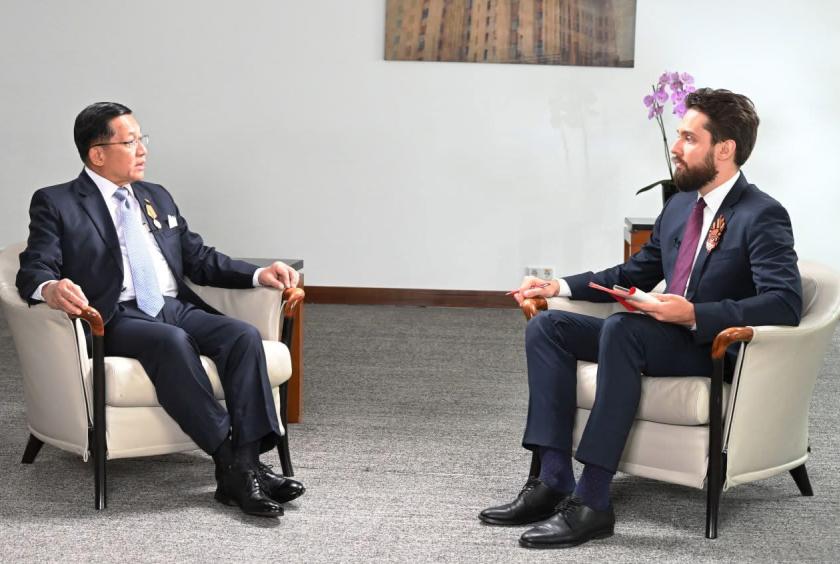
Chairman of the State Administration Council Senior General Min Aung Hlaing stated that although the U.S. had pledged $9 million in aid for earthquake relief in Myanmar, the method of disbursement remains unclear.
In a May 8 interview with Russia’s RT news agency at Ararat Park Hotel in Moscow, the SAC Chairman responded to questions regarding U.S. assistance following the March 28 earthquake. He noted that despite the pledge, the U.S. had simultaneously tightened trade tariffs on Myanmar by up to 44%.
“The Americans did announce $9 million in aid, but we still don’t know how they will deliver it—maybe through the UN or the AHA Centre,” he said.
Following the earthquake, U.S.-based Samaritan’s Purse International Relief arrived in Myanmar on April 4 and opened a mobile hospital at a stadium in Shwekyapin Ward, Zabuthiri Township, Nay Pyi Taw. They provided free medical treatment and surgeries until May 7.
Senior General Min Aung Hlaing also commented that Myanmar’s trade with the U.S. is limited, totaling around $900 million from 2011 to 2025, with annual trade averaging around $800 million. He mentioned that in some years, Myanmar exports more, and in others, U.S. exports dominate.
He further stated that the U.S. tax policies affect not only Myanmar but also some of its allied nations, such as China. “As a developing country, we believe these increased tariffs are unfair,” he said, suggesting that the U.S. may be raising tariffs due to financial challenges in its trade sector.
When asked about Myanmar’s response to sanctions and tariff hikes, he said the country intends to diversify its trade partners rather than relying on one country. “It’s better to trade with multiple countries equally, which also supports cooperation,” he added.
He questioned whether high U.S. product prices, caused possibly by high production costs, are contributing to their reduced competitiveness in global markets. “American goods are good quality, but expensive. That’s a challenge for developing countries like ours,” he said.
In conclusion, he emphasized that Myanmar should not depend solely on the U.S. and should seek stronger trade relations with other countries, especially since many still heavily rely on the American market.