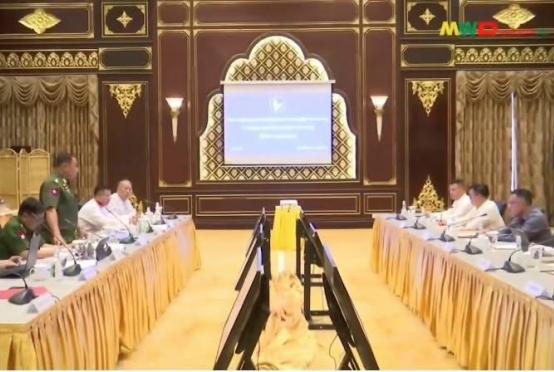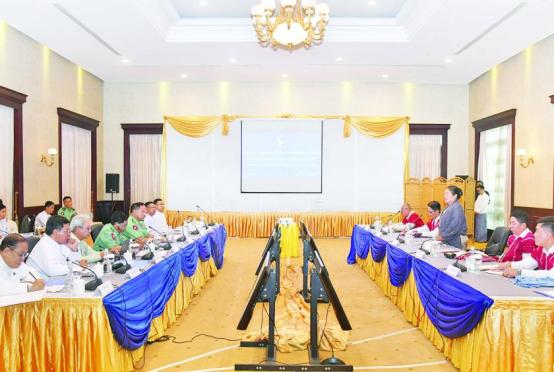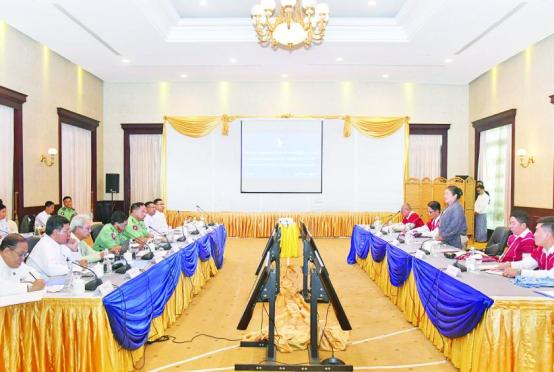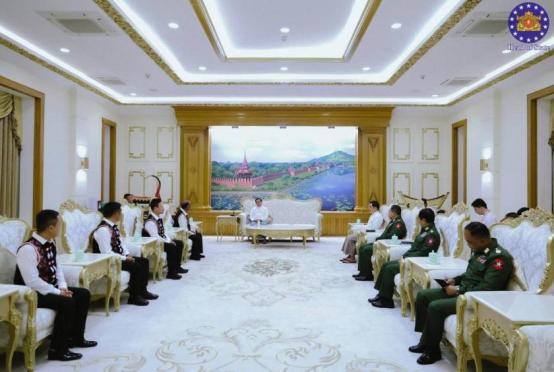

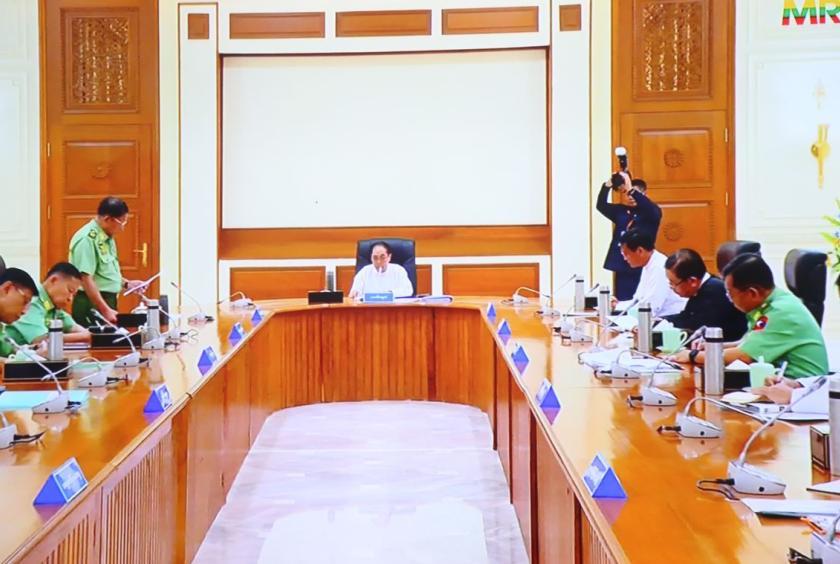
The National Defence and Security Council (NDSC) held a meeting in Nay Pyi Taw on July 31, state media reported.
Present were Pro Tem President U Myint Swe, Vice President U Henry Van Thio, Speaker of the Lower House U T Khun Myat, Commander-in-Chief of Defence Services Senior General Min Aung Hlaing, Deputy Commander-in-Chief of Defence Services Commander-in-Chief (Army) Vice-Senior General Soe Win, Union Minister for Defence General Mya Tun Oo, Union Minister for Home Affairs Lt-Gen Soe Htut, Union Minister for Foreign Affairs U Than Swe, Union Minister for Border Affairs Lt-Gen Tun Tun Naung, and specially invited guests, State Administration Council (SAC) Secretary Lt-Gen Aung Lin Dway, SAC Joint Secretary Lt-Gen Ye Win Oo, and Union Minister for Legal Affairs Attorney-General Dr Thida Oo.
At the meeting, the Commander-in-Chief gave a detailed briefing on the accomplishments and future work programs of the SAC during the extended period of six months.
He stressed the need to further extend the state of emergency as continued measures are necessary for security, peace and stability, citing a lack of full security in all the regions for election purposes and no representation of voters if the election is held only in the safer regions.
“It is the government’s duty to take measures to ensure that all voters have rights to vote peacefully and safely. Vote or no vote is the democratic right of an individual wish of the people. Our government has emerged because of malpractice on voting lists. The election to be held by our government with responsibility is a matter that will be a crucial decision for the nation. Therefore, we will take special care to ensure that such malpractice in voting lists will not happen again in the election to be held in the time of our government. If some weaknesses come out in making decisions and taking measures, our Tatmadaw (military) will be blamed by the people. Thus, as it is unable to hold the election early and hurriedly but is to prepare systematically, we need to continue to take the responsibilities until a certain period,” the Senior General said.
Looking forward to Myanmar’s democracy, the government is working on holding the election compulsorily. Regarding the election, it is possible that two displays come out. The first one is that the election is held except the regions where armed struggles and instabilities are happening currently. The second is that the election is compulsorily held nationwide. Consequences of the first one are that there will be less number of townships than 315 townships in the election held in 2020. It has been learned that discontentment came out in the ethnic regions where the 2020 election could not be held. The people in the townships where the election could not be held will lose their rights to vote and express their wish democratically. It should be considered that elections should be held in safer areas if the election could not be held in the entire township. Moreover, the consequences such as weaknesses in calling parliamentary sessions, choosing chief ministers and forming governments in regions and states left out in the election and those such as no representatives of those regions in the Upper House and the Lower House and weaknesses in forming a government will be faced as well. That will fall into a position where parliamentary sessions are forcibly called in the eyes of the intentional community and the people.
He then dealt with the consequences of the second possible one. He said voting could be banned by means of threats with the reliance on arms in the regions where armed struggles and terrorist attacks are happening mainly and bomb blasts and attacks in terrorist ways and threatening and forcing the people to vote those in favour of the terrorists. As a result, there will be a drop in percentage for the representatives who the voters choose themselves and Hluttaw representatives supporting the terrorists will get to the respective parliaments as well. That will worsen the nation’s path to democracy. To ensure that such situations will not happen, it is urgently necessary to continue to take measures for peace and stability and rule of law with momentum in the regions and states where terrorist attacks are happening currently, the Senior General said.
In analyzing and assessing the main requirements for the two displays to be able to hold the election, the main subjects are: to hold the election nationwide; to enable the people to vote independently and fearlessly; and to ensure peace, stability and rule of law on an entire nation basis. The election we will hold is a general election. As that will become an important decision for the nation, all need to make efforts with a sense of special consideration. For firm and correct emergence of a genuine, disciplined multi-party democracy system that is the wise of the entire people in our country, political parties, ethnic armed organizations (EAOs), all the persons concerned, all the people, local and overseas organizations and international community need to cooperate in a constructive manner with a sense of full understanding. Therefore, as it is necessary to take measures for peace and stability and rule of law with momentum in the regions and states where the terrorist attacks are happening currently, the period of State of Emergency declared for the entire country should be extended for another six months, the Commander-in-Chief commented.
Then, the NDSC members made their reviews and discussions, supporting the need for the state of emergency period extension.
In accordance with Article 425 of the constitution and the opinion statement released by the Constitutional Tribunal on February 1, 2023, "the period of the state of emergency for the entire country has been extended for another 6 months from August 1, 2023.