
They are working to sell 200,000 tons of rice to Bangladesh for the third time and efforts are being made to increase the export of some high quality rice not only to African countries but also to China, said Chair of State Administration Council (SAC), Prime Minister Senior General Min Aung Hlaing.
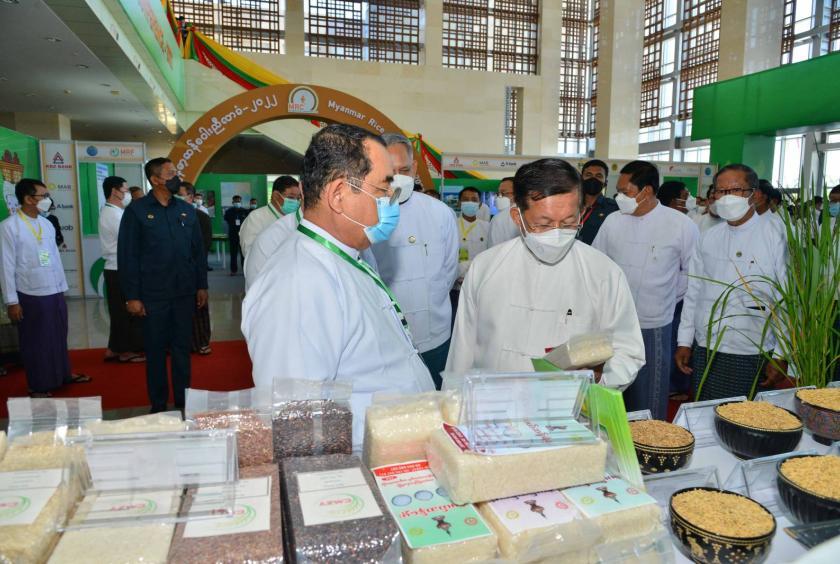
Senior General Min Aung Hlaing added this in his speech at the opening ceremony of the Myanmar Rice Conference - 2022, which was held under the title "Let's try with rice to promote the country's economy" at the Myanmar International Convention (Center-2) in Nay Pyi Taw on October 6.
Myanmar rice was able to be exported in large quantities to countries in Africa and Europe in the past until now it is exported more to the Asian market. Therefore, as it is necessary to find and export to new markets, it is necessary to make efforts to continue exporting to the markets that have already been obtained in the long term. Therefore, among the countries that are buying Myanmar rice, he would like to order the Myanmar Rice Federation and sister associations and the departments to make efforts, in order to be able to re-export and sell rice to the African and South Asian markets that have been buying for the past 3 and 4 years and are not currently buying, said Senior General Min Aung Hlaing.
In an effort to increase rice exports, we are working to sell 200,000 tons of rice to Bangladesh for the third time and efforts are being made to increase the export of some high quality rice not only to African countries but also to China. Therefore, we constantly analyze the international market conditions, He urged that domestic food security and surplus should be properly expanded and exported overseas. He would like to encourage people to make efforts to produce more high-quality rice and increase their income from export sales, SAC chairman said.
In addition, it should be properly managed to produce value-added products from the by-products of the rice industry and waste materials. The rice industry can be considered strategically not only for export promotion but also for import substitution. If we can extract high-value bran oil that can support health as a by-product of bran, which is only useful as animal feed, and meet the domestic consumption oil demand, we will be able to reduce the import of oil from abroad. He would like to encourage various sectors such as private, government and associations to discuss and identify what should be done by sector, the SAC chairman said.
In addition, about 80 percent of the annual rice production goes to the consumption of the entire population, including farmers and people and in the production of snacks, and only about 20 percent is exported. So it is also requires cooperation between the government and private farmers for domestic consumption and the stability of the rice market. He urged related ministries, all regional and state governments and rice associations to act in a balanced manner for farmers to get rice prices that are appropriate for input costs, as well as for consumers to be able to buy and consume rice at reasonable prices, he said.
Similarly, in the production of rice, it is necessary to produce good quality rice and to obtain clean and high-quality rice for milling the rice produced. There are two types of markets in the international rice market, the price market and the quality market. Myanmar is not up-to-date in terms of mill production, so it has been found that the situation has changed from the situation in which the low quality rice that did not get a good price in the past and now the situation in which better quality rice can be exported, he said.
Today's rice industry faces problems related to rice quality, such as red rice, mixing, many varieties and rice grain size which is less attractive to consumers, color of the rice which is not beautiful and poor quality of rice which is affecting the market a lot. Therefore, these challenges need to be reformed by the agricultural production sector, and if the mill production sector is integrated with the activities that need to be changed, then Myanmar's rice market entry will significantly improve. Therefore, as required by the policies and processes led by the federal government, he would like to seriously order the regional and state governments to pay special attention to improving investments in rice milling production sectors, the SAC chairman said.