
The MNDAA has announced that it has reorganized the areas it controls into a new development area, with four districts and a capital, formerly known as Special Region 1, and that it has entered a new phase of development and there have been criticisms that the reorganization of Special Region 1 is inconsistent with the 2008 constitution and is an infringement of sovereignty.
The MNDAA announced on January 6 that January 5, the day the MNDAA took full control of the Kokang region in 2024, the first phase of Operation 1027, and that it had taken control of the military’s regional command headquarters (Laukkai), was designated as Special Region 1 Restoration Day.
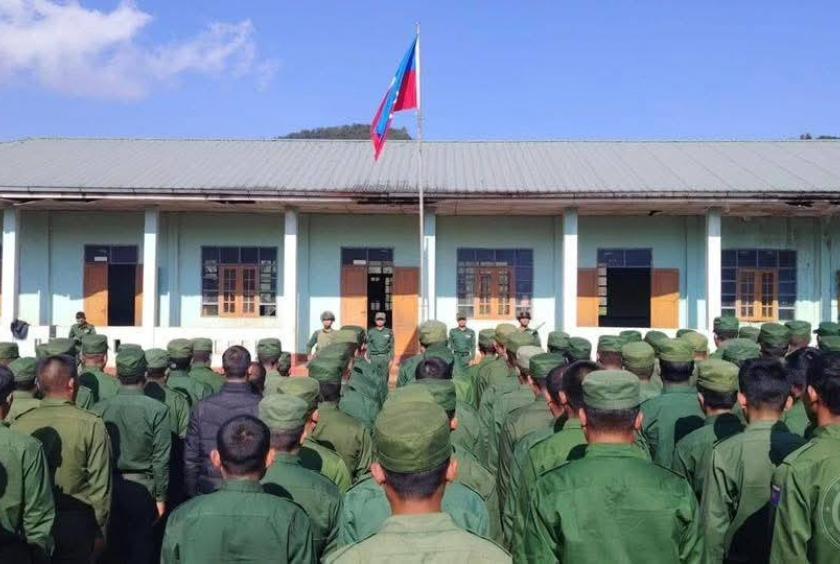
In addition, the MNDAA-controlled Special Region 1 has been reorganized into a structure consisting of four districts and a capital, and has entered a new phase of development, according to the MNDAA’s second Victory Day ceremony to control the Special Region 1 on January 6.
The MNDAA statement stated that Special Region 1 will be organized into four districts and a capital. Although the names were not specified, some local news outlets reported that Laukkai will be designated as the capital of the special region and the districts will be Kutkai, Hsenwi, Monekoe, and Laukkai.
The MNDAA also stated that it has regained the original territory of the Kokang region after waging an armed struggle for 14 years.
The MNDAA, in collaboration with its northern allies, the AA and TNLA, waged a campaign in northern Shan State under the name of Operation 1027, taking control of the towns of Laukkai, Kongyan, Chinshwehaw, Monekoe, Tamoenye, Kyu Kok (Pansai), Lashio, Kunlong, and Hsenwi, and designated them as Special Region 1 of Shan State, where the MNDAA’s administrative machinery operated.
In addition, the MNDAA also has some other areas in northern Shan State that are not included in the Special Region 1 they designated, which they jointly control with the AA and TNLA.
After the MNDAA took control of the Kokang region and its surrounding towns, including the northern capital of Shan State, Lashio, in Operation 1027, they included areas that were not previously included in Special Region 1 under the name of Special Region 1 and began operating their administrative apparatus by flying the Special Region 1 flag and the MNDAA flag, which has been criticized ever since.
After such criticism, initially, Tatmadaw and the MNDAA met with China's mediation and discussed the re-raising of the flag of the Republic of the Union of Myanmar. In mid-April 2025, MNDAA left Lashio, and by the last week of April, the government was back in control of Lashio administration, and a ceasefire was also reached between Tatmadaw and the MNDAA.
A political analyst said that the MNDAA's armed conflict and control over the Kokang Autonomous Region, which is defined by the 2008 constitution, not only violates the country's sovereignty but also opens the way for the collapse of the union.
"The 2008 constitution already includes the Kokang Autonomous Region. It is not surprising that they are fighting to regain control of the region because they want to do something for the benefit of the region. However, in the long run, they will have to go through the election process in their region. Now, they have gone beyond that and are reviving the warlord era of the past, they can do whatever they want. They are recreating the special region. They want to do whatever they want with their economic model. They want to do whatever they want with their resources. They want to do whatever they want with their direct relations with neighboring countries. This is a situation that could lead to the collapse of the union," said a political analyst.
During the military government era in 1989, the Kokang sect, led by Phong Kyar Shin, the father of current MNDAA leader Peng Daxun, broke away from the Communist Party of Burma and made peace with Tatmadaw. After the military government designated Laukkai and Kongyan regions as Special Region 1 of Shan State, granting the Kokang control and administration.
After the 2008 constitution was ratified, the Kongyan and Laukkai townships in Shan State were merged into the Kokang Autonomous Region, and Tatmadaw ordered the MNDAA to transform into a militia or border guard force in 2009, which led to renewed fighting between Tatmadaw and the MNDAA. The MNDAA, led by Phong Kyar Shin, fled from Special Region 1 and lived in Mongla, controlled by his son-in-law U Sai Leun, until his death.
The MNDAA had been fighting in areas related to the Kokang region since late 2014 and early 2025 under President Thein Sein government era, and now, on October 27, 2023, it took control of several towns in a campaign called Operation 1027.
The Wa, which is currently in a ceasefire with Tatmadaw, has made demands in meetings and discussions with the government to officially recognize their Wa Self-Administered Region as Wa State, and the Wa State issue has been requested to be raised in parliament by holding elections in the Wa region in accordance with the constitution, said NSPNC Chairman Lieutenant General Yar Pyae.