
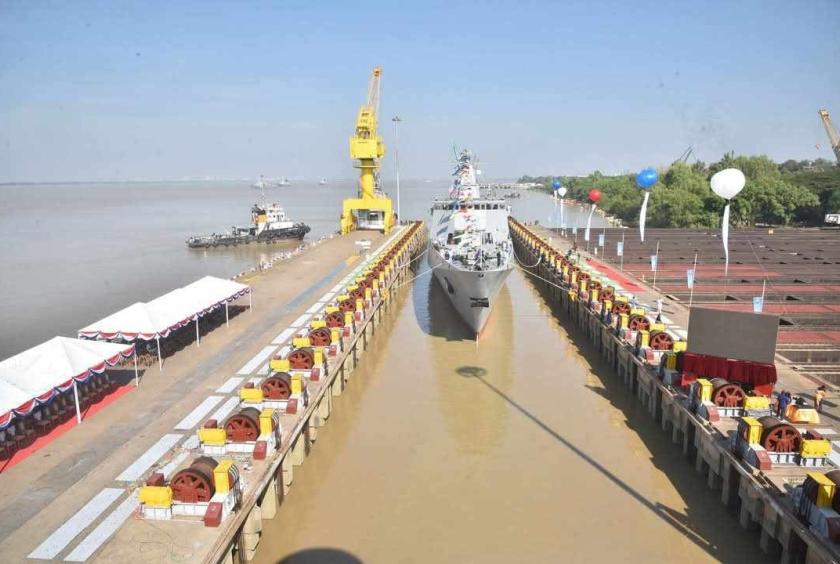
On December 24, the Myanmar Navy marked its 77th Navy Day with the launch and naming of a newly constructed 135-meter frigate, KingThalun. The ceremony was held at the Navy Dockyard Headquarters in Thanlyin and attended by Senior General Min Aung Hlaing, the Commander-in-Chief of Defence Services, along with other high-ranking officials, their spouses, and invited guests. The event also included the commissioning of two 63-meter anti-submarine warfare ships into service.
The newly launched frigate, King Thalun, was named to honor a historical king recognized for his contributions to governance and defense. The ship’s naming ceremony followed traditional naval rituals, including the symbolic breaking of a champagne bottle on the hull. Senior General Min Aung Hlaing presided over the event and emphasized the strategic importance of the frigate in enhancing the navy’s capabilities.
Construction of the 135-meter frigate began in March 2017 under the supervision of the Navy at the Dockyard Headquarters. The ship is the largest and most advanced warship ever built by the Myanmar Navy. It features a length of 135 meters, a width of 14.5 meters, and a height of 9 meters, with a displacement of 3,500 tons. Equipped with modern weapon systems and technology, it can reach a speed of 30 nautical miles per hour, aligning with the requirements of 21st-century naval operations.
The ceremony also saw the commissioning of two 63-meter anti-submarine warfare ships at the No. 3 Navy Pier in Yangon. These ships are designed to counter underwater threats and contribute significantly to the navy’s maritime defence capabilities. The commissioning included a formal handover of relevant documents and honors.
During his remarks, Senior General Min Aung Hlaing highlighted the Myanmar Navy’s progress from purchasing warships to building advanced vessels domestically. He emphasized the importance of protecting Myanmar’s maritime sovereignty and natural resources, pointing out that modern warships like King Thalun are crucial for achieving this goal. He also outlined the navy’s future aspirations to transition from coastal defence to regional operational capabilities.
The event concluded with a naval parade, where various warships, including frigates and missile boats, participated in single-line and line-abreast formations. Officials, naval officers, and personnel involved in the construction of the ships were recognized and presented with commemorative gifts and plaques.