
State Counsellor Aung San Suu Kyi said she could not decide on the letter sent by the Union Election Commission (UEC) to investigate the National League for Democracy (NLD) party and it will be decided by all Central Executive Committee (CEC) members, said Attorney Khin Maung Zaw.
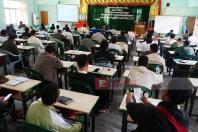
He said the State Counsellor made the remark during the court hearing of President Win Myint, State Counsellor Aung San Suu Kyi and Nay Pyi Taw Council Chairman Dr Myo Aung, who are being prosecuted under Section 505 (b) of the Penal Code in a special court in the compound of Nay Pyi Taw Council, Nay Pyi Taw on September 14.
“The UEC sent the letter Bahan NLD headquarters for investigation. It was brought by a lawyer from Yangon and gave it to the State Counsellor. She said it has to be sent directly to her or to the NLD’s CEC by the UEC. She could not make decision herself and it will be decided by all CEC members,” said the attorney.
The UEC sent a list of 93 political parties and members of the Central Executive Committee to the Ministry of Home Affairs for verification on May 24 whether the political parties comply with the law on registration of political parties or not.
In a letter sent to the Ministry of Home Affairs by the UEC dated on May 24, the UEC has approved the registration of 93 political parties in accordance with the Political Parties Registration Law. When political parties apply for the right to form political parties, they have already signed an agreement to abide by the provisions of six sections of the Political Parties Registration Law. The notice states that in accordance with Section 12, Sub-section (a), Sub-section (3) of the Political Parties Registration Law any party deals with armed insurgent groups and individuals who are armed against the State or directly or indirectly contacting or abetting the organization or its members that has been declared an illegal organization and Sub-section (4) of the law stipulates that a party cannot stand as a political party if it is in conflict with the provisions of Section 6, such as aiding and abetting.
In addition, political parties were sent a letter on 27 August informing them that the information related to political parties should be systematically prepared so that they can be submitted to the joint inspection team. Two joint inspecting teams comprising the Ministry of Home Affairs, Ministry of Planning and Finance and the Office of the Auditor-General of the Union are conducting the inspection of political parties in line with the Section 18 and 23 of the Political Parties Registration Law, the statement said.
The UEC has sent a letter to political parties urging them to prepare information for the co-operation of joint inspection teams comprised of the Ministry of Home Affairs, Ministry of Planning and Finance and the Office of the Auditor-General of the Union formed by the UEC in accordance with law.
The list of documents that political parties should have prepared in advance includes the strength of the party structure, list of party membership fees, list of party monthly collection, accounts of money and items donated by local donors, list of party-owned businesses, the party's annual financial statements, including the revenues of party-owned businesses, general election expenses, the party's financial rules and regulations and bank accounts.
The National Unity Democratic Party (NUD) and the National Democratic Force Party (NDF) were audited by the joint inspection team on August 23 and Union of Solidarity and Development Party (USDP) and Union Betterment Party (UBP) during September.
Section 407 of the 2008 Constitution stipulates that a political party must be deregistered if it finds that (1) a political party may be declared an illegal organization under the existing law, (2) directly or indirectly contacting or abetting the insurgent group launching armed rebellion against the State or the associations and persons determined by the State to have committed terrorist acts or the association declared to be an unlawful association (3) directly or indirectly receiving and expending financial, material and other assistance from a foreign government, a religious association, other association or a person from a foreign country, (4) misuse of religion for political gain. Section 408 of the Constitution stipulates that if the body having authority to register political parties finds that a political party infringes one of the stipulations contained in Section 407, the party’s registration shall be revoked.