
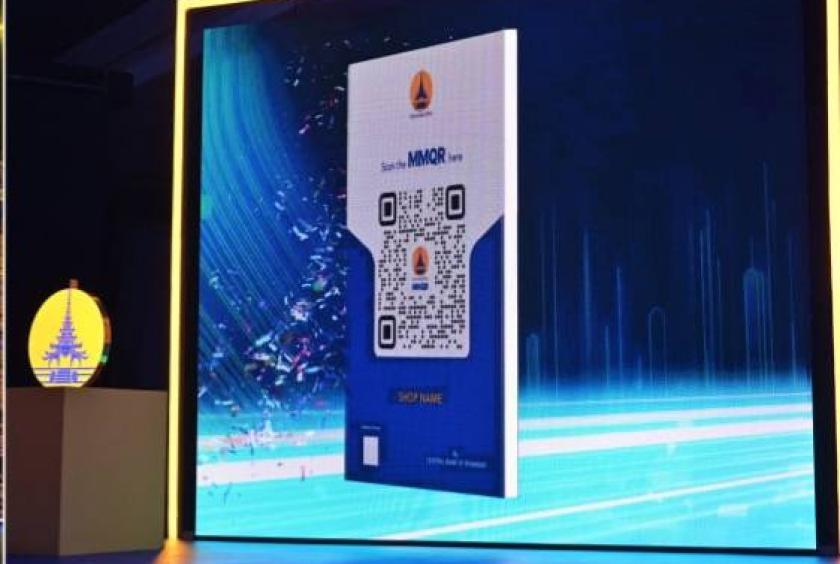
The digital payment system MMQR has surpassed 24 million users since its launch in February 2025, according to the Central Bank of Myanmar.
From February 28, 2025, to the end of January 2026, MMQR recorded more than 30 million transactions, with a total transaction value exceeding MMK 12.7 trillion. The system is now used by over 420,000 merchants nationwide.
The Central Bank stated that building a comprehensive cashless ecosystem cannot be achieved by the banking sector alone. In addition to banks, collaboration with government digitalization initiatives and other sectors is essential to successfully implement a nationwide digital payment framework.
To align with international standards, the Central Bank has been systematically developing the National Payment Infrastructure in phases. It first established CBM-NET as the core interbank payment infrastructure, followed by the formation of the Myanmar Payment Union (MPU), and later progressed to the implementation of MMQR.
Under the leadership of the Central Bank, state-owned banks, private banks, non-bank financial institutions, and technology companies are working together to transition from cash-based payments to a cashless system. The shift aims to promote secure and reliable mobile banking and digital payment systems.
Authorities noted that adopting digital payments accelerates money circulation, enhances transparency in financial transactions, facilitates the integration of micro, small, and medium enterprises (MSMEs) into the formal economy, and expands financial access to rural populations.
The Central Bank said it has studied successful international models in developing its cashless strategy. These include India’s Unified Payments Interface (UPI), which enables real-time QR payments even for street vendors; Thailand’s PromptPay and National QR system, which support cross-border QR linkages; and Singapore’s regulatory sandbox and cloud governance frameworks that balance innovation and regulation.
CBM-NET serves as the backbone of Myanmar’s Real-Time Gross Settlement (RTGS) and Automated Clearing House (ACH) systems. It enables secure, real-time interbank transfers and ensures final settlement for high-value transactions, while facilitating bulk clearing for low-value payments. The system also supports liquidity management, monetary policy transmission, and overall financial stability.
The Myanmar Payment Union operates as the country’s domestic card scheme, connecting ATM, POS, and e-commerce transactions through a domestic switching platform. Its objective is to reduce cash usage and increase card payment adoption.
MMQR, designated as the National QR Standard by the Central Bank, enables interoperability between banking applications and digital wallets. With a single QR code, merchants can accept payments from multiple banks and wallet providers. The system is designed to meet international standards and strengthen the foundation for cross-border QR payment linkages.
Officials emphasized that MMQR supports MSME digitalization by creating transaction data footprints that can be used for credit scoring and digital lending. Since many MSMEs face challenges in providing collateral, digital transaction data can serve as an alternative basis for accessing financing, thereby expanding digital credit opportunities.
The Central Bank highlighted that building a cashless society requires coordinated efforts among regulators, banks, Fin-tech firms, and the public. While promoting innovation, the Bank will continue to ensure financial stability and consumer protection.
Authorities encouraged the public to reduce reliance on cash-based transactions and increase the use of digital payments, stating that broader adoption will contribute to economic development and improved socio-economic well-being.