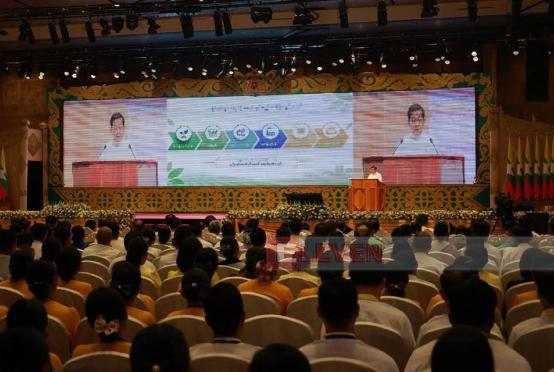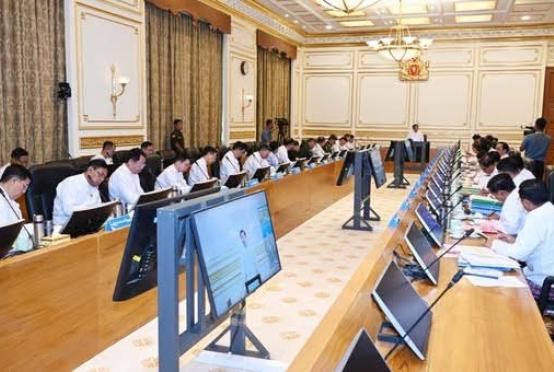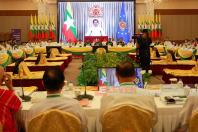

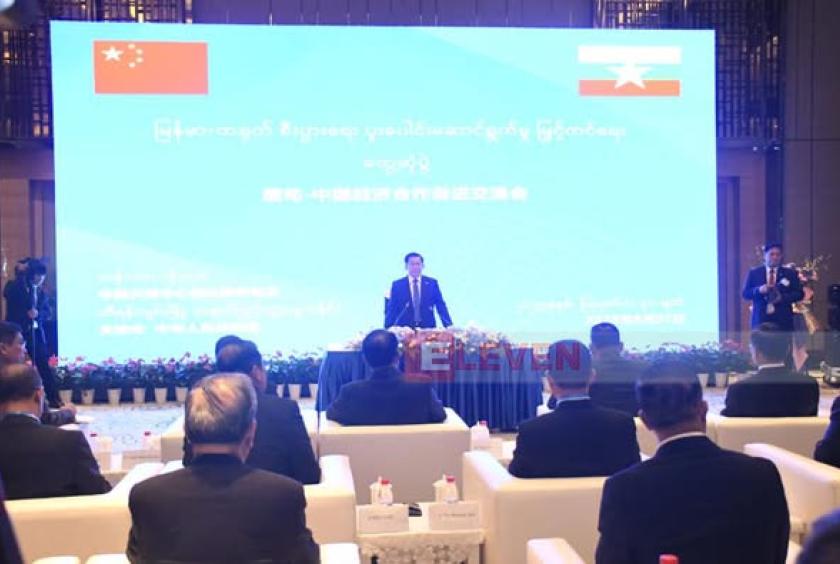
Acting President of the Republic of the Union of Myanmar, Chairman of the State Security and Peace Commission (SSPP), Senior General Min Aung Hlaing, delivered a speech at the Myanmar–China Economic Cooperation Promotion Meeting held at Tangle Hotel in Tianjin, People’s Republic of China, at 9 a.m. Chinese Standard Time yesterday.
He highlighted that Myanmar and China are jointly implementing major projects such as the Kyaukpyu deep-sea port, the Myitsone hydropower project, and the oil and natural gas pipeline. Ongoing projects also include the Muse–Mandalay new railway and the Mandalay–Kyaukpyu railway.
With China’s support, Myanmar is undertaking initiatives to promote socio-economic development in education, health, electricity, energy, agriculture, industry, and transport and communications. The Muse–Mandalay railway, a high-speed line connecting the border town of Muse with Mandalay, will integrate with China’s Beijing–Kunming–Ruili railway and provide crucial trade access. In the 2023–2024 fiscal year, border trade between the two countries exceeded US$3.2 billion, with more than US$2 billion flowing through the Muse–Ruili checkpoint.
These railway projects form part of the larger Kyaukpyu–Kunming railway plan, offering China vital access to the Indian Ocean through Myanmar. Given its strategic location at the crossroads of South Asia, Southeast Asia, and China, Myanmar plays an essential role in regional connectivity and trade.
Senior General Min Aung Hlaing also emphasized the potential for Myanmar, China, and Russia to expand trade collaboration, which would significantly boost regional goods flow. He noted Myanmar’s ratification of the Regional Comprehensive Economic Partnership (RCEP) and reaffirmed its participation in the Belt and Road Initiative (BRI) since 2017.
Myanmar aligns with several priority areas of China’s Global Development Initiatives (GDI), making it an attractive destination for foreign investment. The country offers tax exemptions and favorable policies to ensure investors can operate without disadvantages. He encouraged international businesses to invest with confidence, particularly in the electric vehicle (EV) sector, as Myanmar seeks to reduce fuel-powered vehicle usage and promote EV adoption.
He also said that a free and fair general election will be held in Myanmar this coming December, which will further strengthen political stability in the country. With greater stability, more opportunities for economic activities will also emerge. He added that if Myanmar’s land, underground and water resources, as well as human resources, are combined with China’s investments, it would bring about significant positive results for both countries.
Also, present at the meeting were members of the high-level Myanmar delegation, Union ministers, the Myanmar Ambassador to China and Chairman of the Union of Myanmar Federation of Chambers of Commerce and Industry.