

After announcing the cessation of military weapon supplies to the MNDAA, TNLA, AA, and PDF groups, non-military goods are now permitted to cross freely at the Wa-China border gates.
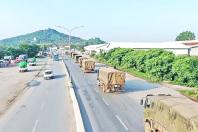
Following the declaration to halt military weapon supplies to the Brotherhood Alliance armed groups—the Kokang Army (MNDAA), the Ta'ang National Liberation Army (TNLA), the Arakan Army (AA), and PDF groups—it has been learned from a report by Wa News Land, a news agency within the Wa region, that non-military goods are now allowed to cross freely at the Wa-China border gates, with the exception of military supplies.
According to Wa News Land's report, citing sources from "Wa Youth Voice," ground sources indicate that at the Wa-China border gates in the United Wa State Army (UWSA) controlled territory, all goods except for military weapons and equipment from the Chinese side are now being permitted to cross.
An anonymous news source stated in the Wa News Land report that this situation arose after the Wa armed group (UWSA), complying with China's wishes, officially announced the cessation of military weapon supplies and any further assistance to the Brotherhood Alliance (Arakan Army (AA), Ta'ang Army (TNLA), Kokang Army (MNDAA)) and other PDF groups involved in the ongoing conflicts in northern Shan State, following which the Chinese side began to permit crossings again.
An anonymous source told Wa News Land: "The restrictions on importing goods via the Wa-China border gate started around August 2024 during the second phase of the 1027 Operation. We've been enduring this hardship for a full year now, and it's only now being officially stated. The Chinese pressure was also explicitly declared. After the announcement, we observed some relaxation of pressure from the Chinese side during September and October. Goods started coming in again, petrol came back in, building materials, electrical goods, foodstuffs, and so on."
Following the relaxation of these restrictions, business operators have simultaneously returned, and construction projects and businesses previously halted have resumed operation, according to a local resident in Hopang who spoke to Wa News Land.
He told Wa News Land: "I don't know if it's because of the Chinese leadership's meeting and the approaching New Year that the gates are temporarily reopened and goods are allowed to be imported again. But we can order Chinese goods again now. Before, we couldn't. In Hopang, Chinese business operators are coming back in. Shops that were closed before are reopening. Construction projects that were stopped because we couldn't order materials due to the closed Chinese gates are now starting up again. In Mong Pawk and Pang Sang, we also see people gathering again."
Wa News Land's report states that China's initial coercive pressure began in August during the second phase of the 1027 Operation, when restrictions and closures on goods imports and pedestrian movement started at the four main Wa-China border gates.
According to Wa News Land's reporting, besides the major Wa border gates—Mong Ah (Mong Zi Gate), Sao Fa (Pang Wei Gate), Man Hka (Namtit Gate), and Yung Hawt Gate—other border gates captured by Ethnic Armed Organizations during the 1027 Operation period were also subjected to restrictions and closures.
Wa News Land reported that due to the closure of the Wa border gates, people living in the four districts of the Wa region (Hopang, Mong Pawk, Mong Lin, Mong Mau) faced difficulties including shortages of local food supplies, consumer goods, basic medicines, electrical appliances, building materials, and petrol.
The Wa News Land report also stated that individuals and families were only allowed to shop in limited, piecemeal quantities, and for locals who rely on farming and agricultural work for their livelihood, the inability to export to China caused significant food security challenges.
Wa News Land's report also indicated that Kokang groups, alongside the Wa forces, were subjected to these border restrictions and pressures from China.