

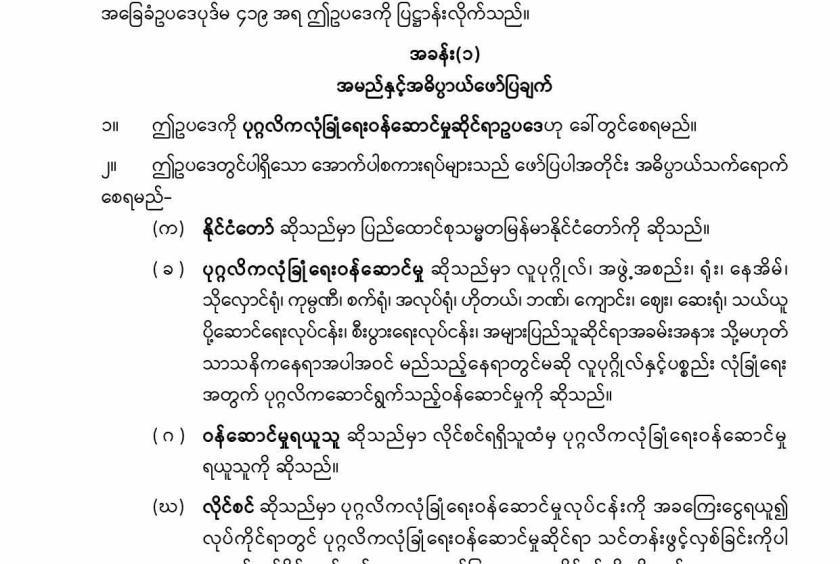
The Private Security Service Law, enacted with 13 chapters, mandates that licensed foreign companies must employ at least 75% Myanmar nationals. This law was promulgated by the State Administration Council on February 18, under Section 419 of the Constitution, through Notification No. 4/2025.
The law comprises 13 chapters, covering various aspects such as the formation and responsibilities of the Central Committee, licensing procedures, duties and rights of license holders, dispute resolution, administrative actions, prohibitions, offenses, and penalties. Its objectives include supporting national security, public order, and collaboration with state security agencies, developing human resources in the private security sector, preventing misuse of private security services, and fostering international cooperation.
The Union Government has established a Central Supervisory Committee for Private Security Services, chaired by the Union Minister for Home Affairs, with the Police Chief as Vice-Chairman. The committee is responsible for policy formulation, supervision, and coordination with state security agencies. It also sets license fees, service charges, and regulations for private security personnel, including uniforms and insignia.
Applicants for private security licenses must be registered companies under Myanmar law. Foreign companies must also meet registration requirements and ensure their operations do not compromise national security. Additionally, they must deposit a security bond of at least MMK 100 million in a designated bank. License holders must comply with all regulations, cooperate with state security agencies, and adhere to directives issued under the law.
Foreign employees in private security roles must meet labor ministry criteria, provide clearance certificates from their home countries, and not be members of any armed forces. Foreign companies must ensure at least 75% of their security staff are Myanmar nationals. Entities employing more than 10 security personnel for non-commercial purposes must apply for a permit, valid for three years.
Violations of the law, such as breaching prohibitions under Sections 34, 35, or 37, can result in imprisonment for one to three years and fines of up to MMK 10 million. Companies or organizations found guilty may face fines ranging from MMK 100 million billion to MMK 300 million. Existing private security service providers must apply for licenses within six months of the law's enactment, and those employing more than 10 personnel must obtain permits within the same period. The law designates these offenses as police-applicable crimes.