
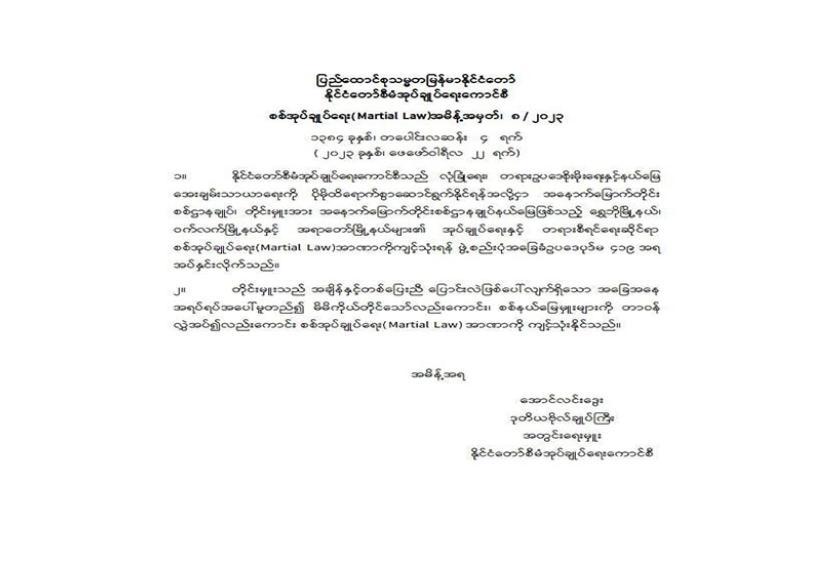
The State Administration Council (SAC) has issued a declaration to the Commander of the Northwest Regional Military Command stating that Shwebo, Ayadaw and Wetlet townships, which is the area of Northwest Regional Military Command, have been entrusted with the exercise of martial law under Article 419 of the Constitution in order to more effectively implement the rule of law and peace in the area.
The order also states that either the Commander of the Northwest Regional Military Command or the commanders of military areas can exercise the martial law depending on the circumstances that are changing at the same time.
All levels of local authority organizations within the military administration region must carry out their related tasks under the command of the Commander of the Northwest Regional Military Headquarters. The Commander of the Northwest Regional Military Command can designate military areas within the martial law region and appoint military commanders with the approval of the Chairman of the SAC.
The administrative and judicial matters must be completed by the Commander of the Northwest Regional Military Command or military commanders, a person or a group to whom the Commander delegates his responsibilities. The Commander of the Northwest Regional Military Command can form a military advisory group to assist him in carrying out his responsibilities and he will need to report of the events occurring in the military administration region to the SAC Chairman.
The crimes to be investigated by a military court in the Northwest Regional Military Command are Section 122 for conviction of high treason, Section 124(a) for defaming the government, Section 124(c) for delaying or disrupting Tatmadaw or law enforcement operations, Section 124(d) for obstructing military personnel or government employees, offences under Section 505 of the Penal Code, Section 505(a) of the Penal Code for directly and indirectly causing a government employee to commit a crime, frightening, inciting and spreading false news, and offenses under the Unlawful Associations Act.
In addition, crimes under the Arms Act, murder, death, rape, robbery, and corruption cases, offenses under the Narcotics and Psychotropic Substances Law (1993), offenses under the Public Property Protection Act, offenses under the 1963 Law on the Public Property Protection, crimes under the Media Law, offenses under the Printing and Publishing Law, offenses under the Myanmar Immigration (Emergency Provisions) Act 1947, offenses under the Electronic Transactions Law, crimes under the Ward or Village Administrative Law and crimes under the Counter-Terrorism Law, can be prosecuted.