
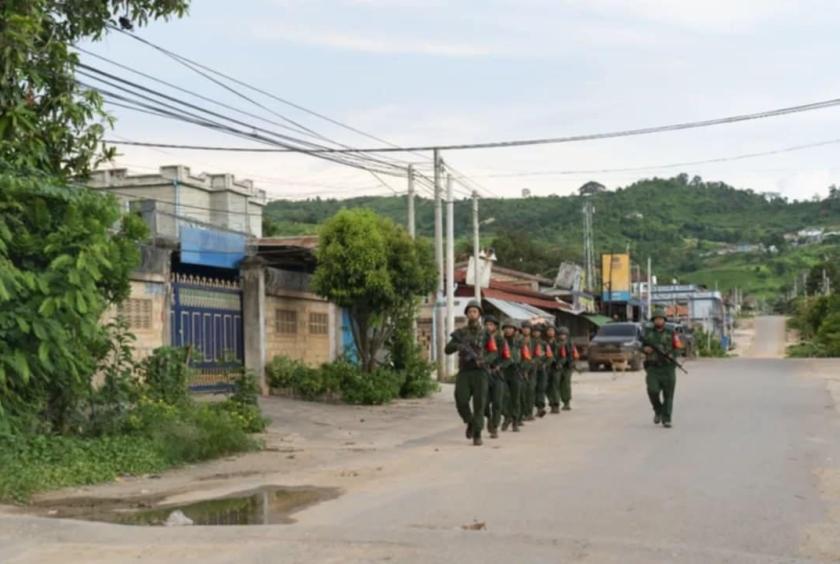
The northern alliances that have been announcing their desire for political dialogue have not yet shown any signs of wanting peace on the ground, responded the State Administration Council (SAC).
In response to a question from NP News about the northern alliances that have been frequently announcing their desire for political dialogue, SAC spokesperson Maj. Gen. Zaw Min Tun made the following statement.
“Regarding these northern alliance groups, when we met with the Chinese Premier, we said they need to take practical actions to show that they want peace. These groups are only making such statements because of the positions and circumstances of others regarding peace. On the ground, they have not shown any signs of wanting peace,” Maj. Gen. Zaw Min Tun said.
Maj. Gen. Zaw Min Tun added that talks can only take place if the northern armed groups, such as the MNDAA and TNLA, can show that they really want peace.
In response to questions about the lack of information regarding the military’s air strikes, Maj. Gen. Zaw Min Tun replied, “In some places, it is generally effective. In some places, we have some shortcomings in reaching the area in time because the information we receive is late.”
Eleven Media Group contacted Maj. Gen. Zaw Min Tun, the spokesman for the SAC, separately for the statement, but he did not respond.
The MNDAA issued a statement on December 3 stating that it would hold talks with China’s mediation while the Tatmadaw responded with airstrikes and that its troops would cease fire wherever they were located.
The MNDAA statement said that in order to take into account the interests of the people who are suffering greatly from the war, to protect and maintain peace and stability along the China-Myanmar border, to resolve civil conflicts through political means, and to practically promote peace in the region, the MNTJP and MNDAA will not secede from the state and establish a new state, but only demand a genuine self-administered zone, and will firmly maintain and protect the sovereignty and territorial integrity of the state.
In addition, from December 3, its troops will immediately cease fire wherever they are and will not launch any offensive attacks. The MNDAA stated that it hopes that relevant issues, including Lashio, can be resolved through dialogue under China’s mediation efforts, and that it will actively cooperate with China’s mediation efforts.
In addition, the MNDAA called on the Myanmar military to cease air and ground attacks.
The MNDAA said in its statement that it would send a high-level delegation to the talks and hoped that the conflicts and differences between the two sides could be resolved through political means. It also said that while it supports the political means, it will continue to uphold the right to self-defense as before.
Similarly, the Ta’ang National Liberation Army (TNLA) issued a statement on November 25, expressing its readiness to hold talks to end the military conflict, out of concern for the interests of the local people who have been severely affected by the fighting in the Ta’ang region, and while respecting and acknowledging the efforts of the Chinese government to intervene to stabilize the border and end the fighting.
Currently, the AA, one of the Northern Alliance groups, is carrying out attacks in Chin State and Magway Region, which are adjacent to the Rakhine areas they control. Judging from the statements of AA leaders and the fighting on the ground, they are preparing to secede from the Union, analyzed a political analyst and researcher about the situation and dangers that may arise from the AA's fighting.
“The northern alliance groups are changing their uniforms and fighting. AA, TNLA and MNDAA are all the same. There are also PDFs who are changing their uniforms. It is clear that those who are fighting in Rakhine State are also fighting in northern Shan State. Then, when those parties stop fighting, PDFs can change their uniforms and fight in areas like Myingyan and Anyar areas (the heartland of Myanmar) and threaten to attack Nay Pyi Taw. Then, the situation will become more complicated. It will cause more instability in Mandalay, Nay Pyi Taw, Yangon and Ayeyawady. If we look at the activities and preparations of the armed groups, we can calculate the potential impact of their actions. Now, the AA and PDF groups are attacking in Gwa, Taunggyi, and Ann. After fighting like this, they will hold peace talks on the other hand, and after the fighting stops, they will take advantage of that and their forces in those areas will come to the stable areas. It is not honest for them to negotiate peace in such a situation. The northern alliance groups, which only make up about ten percent of Myanmar’s population, are preparing to control 50 percent of the country’s territory and if it is possible, they will take control of 80 percent of the country. They are also threatening the cities of Yangon and Nay Pyi Taw. At this time, China needs to show the right attitude and not let a situation arise that will disintegrate Myanmar. We need to prevent a situation where armed groups are allowed to negotiate on one side and gather forces on the other side and fight one town after another. There are examples in the past. They said they stopped after the Haigeng Agreement. And then in the second phase of Operation 1027, they fought again in northern Shan. So China’s peace talks are scary. It is true that Haigeng in your editorial will be the same as the Treaty of Yandabo. When talking about peace and if they continue fighting, it will be like the whole country being taken over in three or four years,” said a political analyst.
The MNDAA, TNLA, and AA launched Operation 1027 in northern Shan State on October 27, 2023. Two months later, the National Solidarity and Peacemaking Negotiation Committee (NSPNC) of the SAC and officials from the MNDAA, TNLA, and AA met in Kunming, China, under the influence of China.
Representatives from the two sides met three times, and an agreement was reached for a temporary ceasefire between the Tatmadaw and the three Northern Alliance groups in northern Shan State at the third Haigeng talks held in Kunming, China, from January 10 to 11, 2024.
The fourth Haigeng talks were held in Kunming, Yunnan Province, China, from February 29 to March 1.
While these talks were still ongoing, on June 25, 2024, the TNLA launched second phase of Operation 1027 against military bases in Hsipaw and Kyaukme townships, and on July 3, the MNDAA attacked Lashio.
Northern armed groups launched a campaign in northern Shan State under the name of Operation 1027, during which they captured Laukkai, Lashio, Nawnghkio, Kyaukme, and Mogok, but the military responded with airstrikes, while northern groups issued statements calling for talks.
The MNDAA, TNLA, and AA were designated as terrorist groups by the Central Committee for Counter Terrorism on September 2, 2024.
“As Chinese Foreign Minister Wang Yi said during his visit to Myanmar, they should stand by their original stance of opposing the attacks on towns and villages by the EAOs in northern Shan State. China should not force talks in this situation. If it tries to divide Myanmar, China will inevitably suffer the consequences. If it tries to seize territory while holding peace talks, it will be like Haigeng Agreement and the Treaty of Yandabo. Therefore, for China to stabilize Myanmar and truly talk about peace, it is important to prevent Chinese weapons from reaching the northern armed groups. If we cannot defend our own country by relying on peace talks, we will ultimately lose the independence and sovereignty,” said a political analyst.