
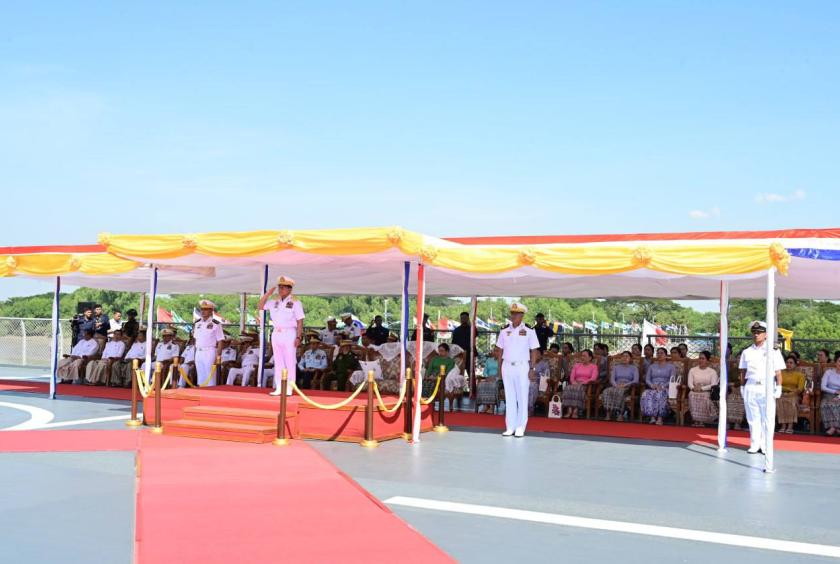
The 78th anniversary of the establishment of the Tatmadaw (Navy) was celebrated on December 24 at Thiri Maha Zeya Kyaw Htin Hall, Thanlyin Naval Station.
The ceremony was attended by the Chairman of the State Security and Peace Commission (SSPC), Commander-in-Chief of the Defence Services Senior General Min Aung Hlaing, his wife Daw Kyu Kyu Hla, Secretary of the Commission General Ye Win Oo and his wife, retired Commander-in-Chiefs (Navy) and their wives, Commander-in-Chief (Navy) Admiral Htein Win and his wife, Commander-in-Chief (Air) General Tun Aung and his wife, Union-level dignitaries and their wives, senior military officers and their wives from the Office of the Commander-in-Chief of the Defence Services, Commanders of the Yangon Command, Commanders of the Naval Commands, naval base commanders, officers and other ranks from the navy, and invited guests.
At the ceremony, the Commander-in-Chief of the Defence Services said that if we look back at the history of the Tatmadaw (Navy), we will see that it was established since the time of the ancient kings in Myanmar. The Myanmar Navy began in the 12th century Bagan period and was systematically organized with ranks and honors during the 18th century Konbaung period, but it was forgotten with the arrival of its servitude under the British in 1885. Then, in 1940, the Burma Royal Naval Volunteer Reserve (BRNVR) was formed. When the Japanese occupied Myanmar in 1942, some of the BRNVR forces also went to India with the British and was reorganized as the Burma Independence Navy (BIN) on June 20, 1942. After the Second World War, the British regained control of Myanmar, and on December 24, 1947, just days before independence, the Burma Reserve Naval Force was reorganized as the “Burma Navy.” Lieutenant Colonel Khin Maung Bo took over as the Navy Chief from the British and when it was established, it started with 75 officers and 500 soldiers. The warships started with a frigate (Mayu), two minesweepers and 12 battleships, a total of 15 warships. Today, the navy has designed and built its own frigates, and has also been able to strengthen its amphibious warfare vessels, including attack submarines. The navy, which was previously only able to conduct limited sea operations, has now become a navy that can dominate the exclusive economic zone and maritime borders.
In addition, our country has a coastline of 1,260 nautical miles and over 1,400 islands and islets, including strategically important islands such as Cocogyun. Our maritime border is over 140,000 square miles and is full of natural beauty, rich in valuable underwater and surface resources. To protect the Myanmar seas, which are rich in underwater and surface resources, we are building large warships capable of surface, air, and underwater warfare. We are also conducting joint operations with the Tatmadaw (Army) and Tatmadaw (Air), providing military support, providing administrative support to the various Army, Navy, and Air Forces, transporting materials for state building and development, providing humanitarian assistance, providing medical care, and conducting search and rescue operations. The multi-purpose riverine warships, landing crafts, support vessels, and hospital ships are being built, commissioned, and transferred to the navy, said the Commander-in-Chief of the Defence Services.
Furthermore, in the 21st century, most countries are facing maritime security challenges, including conventional threats as well as unconventional threats such as piracy, human trafficking, drug trafficking, and arms smuggling. To address such threats, it is necessary to have a modern and strong navy, so that our territorial sea, exclusive economic zone, coastal areas, and maritime interests of the country can be fully protected in accordance with international maritime laws.
Recent international conflicts and domestic situations have shown that maritime resources are indispensable. Maritime resources can not only transport troops, food, and ammunition, but also provide supporting attacks. In order to gain maritime power, the navy is expanding and the coast guard has also been established. The Tatmadaw (Navy) must lead and work together with the coast guard and maritime police to ensure the maritime security of our country. Maritime interests extend not only to the territorial sea but also to the offshore waters, which are our country's exclusive economic zone. Therefore, the Tatmadaw (Navy) needs to be able to provide comprehensive protection. In addition, it is necessary to have a balanced and well-equipped fleet of warships with high performance and combat power to compete with the navies of neighboring countries bordering the sea. The Commander-in-Chief of the Defence Services has ensured that the Tatmadaw (Navy) is fully equipped with three readiness levels: warship readiness, weapons and weapon system readiness, and naval personnel readiness. In terms of naval readiness, the navy has been provided a wide range of warships, from frigates to fast riverine combat vessels and support vessels, to be able to respond to conventional and unconventional threats, said the Commander-in-Chief of the Defence Services.
The navy has been able to build and commission large-scale frigates, from riverine combat vessels to large-scale frigates, which has greatly assisted the Myanmar Defence Forces in carrying out its national defense and security responsibilities, as well as strengthening the security of Myanmar’s territorial waters.
Similarly, in the diplomatic sector, the Tatmadaw (Navy) has been able to demonstrate its level by continuously conducting joint exercises with neighboring countries' navies, ASEAN navies, and international navies. The Tatmadaw (Navy) has been able to effectively and successfully carry out diplomatic affairs by participating in the ASEAN Chiefs of Naval Staff Meeting, meetings with neighboring countries' navies, ASEAN navies, and exercises with ASEAN navies and navies of various countries. In order to make the Tatmadaw (Navy) combat-ready, it is necessary to continuously work to fulfill the three readiness levels: warship readiness, weapons and weapon systems readiness, and naval personnel readiness. Individual soldiers must constantly study and practice to develop their own skills, and it is necessary to train them to master weapons and weapon systems. The Tatmadaw (Navy) new generation officers and soldiers who will take on the role of commanders must also pass on good traditions. The Navy has been urged to fulfill its responsibilities to protect Myanmar's seas and maritime interests, said the Commander-in-Chief of the Defence Services.
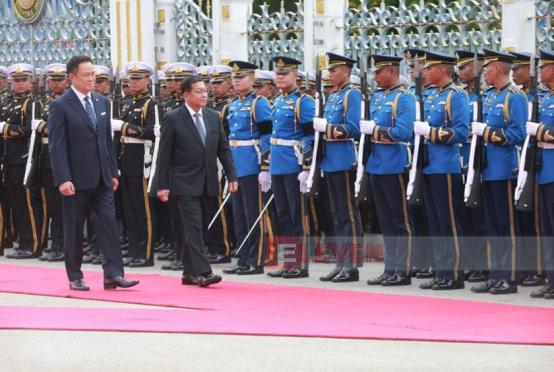
Then, the Commander-in-Chief of the Defence Services received the guard of honor from the salute platform on the warship (Mottama), inspected the guard of honor, and while receiving the guard of honor, the warship (Yan Taing Aung) and the warship (Yan Gyi Aung) fired 21-gun salutes.
Then, the submarine (Minye Kyaw Htin), the frigate (Aung Zeya), the frigate (Kyan Sitthar), the frigate (Sin Phyu Shin), the corvette (Tabin Shwe Htee), the offshore patrol vessel (Inlay), anti-submarine warfare vessels (Yan Nyein Aung) and (Yan Ye Aung), fast attack crafts, coastal patrol crafts, and fast patrol crafts marched in formation and saluted the Commander-in-Chief of the Defence Services.
Next, the Commander-in-Chief (Navy) presented the first artillery shell fired in the salute to the Commander-in-Chief of the Defence Services as a commemorative gift. The Commander-in-Chief of the Defence Services presented the commemorative medal and commemorative gifts to the respective officials, after which the Commander-in-Chief of the Defence Services delivered a speech of guidance to the officers and other ranks of the navy.