
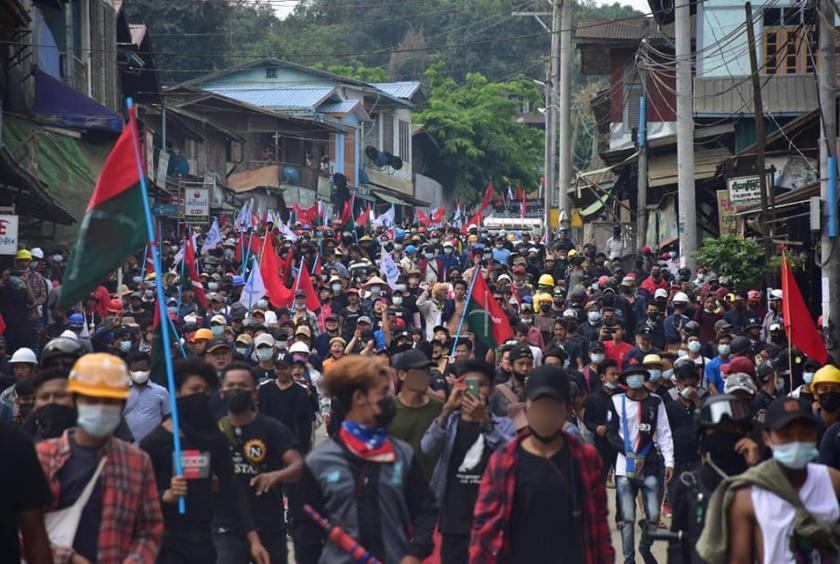
BANGKOK – Asean is urged to speed up its effort to support crisis-hit Myanmar with humanitarian and economic assistance in wake of a UNDP forecast that almost half of the population, or about 25 million, could fall below poverty line in six months.
“We are going to have an economic crisis on hand in Myanmar. Humanitarian assistance should be different to Nargis (Cyclone support in 2008) and should include economic assistance to help to tie in the Myanmar people during this difficult time, said Mr Virasakdi Futrakul, former Thai ambassador to Myanmar and former deputy foreign minister said.
Mr Virasakdi’s assessment was echoed by two other former Thai ambassadors and regional experts at a Clubhouse discussion on “Can Asean help to bring peace to Myanmar?” organised by Asia News Network, an alliance of 23 national media from 19 Asian countries over the weekend.
Ms Yuyun Wahyuningrum, Indonesia representative to the ASEAN Intergovernmental Commission on Human Rights, called on Asean to immediately appoint a special envoy with a strong mandate to carry out the so called five-point consensus reached at the Asean Leaders’ Summit on April 24.
“It’s very important that Thailand and Indonesia work together on this. Perhaps the most important dynamic that needs to be brought forward. You can’t have an effective strategy of engaging Myanmar without Thailand and Indonesia, said Mr Michael Vatikiotis, Asia Director, Centre for Humanitarian Dialogue based in Malaysia.
The United Nations Development Programme’s study revealed that 83 per cent of the Myanmar households had reported cuts in their incomes by almost half already by the Covid-19 impact. The agency projects that 48.8 per cent of the population could fall under poverty line, defined as income below US$1.15 per day in six months.
“I believe that time of the essence…the (recent) statement from military seem to backtrack but should not deter us…Humanitarian assistance is immediate focus and provide initial platform for a dialogue,” said Mr Sihasak Phuangketkeow, former Thai permanent secretary, in his comment at ANN’s Clubhouse session.
Ms Yuyun said the Asean envoy to work on Myanmar should be either an Indonesian military or civilian. Among names suggested included former foreign ministers Marty Natalegawa and Hassan Wirajuda, or former deputy foreign minister Dino Patti Djalal.
“I think Envoy not only to have capability and capacity but acceptance and ability to talk to different stakeholders in Myanmar and know the context of Myanmar very well, said Ms Yuyun.
Mr Sihasak is in favour of Thai Foreign Minister Don Pramudwinai’s proposals of “Friends of the Chair” that could comprise of two or three persons. They will only have to work with Myanmar but also engage in close coordination with Asean member states and other key players such as China, Japan, India, US, and the EU.
Mr Kobsak Chotikul, another former Thai ambassador, in his Clubhouse comment warned of harsh reality in dealing with the Tatmadaw and cautioned that Myanmar had gone through “a lot of” special envoys from UN, UNHRC and so on.
“In the past 20-30 years, Myanmar (military) appears to be able to deal with these so called special envoys who come….and they know how to thwart, and kick the ball down, pan down the road, how to evade, how to buy time,” said Mr Kobsak, who himself got the first-hand experience in dealing with Myanmar officials as the special adviser of a board set up by Aung San Suu Kyi to advise on the implementation of former UN Secretary General Kofi Annan proposals on the Rakhine situation.
Ms Kanda Naknoi, Economic Professor and author based in the US, asked a pertinent question of the Myanmar’s “civil war” which needs supplies such as bullets and weapons as well as medical and other necessities. “So, where they are coming from. A question that Asean can’t pretend there is no answer.”
Mr Vatikiotis called on Asean to prop up human resources at the Asean Humanitarian Assistance (AHA) which is presently far from equipped to deal with the Myanmar crisis.
Mr Virasakdi underlined the importance of “trust” in Asean’s latest foray.
“Trust between Asean and Myanmar authorities, trust between population of Myanmar and Asean, and trust between Myanmar authorities and parties inside Myanmar both the Burmese and ethnic groups.”
“So underlining all these how you bring people with different perceptions of interest to be willing to sit down together and to discuss a peaceful resolution of their problems. I think that is the main challenge facing Asean, he added.
The former Thai deputy foreign minister also referred to the late 1980s and early 1990s, when Asean worked to bring peace to Cambodia although it was a very long process and all kinds of diplomacies were practiced. “We tried everything, closed door, cocktail diplomacy, proximity talk, and ultimately what was the cause of the success was the sitting down together between Prime Minister Hun Sen and HRH Prince Sihanouk at that time in Paris.”
As of now, from Bangkok, the situation appears in dire desperation the report of 3.4 million people without adequate food. The number is rising and the economic crisis could result in Thailand facing a large number of economic migrants if the UNDP’s warning about poverty whirlpool is not stopped; and when the Thai public health system is already strained so much by Covid-19 pandemic.
The speakers agreed that the outcome in Myanmar will have effects on Thailand and the region.
They acknowledged that ultimately Myanmar people want a transition back to democracy, and naturally suspicious of Asean giving a limelight to the military.