
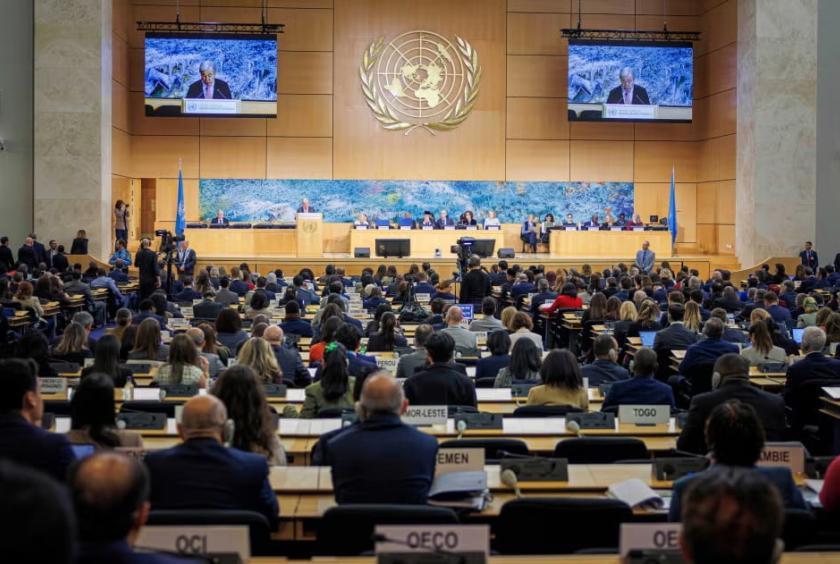
The Ministry of Foreign Affairs (MOFA) on July 9 rejected a resolution on Myanmar adopted by the UN Human Rights Council, reiterating that Myanmar consistently opposes country-specific discussions and resolutions, saying they do not contribute to constructive dialogue or international cooperation.
In a statement, the ministry said the 62nd regular session of the UN Human Rights Council, held in Geneva, Switzerland, from June 15 to July 8, 2026, included discussions on Myanmar that it said were inconsistent with the principles of constructive dialogue and cooperation. During the session, the UN High Commissioner for Human Rights presented a report on Myanmar on June 29, while a resolution on Myanmar submitted by the Organization of Islamic Cooperation (OIC) was adopted on July 6 without Myanmar's participation.
According to the ministry, the High Commissioner's report largely repeated information and allegations contained in previous reports by the Special Rapporteur on the situation of human rights in Myanmar. It expressed disappointment that the report reflected what it described as one-sided views and unsubstantiated allegations that failed to accurately portray the situation on the ground.
The ministry also criticized previous Human Rights Council resolutions, including the latest OIC-sponsored resolution, saying they failed to address the root causes of the displacement in northern Rakhine State in 2016 and 2017. It argued that the resolutions did not demonstrate a genuine commitment to resolving the issue of displaced persons through sincere and cooperative engagement and rejected allegations concerning hate speech and the conduct of Myanmar's security forces as baseless.
The statement reiterated that Myanmar has the political will to repatriate verified displaced persons in accordance with bilateral agreements once security and stability are restored in northern Rakhine State. It said Myanmar continues to verify lists of displaced persons submitted by Bangladesh and returns the verified lists to the Bangladeshi authorities each month in preparation for repatriation. The ministry added that the current delays in the repatriation process are solely the result of attacks by the AA terrorist group.
The ministry further stated that Myanmar has held what it described as free and fair multiparty democratic general elections, leading to the formation of an elected government in accordance with the will of the people. It also noted that the President has designated the period from April 20 to July 31, 2026, as the implementation period for the Union Government's 100-day plan and has invited both signatories and non-signatories of the Nationwide Ceasefire Agreement (NCA) to participate in peace talks with ethnic armed organizations (EAOs).
The statement added that members of the People's Defence Forces (PDFs) have also been invited to return to the legal framework. According to the ministry, more than 4,000 members of some ethnic armed organizations, including PDF members, have responded to these invitations and returned to the legal fold.
The ministry said the government will continue pursuing stability, peace, and national development through a Myanmar-led process. It reiterated Myanmar's long-standing opposition to country-specific discussions and resolutions at the Human Rights Council, stating that such measures undermine constructive dialogue and cooperation. It also reaffirmed Myanmar's categorical and unconditional rejection of the OIC-sponsored resolution and expressed appreciation to countries that adopted what it described as a balanced position during the Human Rights Council's deliberations.