
Russian President Vladimir Putin said Russia is willing to cooperate with Myanmar in the exploration of natural resources and oil and gas extraction, including offshore projects, stressing that the energy sector is an important area of bilateral cooperation.
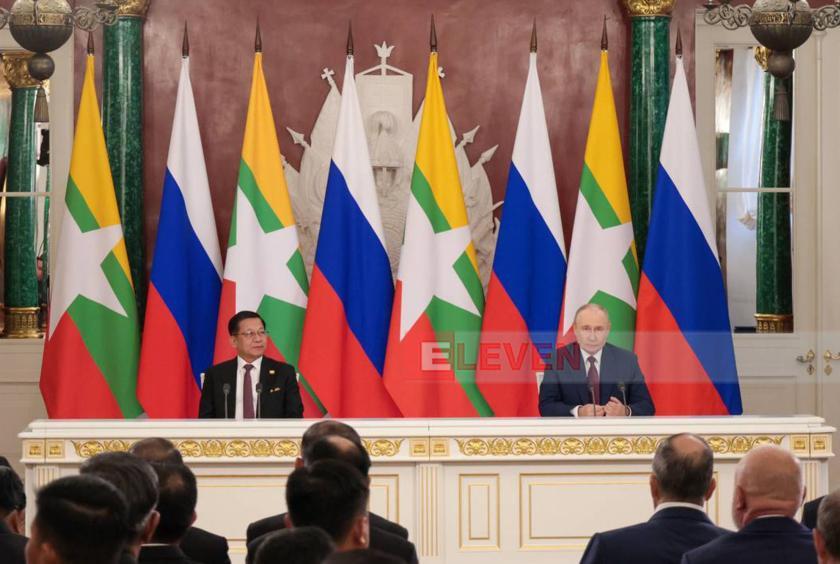
He made the remarks during a meeting with the media on August 18 together with Myanmar President U Min Aung Hlaing.
President Putin said Russia-Myanmar relations are based on long-standing friendship, while bilateral cooperation is founded on fairness, mutual respect and mutual benefit. He noted that the Soviet Union provided substantial assistance to Myanmar in the social, economic and defense sectors during the 1950s and 1960s.
He also said that major infrastructure projects built in Myanmar during the Soviet era, including hospitals and universities, continue to benefit the Myanmar people to this day.
“First and foremost, I would like to say that Russia-Myanmar relations continue to develop and strengthen. There are many contacts between the governments of the two countries. The foreign ministries of both countries maintain systematic communication and relations. Consultations and discussions are also being held continuously between security councils, parliaments and political parties,” President Putin said.
He added that many projects serving the interests of both countries are being implemented and that international issues had also been discussed during the meeting. A number of agreements between the governments and relevant departments of Russia and Myanmar have been signed, with economic cooperation to remain a key focus.
President Putin said the two countries have a reliable and strong payment system based on mutual trust, while the energy sector remains an important area of cooperation. He noted that coal-fired power plant and oil refinery projects are being undertaken in Myanmar.
“Russia is willing to cooperate in natural resource exploration and oil and gas extraction in Myanmar, including offshore areas. There is considerable potential for Russia to export LNG to Myanmar. The LNG could be used domestically and also exported to other countries,” President Putin said.
He added that Russia and Myanmar signed an agreement last year to build a nuclear power plant in Myanmar, describing it as a key project for both countries.
“There is also potential for many projects in the industrial and transportation sectors. For example, a steel plant and a fertilizer plant are being built in Myanmar. We are also discussing a deep-sea port construction project in southern Myanmar. We are discussing cooperation in high-tech fields as well. Russian companies have many proposals and plans in Myanmar’s digital sector, cybersecurity and other high-tech fields,” he said.
Regarding space cooperation, President Putin said the two countries signed an agreement on mutual cooperation in 2025 and are implementing projects in the field. He also described human-resource development as an important area of bilateral cooperation.
He said that, under the visa-free arrangement between the two countries, scientists, young people, tourists and athletes have been travelling between Russia and Myanmar. He added that a Myanmar consulate would soon be opened in Vladivostok, while Myanmar cultural and religious centers have already been established in the Russian regions of Altai and Kaluga and in Moscow.
President Putin also said approval had been given to build a Russian Orthodox Christian church in Yangon. He welcomed the growing interest in the Russian language in Myanmar, noting that Russian is being taught at universities in Yangon and Mandalay as well as at the military academy.
“There are currently 400 Myanmar students studying at Russian universities. A total of 17,000 Myanmar students have graduated from Russian universities. Russia and Myanmar have very similar views on international issues. Russia and Myanmar consistently oppose interference in the internal affairs of countries and in the affairs of international organizations,” President Putin said.
He added that Russia-Myanmar military-technical cooperation was developing well, with the two countries frequently conducting military exercises in Myanmar’s waters. Russian naval vessels have also made frequent visits to Myanmar.
President Putin expressed his appreciation to the delegation led by President U Min Aung Hlaing for visiting Russia and said he was confident that the Myanmar president’s current visit would be successful.
He also expressed hope that the agreements signed during the visit would provide significant support for Russia-Myanmar cooperation and their partnership.
A total of 12 memorandums of understanding (MoUs) were signed between Myanmar and Russia during President U Min Aung Hlaing’s current visit.