

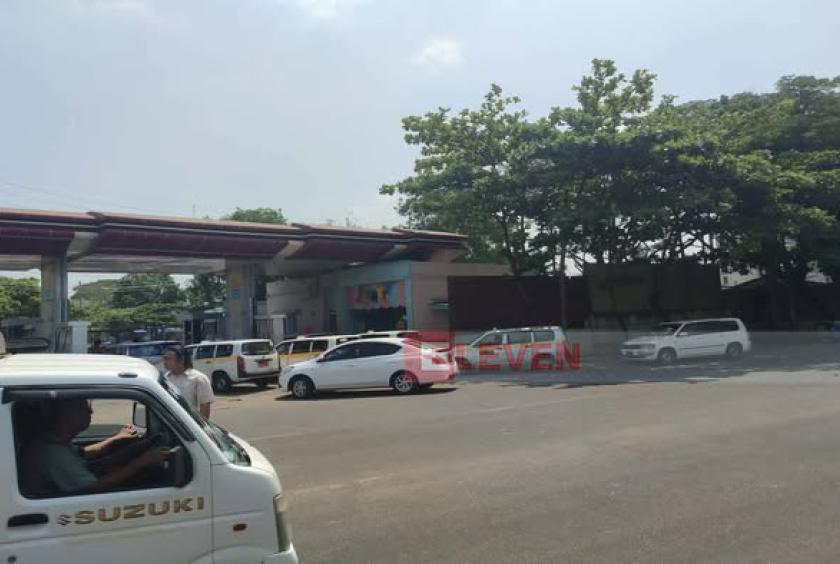
Fuel prices in Yangon have shown a slight decline, with diesel prices falling by more than 700 kyats per liter. As a result, long queues at fuel stations have largely disappeared, according to local drivers.
On April 24, the Fuel Import, Storage, and Distribution Supervisory Committee announced updated prices as follows, 92-octane petrol: 4,668 kyats per liter, 95-octane petrol: 4,909 kyats per liter, regular diesel: 5,752 kyats per liter, premium diesel: 7,012 kyats per liter.
Fuel prices are typically revised on Fridays, the final working day of the week. Compared to the previous week, prices have declined noticeably. Last week’s rates were: 92-octane petrol: 4,735 kyats per liter, 95-octane petrol: 4,945 kyats per liter. Regular diesel: 6,485 kyats per liter, Premium diesel: 7,755 kyats per liter.
This indicates a drop of 67 kyats per liter for 92-octane petrol and 36 kyats for 95-octane petrol. Diesel prices saw sharper decreases, with regular diesel falling by 733 kyats per liter and premium diesel by 743 kyats.
The significant reduction in diesel prices follows a temporary tax exemption on imported HSD (500 ppm) diesel. The Ministry of Planning and Finance announced that customs duties, commercial tax, special goods tax, and a 2% advance income tax would be waived for one month, from April 1 to April 30, 2026. The exemption applies only to diesel imports registered with the Customs Department during this period.
In addition, the Central Bank of Myanmar has continued selling U.S. dollars to fuel importers, helping stabilize supply.
Since after the Thingyan festival, fuel availability in Yangon has improved considerably. Drivers report that waiting times at fuel stations have disappeared, with only a few vehicles occasionally ahead in line.
“I feel much more at ease now. There’s no need to queue anymore. You can just go to any station and fill up. At most, you wait behind three to five cars,” said a Yangon driver.
Global oil price fluctuations, influenced by ongoing conflicts in the Middle East, continue to impact domestic fuel prices. Meanwhile, many countries worldwide are implementing measures to reduce fuel consumption amid ongoing energy concerns.