

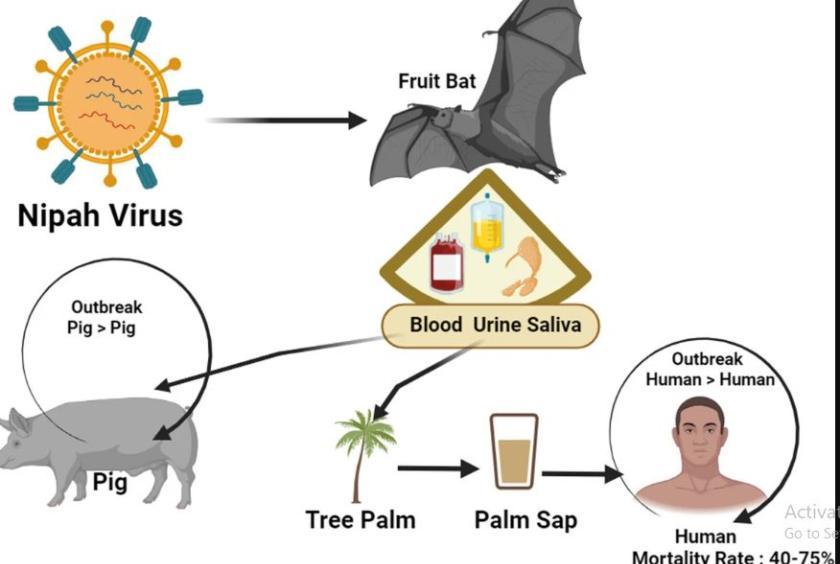
The Ministry of Health has announced that although the bat-borne Nipah virus has been detected in neighboring countries, no cases have been found in Myanmar to date.
The ministry stated that while no Nipah virus infections have been identified in Myanmar so far, the country is home to abundant fruit trees commonly consumed by fruit bats—the natural reservoir of the virus—and shares borders with countries where outbreaks have occurred frequently. For these reasons, surveillance and monitoring for Nipah virus are being given special priority.
The Ministry of Health has also urged the public to avoid unnecessary travel to areas currently experiencing Nipah virus outbreaks, such as West Bengal. Those who are currently in affected areas are advised not to visit hospitals in outbreak zones or places with large numbers of patients unless absolutely necessary.
In addition, travelers returning from outbreak areas are instructed to report immediately to airport health authorities or health officials at border entry and exit points if they experience suspected symptoms such as high fever and headache, coughing and difficulty breathing, confusion, or drowsiness. Anyone who develops these symptoms within 14 days of returning from an affected area should promptly contact the nearest health facility, clearly inform doctors of their travel history, and undergo timely testing and treatment.
The ministry further advised that if family members returning from affected countries show suspected symptoms, or if unusually high numbers of animals such as pigs or fruit bats are found dead in residential areas, the nearest health department should be informed immediately.
The Nipah virus was first identified in 1999 in a village called Sungai Nipah in Malaysia, from which the virus derives its name.
Previously, outbreaks of the virus have occurred in several Asian countries, including Malaysia, Singapore, and Bangladesh.
The virus is known to have a higher fatality rate than COVID-19, with an estimated mortality rate ranging from 40 percent to as high as 75 percent among those infected.
The World Health Organization has warned that the Nipah virus has the potential to cause a pandemic and has called for urgent research and preparedness measures.