
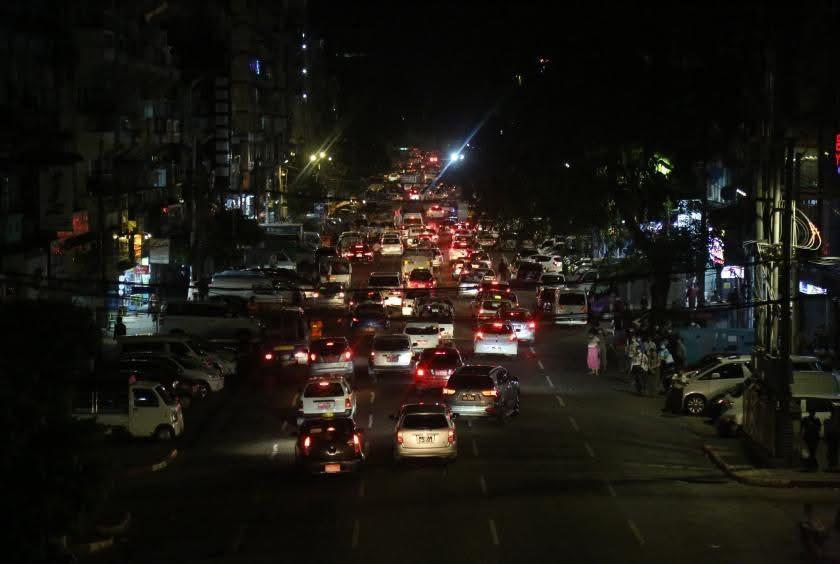
In Yangon, a city with a population of over seven million, residents can no longer expect a continuous supply of electricity for more than four hours. Despite a more than twofold increase in electricity meter fees as of September 1, 2024, power outages have worsened rather than improved. Although Yangon receives nearly half of the total electricity generated nationwide, the situation has become increasingly dire, with frequent outages.
Previously, electricity in Yangon was provided on a four-hour rotating schedule among two groups, but now, the city has been divided into three groups, each receiving four hours of power followed by eight hours without electricity.
Reasons Behind the Power Outages:
Myanmar has a total installed power capacity of 6,878 MW across 30 hydropower plants (3,232 MW), 26 natural gas power plants (3,268 MW), two coal power plants (138 MW), and eight solar power plants (240 MW). However, the Ministry of Electric Power stated that due to operational inefficiencies, only around 4,000 MW can be generated and distributed under optimal conditions.
Compounding this issue are damaged transmission lines. The ministry reported that 14 major power lines, including 230 kV and 132 kV lines, have been disrupted, leading to a production shortfall of 1,009 MW. Additionally, natural gas supplies for power plants have decreased, reducing the production capacity of gas-based power plants by approximately 291 MW. Hydropower plants have also been affected by flooding from Typhoon Yagi, which has necessitated maintenance work, further reducing production by 140 MW.
As a result, the country’s daily power generation now averages only 2,200 MW, roughly 50% of the installed capacity.
Power distribution schedule:
In January 2025, Yangon receives 48% of the available power, Mandalay 17%, and the remaining regions and states share 35%. Yangon has been divided into three groups, with each group receiving four hours of power followed by eight hours of outage. Mandalay is divided into four groups with three-hour power supply cycles, and Naypyitaw provides 16 hours of power to the public and 18 hours to government housing daily. Other regions and states implement six-hour rotating schedules.
Social impacts of power outages:
Residents of Yangon report significant challenges. Families with office workers and students struggle to prepare meals in time, often resorting to eating out, which increases expenses. High-rise residents face difficulties with water supply, while working individuals find it hard to charge phones or complete household chores during the limited hours of electricity.
One Yangon resident stated, “We have to rush to do everything during the brief power supply period—cooking, charging devices, ironing clothes, and more. It’s exhausting and disruptive.” Others noted the rising cost of candles and rechargeable lights, further straining household budgets.
Broader Challenges:
The power crisis stems from outdated power plants, reduced natural gas supplies, damaged infrastructure, and insufficient investment in the energy sector. Political instability and armed conflicts have also exacerbated the situation. According to the World Bank, the departure of major international investors, such as Total and Woodside, has further hindered development in Myanmar’s energy sector.
The Ministry of Electric Power plans to address the crisis by repairing damaged infrastructure, accelerating LNG power projects, and promoting renewable energy sources like solar, wind, and hydro. However, these long-term plans are unlikely to resolve the immediate power shortage.