
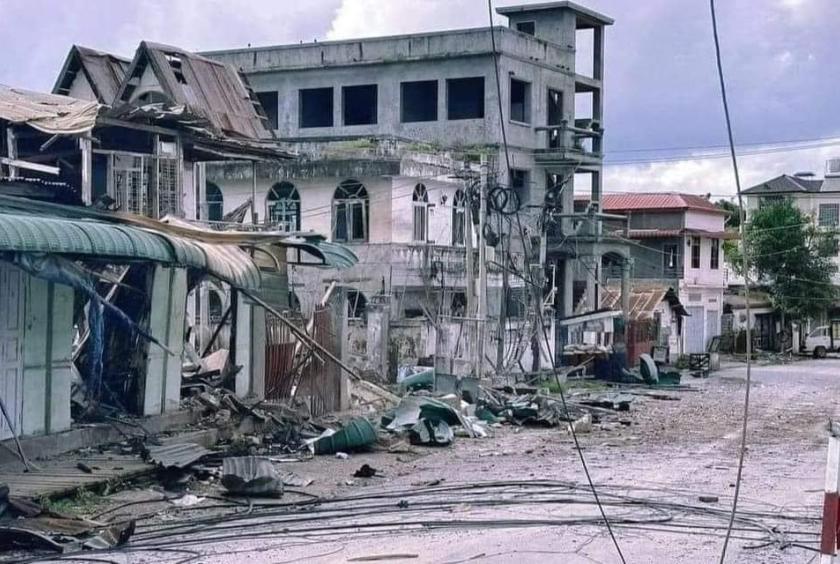
The streets are deserted because there are no more people. On the streets, not only are there no people, but there are also hardly any cars passing by. The once bustling town, filled with cars and people, now feels as quiet and eerie as a graveyard.
On one side of a street, there are abandoned houses and closed shops. The asphalt road, without the sounds of footsteps and cars, seems to be in a deep slumber. The large trees lining the streets stand tall and alone in this deserted town. Although it's raining in Lashio, it doesn't feel as refreshing as before.
Since there is no one to clean in front of houses and shops, the trash has piled up, creating an unsightly mess. The remaining people in the town are living in panic. In the morning, when the market opens, the vendors sell quickly, and the buyers come and go in a rush, purchasing hurriedly and then leaving quickly. It doesn't even feel safe to stay inside one's own home, let alone be out on the streets.
The faces of the locals are etched with worry. Fear and anxiety are clearly visible in their eyes. In some parts of the city, plumes of smoke can be seen. On certain main streets, bodies are found. In some neighborhoods, damaged and collapsed houses and buildings are visible. Almost daily, the city echoes with the sounds of gunfire and explosions. The residents of the city have been enduring these conditions for nearly a month now.
The battles in Lashio began on July 3. The MNDAA group and its allied forces started attacking the outskirts of Lashio on July 3. The MNDAA group targeted residential areas with rocket artillery, drones, and bombings rather than military sites, according to local residents.
From 4 a.m. on July 3, local residents reported hearing the sounds of heavy artillery exploding within a 20-mile radius of Lashio. That day, due to shootings in Nampaung, the road from Lashio to Nampaung was closed. Access to Hanna was also blocked. Additionally, temporary closures were implemented for entries and exits to Lashio, and all flights to and from Lashio were suspended. This situation depicted the condition of Lashio on the first day of the battles. In the following days, rockets hit residential areas in Lashio, causing casualties.
On July 5, the entries and exits to Lashio were reopened, and many people displaced by the conflict were seen. With more rockets landing in residential areas, more people fled the town and sought refuge in monasteries. Many were injured due to the explosions, and humanitarian organizations transported the injured to medical facilities. Displacement due to the conflict extended along the Lashio-Sintin-Pannyu-Namlan-Kyaukgu-Nawngkhio-Banbway-PyinOoLwin-Mandalay route. On the same day, most government offices in Lashio were closed.
On July 6, most gas stations in Lashio were closed, with only a few remaining open. Markets and other shops were also shut down. White-flagged vehicles and motorcycles carrying displaced people were increasingly seen that day.
On July 7, due to an increase in rocket explosions in the area around Upper Manai, locals fled into the city for refuge. On July 8, thousands of vehicles evacuating refugees were stuck from the Mehan Gate to the outskirts of the city. Local residents reported that there were also shootings near Naung Mon village along the Union Highway.
On July 9, there were no significant incidents, but on July 10, multiple rocket attacks were launched from various locations, causing explosions throughout the day in civilian areas within Lashio. These attacks led to damage and casualties, particularly in Ward 9. Additionally, locals reported nighttime burglaries in residential areas, with homes being broken into under the cover of darkness.
"While I was sleeping soundly in the cool weather, a thief broke into my house. They managed to steal a phone and a small necklace. When I woke up, they had already fled. The thief was so experienced that they even locked the door from the outside so we couldn’t get out. We heard noises and tried to open the door, but it was jammed. When we finally managed to push the door open, the thief had already escaped, leaving a wallet by the gate. Luckily, the wallet contained only identification documents, which they didn’t take. The thief had even attempted to take a child’s bicycle, which was found near the corner of the compound," recounted a local resident, Ko Nay Myo.
With gas stations closed, there were fuel shortages and rising fuel prices, while phone lines also became increasingly unreliable. In the evenings, residents reported hearing sporadic gunfire from the eastern side of Lashio, particularly around Humon, German Village, and Lwepyay.
On July 11, aside from occasional sounds of heavy artillery fire, Lashio remained quiet. There was minimal movement in the city, and most shops remained closed. At the Lashio People’s Hospital’s outpatient department (OPD), people arrived for various treatments, including those with injuries and some in labour.
On July 12, rocket attacks increased in the Cherry Myaing and Parami areas of Lashio. As the fighting continued, the residents of Lashio faced increasing difficulties with food and water supplies, prompting social organizations to coordinate and provide donations.
On July 14, the entire area around Lashio echoed with sounds of heavy artillery and gunfire throughout the day. Continuous shooting was heard in Ward 7 near Lwe Pyay. On that same day, the MNDAA announced a temporary ceasefire from July 15 to 18. Despite this announcement, attacks and daily rocket fire continued within Lashio.
On July 16, battles occurred near Hopeik and 507 Hill, with locals reporting the sounds of heavy artillery and gunfire.
On July 17, while the gunfire in Lashio had subsided, phone and internet connections remained unreliable, making communication difficult. On the morning of July 18, locals reported hearing the sounds of heavy artillery explosions in Lashio.
On July 19, in many areas of Lashio, phone and internet lines were down, and Kpay was also unavailable. Explosions from heavy artillery continued to echo around the city. Gunfire could be heard from the area between Shwe Taung Valley and the upper bus terminal compound in Cherry Myaing. There were also battles near the 41st Battalion.
Despite the fact that Buddhist Lent has come, the monks in Lashio are living as war refugees. Because of the fighting in the Namakhaw area, the convoy of monks who were attempting to evacuate had to turn back. Almost every monastery in Lashio has monks living as war refugees.
On July 20, just like the previous day, battles were ongoing near the 41st Battalion. Gunfire and artillery shots echoed throughout the day. Residents living near the conflict areas had to flee to safer places. Drones could be seen flying in the sky, and explosions from drone-launched artillery shook the nearby houses.
On July 21, starting at 4 a.m., intense fighting broke out in areas such as Ward 5, 507 Hill, Ward 4 near Yekan mountain and forestry office, Ward 1 Namakhaw, Shwe Taung Valley, Cherry Myaing, and Region 8. By midday, the fighting had spread from Ward 1 Cherry Myaing to the western part of Yan Taing Aung. With artillery shells landing and exploding in residential areas, many houses in Namakhaw, Cherry Myaing, and Region 8 were evacuated by residents seeking safety.
In some tall buildings, MNDAA fighters entered, forcing residents to flee. Tall buildings in the Namakhaw area were the most affected by the artillery strikes. The sounds of gunfire continued throughout the afternoon.
Groups trying to leave Lashio for other regions couldn’t make it out. Due to the ongoing exchanges of gunfire between 41 Hill and Namakhaw, cars and motorcycles attempting to leave had to turn back. In Ward 4, many houses on the western hill near the forestry office were damaged, forcing residents to flee to safer areas.
On July 22, while intense fighting occurred around Yekan mountain, below Sutaungpyae, and between 522 and 41, other areas remained calm.
On July 23, it became difficult to purchase rice, oil, eggs, and vegetables for the war refugees, and traveling became increasingly challenging. Due to the ongoing fighting, many people remained trapped in certain areas. Local residents reported hearing artillery and gunfire sporadically in Wards 1, 2, 3, 4, 5, and 6. War refugees had already taken shelter in refugee camps, monasteries, and Christian churches.
On July 24, gunfire was heard from early morning. There was shooting near School No. 19 in Ward 4. Additionally, there were clashes to the west of Yan Taing Aung in Ward 1, west of Aye Chan Thar Dhama Yone, and near the old police station. Fighting also continued between both sides around 68 Hill.
People leaving Lashio have been granted time and permission to exit, but entry is no longer allowed. Most large shops and pharmacies are closed. Although the main hospital OPD is open, social aid organizations report difficulties in assisting and transporting injured people due to security and vehicle issues.
In the afternoon, fighting continued near Ward 4 at Lake Road and Khaing Shwe Wah Road, as well as in Ward 1 near the Township Administration Office and Aye Chan Thar Dhama Yone. In Ward 5, between Aung Mingalar Market Road and Temple Road, an artillery shell hit, causing a house to catch fire near 39th Street.
On July 25, gunfire was heard from dawn, with sounds becoming closer to the city center. Residents sought refuge in safer areas and monasteries. Fighting occurred between Mansu and Humon along Aweiya Road. As fighting surrounded the city, people fled to places they thought were safe. Near the Mytel telecom office, fighting broke out and an artillery shell hit, causing a house to catch fire.
On July 26, starting at 4 a.m., drones flew over City Hall and the police station, dropping bombs. This attack caused significant damage to City Hall, according to local residents. Additionally, houses in Ward 1, Region 8, and Ward 4 near Bamar Hill caught fire due to bomb damage, but there was no one available to extinguish the fires.
"Destruction and devastation can be seen on every street. The City Hall, known as a landmark building, is now damaged by dropped bombs. Almost no buildings are left unscathed by gunfire. Many houses in the neighborhoods are on fire due to bomb damage, but at this time, there is no one to extinguish the flames," said a local resident.
On Theinni Street, under the Maternal and Child Welfare Office in Ward 8, a homemade rocket fell and exploded at a spot where people gathered to use the available Wi-Fi, causing injuries and fatalities.
Gunfire was heard from the Mytel telecom office to the Red Cross Office corner, leading the Red Cross team to leave Lashio. Humanitarian aid groups assisting in Lashio have mostly ceased their activities due to being targeted by the gunfire.
Currently, funeral assistance groups have also left, leaving individuals to handle burials on their own. Transporting to the Kyakan Cemetery is no longer feasible, causing hardship for the locals.
On the evening of July 27, clashes occurred near the Northeast Military Command Headquarters and 626. Within Lashio, there were also homemade rocket strikes causing deaths and house fires.
Locals reported that while the city center was quiet, fighting occurred on Theinni Street, near AT, and the prison area.
On July 29, more fighting broke out in Lashio, with gunfire heard near the railway station, around the foothills of the Sasana (2500) Mountain, near Ward 8 on Thein Street, and towards Lashio Gyi. Clashes also intensified near the Northeast Military Command.
In the areas with ongoing fighting, artillery shells caused daily casualties among those trapped or hiding in their homes. Humanitarian workers reported that some bodies were left unburied due to a lack of assistance.
Due to these conflicts, Lashio residents have suffered loss and destruction of homes, religious buildings, bridges, hospitals, and schools.
From July 3 to 27, the State Administration Council reported that 30 civilians, including five children, had died, and 55 were injured. However, according to civil soceity organizations, by July 31, 133 civilians had died, and around 170 were injured.
By July 31, fighting had damaged 105 buildings, including monasteries, schools, and homes, according to CSOs.
Now, Lashio has become a battlefield amid conflicts, and even if the fighting stops, locals believe they will never regain the peaceful, beautiful town it once was. It is certain that the residents will long for the once tranquil and lovely town of Lashio.