

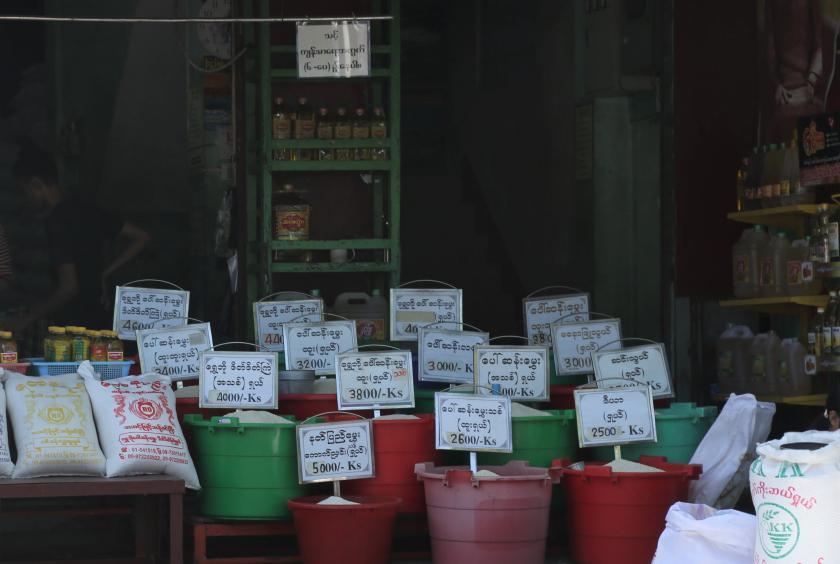
Global economy has started to face consequences one year after Russia invaded Ukraine on February 24, 2022.
With rising inflation rates and economic uncertainties, the world is also facing shortages of rice, fertilizer and energy sources.
Particularly, exorbitant prices in food have greatly impacted the poor.
According to IMF, in the previous year, food prices increased by 7.3$ (3.9% in January’s estimation) in the richest countries and 9.9% (5.9% before the Ukraine war) in the poor countries.
Despite being an agricultural country, Myanmar has seen rice prices increase two or three times when compared to the previous year.
■ Local rice prices that have doubled over the past two years
According to official data, a bag (about 112.56 pounds) of Shwebo Pawsan rice was priced at 58,000 kyats in 2021 and 87,000 kyats in the local market in February this year.
The price of a bag of Aemahta rice was just around Ks20,000, and it has now increased to Ks56,000.
On February 18 this year, the price of Shwebo Pawsan rice (old) was Ks4,600 per pyi (4.69 pounds), that of Shwebo Pawsan rice (newly harvested) Ks4,000, that of Pyapon Pawsan (old) Ks4,000 and that of Pyapon Pawsan (newly harvested) Ks3,800 in the retail market.
“We recently bought a bag of old Shwebo Pawsan rice for Ks110,400. Then we resold a pyi for Ks 4,600. Now the price has increased to Ks112,000 per bag. A bag of newly harvested rice was recently priced at Ks96,000 and it is now Ks100,500. They are just a process of order. They are not coming yet. They are still at the rice mill,” said a rice shop owner in Thingangyun Township, Yangon Region.
Last year, the price of Shwebo Pawsan rice per pyi was Ks4,000 on August 3 and Ks4,200 on September 3. Since then, it has been increasing gradually and reached Ks4,500 in mid-February this year.
A rice merchant from the central Myanmar said: “Rice prices have increased since earlier this month (February). A bag of rice has increased by Ks8,000 to 10,000. In comparison with the previous years, this year sees significantly high prices. Ziya rice from the lower part of the country is worth about Ks58,000 per bag and Manaw Thukha rice a little more than Ks60,000 per bag. Even merchants have to consider buying because we have to think about selling them again. Last month we sold a bag of rice for Ks60,000. Now we have to buy it for Ks65,000. Consumers are also murmuring against the prices. You know, our people are earning low income now.”
Currently, the arrival of rice from various regions at the Bayintnaung rice wholesale market in Yangon has half decreased compared to last year, according to local rice dealers.
A rice grower from Thonegwa Township also said this year’s paddy yield had also decreased half.
Sources from Wahdan rice wholesale market say that the arrival of rice has half decreased this year due to water transport difficulties and time constraints in transporting rice.
A local farmer from Shwebo, however, said: “When it comes to increasing rice prices in other regions, merchants might have been playing market. In our region, stocks of Baykya paddy called Shwebo Pawsan are running low. With regional instability, most farmers here have sold out their stocks. Another thing is that thousands of baskets of rice (one basket contains 75.04 pounds) were lost in arson attacks. Besides, farmers in some areas could not grow rice due to regional instability. We farmers always have to suffer most.”
Fearing regional instability, most local growers have sold their paddy quickly with the prices they got. With their paddy stocks running low, they say merchants have grab the opportunity to speculate on the rice market.
“Due to regional instability, low cultivation acreage and arson attacks in our region, I think Shwebo Pawsan rice price will continue to go up. What’s more, other commodity prices as well as fuel prices are increasing. So I don’t think paddy and rice prices will decrease again,” said a local famer from Shwebo District.
An official from Myanmar Rice Federation said Ayeyawady, Bago and Yangon regions could grow rice regularly while some townships in Sagaing Region had seen some damage and low acreage due to conflicts.
“Myanmar people usually eat old rice. In local markets we can see new rice harvested from the monsoon 2022 and old rice from 2021. In coming April and May, summer paddy will come. The State economy promotion fund is providing Ks200,000 for fertilizer for per acre of summer paddy. Summer paddy yield will be better this year as fertilizers are being provided for up to 400,000 or 500,000 acres of summer paddy. Our federation is constantly learning local rice market situations. No worries. It is important to release correct information to avoid panic buying,” the official said.
■ Did low yield lead to high prices?
The Central Statistics Organization quoted the Department of Agriculture Land Management and Statistics as saying Myanmar grows about 17.8 million acres of paddy every year, and the 2018-2019 fiscal was the year of the highest yield in five years producing around 27 million tons of paddy.
According to annual data the Department of Agriculture Land Management and Statistics about paddy cultivation acreage and yields in Myanmar, there were over 17 million acres in paddy cultivation and over 26 million tons in paddy production in 2014-2015 FY, over 17 million acres and over 26 million tons in 2015-2016 FY, over 17 million acres and over 25 million tons, over 17 million acres and over 25 million tons in 2017-2018 FY, and over 17 million acres and over 27 million tons in 2018-2019 FY, which saw the highest yield in five years.
In Myanmar, paddy is the main crop, accounting for 34 percent of the total cultivated area. In 2020-2021, a total of 17 million acres of paddy could be planted, and in 2021-2022, 15 million acres of rain fed paddy and 2.4 million acres of summer paddy. In total, about 17.4 million acres of paddy were cultivated.
At present, the price of Aemahta rice in the domestic rice market is 900,000 or 1,000,000 kyats for 100 baskets at the time when the paddies are reaped and it has increased to around 1,000,000 to 1,500,000 kyats, according to the market.
According to rice farmers, the price of rice produced in Paung Township of Mon State is unprecedented, but the rice yield is low and they are not making any profit.
Last year, the price of Pawsan rice was only around 800,000 to 900,000 kyats for 100 baskets, but in November 2022, when the rainy season began, the price of 100 baskets of Pawsan rice was up to 1,300,000 kyats.
"Last year, 100 baskets of Pawsan rice cost less than 1,000,000 kyats. This year, we can say that the price of rice has been good since the beginning of the rice season. A few days ago, the price of 100 baskets of Pawsan rice was up to 1,900,000 kyats. I've never had this kind of price," said a rice farmer from Zin Kyaik.
In addition, it is reported that the price of ordinary Pawsan rice reached 1,700,000 kyats for 100 baskets and 1,450,000 kyats for 100 baskets of Kamarkyi rice and 1,400,000 kyats for 100 baskets of Japanese Shwewatun rice.
"This year's rice yield is lower than usual. Next, fertilizer prices went up three or four times. So even though the price of rice is good, the profit is small. There are some who have lost their crops due to bugs. Some of them get their money back. All are not the same," said a rice farmer from Phyu Ba Village, Paung Township.
According to reports received from Shwebo district rice market, the price of new Shwebo Pawsan rice reached over 1,600,000 kyats for 100 baskets starting from January 10 and it increased to over 1,700,000 kyats for 100 baskets on January 11, over 1,900,000 kyats for 100 baskets on January 14, over 2,000,000 kyats for 100 baskets on January 15, and over 2,200,000 kyats for 100 baskets on January 18. It is reported that the price of old Shwebo Pawsan rice (last year's rice) 2,700,000 kyats for 100 baskets.
"The area here is still not peaceful. So the farmers have to move the harvested rice to another place. There are things that have to be sold at market price. Currently, there are those who come to buy Shwebo Pawsan rice at the price of 2,000,000 and 2,100,000 kyats in the market. Farmers are afraid of fire, so many of them are preparing to sell. Currently, the rice Shwebo Pawsan price has been hovering at more than 2,000,000 kyats for almost a month," said a farmer from Shwebo.
If we take a look at the national scale, there is enough rice for domestic consumption. There is no need to worry about rice, said an official from the Myanmar Rice Federation (MRF).
■ Status of rice exports abroad
According to the statistics (provisional) from April 1 to January 20 in 2022-2023 FY, rice was exported to 44 countries around the world, with China exporting the most, Bangladesh and the Philippines the second and third, followed by EU member countries including Italy, Spain, Croatia, Greece, Germany, Netherlands, and France, according to the Ministry of Commerce.
Myanmar exported more 20,000 tons of rice to China, Spain, Italy, Belgium and Togo averagely compared to the same period last year. Rice exports to the Philippines, Côte d'Ivoire and Cameroon were decreased significantly and Myanmar exported over 30,000 tons of rice to the Philippines, over 100,000 tons of rice to Côte d'Ivoire and over 50,000 tons of rice to Cameroon in that period.
According to the statistics (provisional) from April 1 to January 20 in 2022-2023 FY, It was found that in the current fiscal year, there were exports to countries such as Indonesia, Turkey, Greece, UK, Madagascar, Lebanon, Slovakia, Puerto Rico and Estonia, which had no exports last year,.
According to information received from the MRF, Myanmar is planning to export 2.2 million tons of rice and broken rice in the 2022-2023 FY.
A total of 1.9 million tons of rice and broken rice have been exported until the end of January in 2022-2023 FY.
It is planned to export about 300,000 tons during the remaining two months, February and March. It is reported that the MRF and companies will coordinate and plan to export 200,000 tons of rice and broken rice from maritime routes and about 100,000 tons from the border routes in the remaining two months.
■ Exporters have discretionary control over the market?
It is reported that the increase in the price of white and brown rice is due to the drop in rice yield as well as speculation by exporters.
"Rice prices are exorbitant now. It's because of what the exporters do and the scarcity of rice. The yield of rice increased from over 80 baskets per acre last year to 30 or 40 this year. The yield is reduced by half," said a rice trader from Thongwa Township.
According to a rice dealer, the main reasons for the rise in the price of rice include the fact that they are buying in parallel with exporters.
As the export price of brown rice has been raised, the price of other refined rice has also increased. At present, the price of export rice and the price of the kind of domestic consumption rice, Manawthukha, are the same. An entrepreneur also said that due to the rise in the price of rice, local rice traders cannot buy much rice.
"This year, there are many people who store rice and paddy. Normally, there is no problem with reproducing and selling at a reasonable profit, but if you want to gamble and only look at the short-term benefit to make a big profit, it is needed to regulate so that it doesn't happen," said a Myanmar rice market observer.
The necessary education, organizing, verification by the inspection team (MITS) assigned by the ministry to organize the maintenance of rules and regulations for rice traders and people storing large quantities of rice including exporter companies to orderly buy and collect rice in the rice market and to prevent rush buying and collecting that will affect the stability of the market. Plans are being developed for government-private cooperation to check this, according to the MRF.
"In some places, the area is not peaceful, and the rice growers are fleeing from the war, so the farmers can't delay selling as before, but have to sell immediately to traders. Since the beginning, once the paddy in the hands of the farmer is cut off, the traders raise the price. Because of the fighting, the farmer didn't dare to keep the rice in his hands. The SAC wants to increase exports. The world's demand for food is high and all the conditions are coming together. At that time, the public was suffered from the rising price of rice. Exporters who want to raise prices and people who stored large quantities of rice are misusing this situation. The SAC needs to be able to control this. If they don't want the rice price crisis to cause tension among the people, the government must control the excessive price of rice," said a person who monitors the rice market.