
Developing garment industry
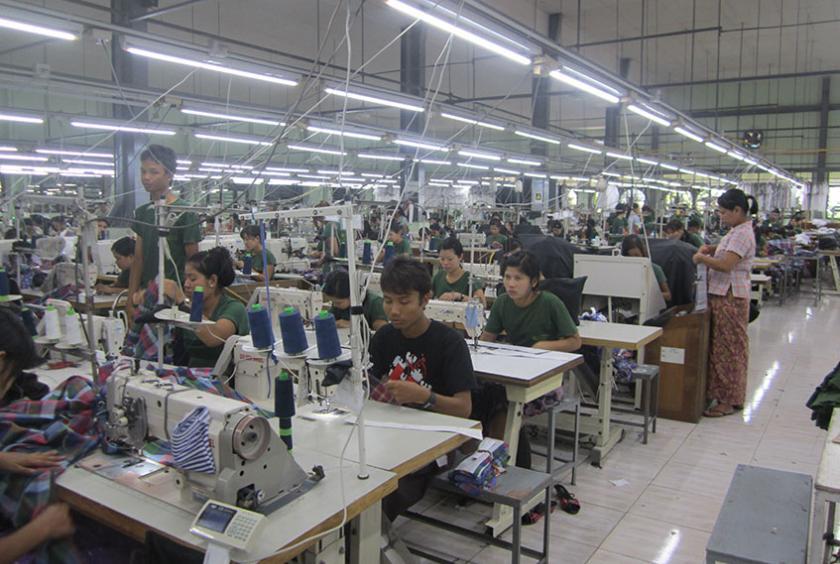
“My overtime is still less than it used to be,” said a 35-year-old who works making jackets and hooded tops for South Korean brands told Nikkei Asia. She is comparing it to the rate before February 2021. “But the economy is better than it was a year ago,” she commented.
Myanmar earned over US$3,194 million from garment exports in seven months of 2022, according to the Central Statistics Organization (CSO) under the Ministry of Planning and Finance.
The garment export earnings in those seven months were US$410.3 million in January, US$360.6 million in February, US$403.8 million in March, US$297.8 million in April, US$442.9 million in May, US$623.2 million in June and US$656.2 million in July.
The mini-budget period of the 2021-2022 fiscal year from October to March, garment export earnings totalled US$2,229.8 million.
Annually, garment export earnings were US$217.2 million in February, US$268 million in March, US$238.7 million in April, US$278.5 million in May, US$319.3 million in June, US$310.7 million in July, US$424.5 million in August, US$378.3 million in September, US$302.9 million in October, US$337.9 million in November and US$414.3 million in December 2021 and US$410.3 million in January, US$360.6 million in February and US$403.8 million in March in 2022.
Most of the garment factories in Myanmar are operating under Cut-Make-Pack (CMP) system, and are receiving orders mainly from Japan, China, Korea and EU countries.
In 2018, Germany topped the largest garment importing countries with an amount of US$930 million, followed by Japan with US$834 million and Korea with US$399 million. Other countries such UK, Spain, France, Denmark, Italy, the Netherlands and the US were among the top-ten countries importing garment from Myanmar.
According to the Ministry of Commerce, garment export earnings tripled in 2014 up from US$337 million in 2010. In 2015, garment export value reached US$1.46 billion.
US$3.3 billion was earned from exporting garment to the EU, Japan and the United States from January to September in 2022, accounting for an increase of 1.6 times compared to the same period of the previous year.
Despite Western countries’ sanctions against military-backed companies, there has been no severe punishment that could lead to the loss of a large number of jobs.
Global brands including H&M, Adidas and Uniqlo still open doors to Myanmar. Economic sanctions are not subject either to other sectors. Unilever still operates in Myanmar while Toyota Motor could have started operating a new factory after delays caused by the political situation.
Daily minimum wage has remained as Ks4,800 (about US$1.68) since 2018, but the majority of people still view factories as a single source of their income.
“I had to make my 17-year-old daughter drop out of school,” said a passenger on a circular train in Yangon, the old capital and the largest city of Myanmar.
Due to waning public affordability after cabinet change, the daily income of a snack seller at Yangon Railway Station has decreased from around Ks10,000 to around Ks4,000, said a father of 10. His oldest sister is working at a garment factory to support her family.
According to World Bank data, those living under poverty line in Myanmar accounted for 40% of the population in 2022. The number was 20% in 2019 when Covid-19 outbreak started.
At that time, the factories belonging to Myanmar Garment Entrepreneurs Association had hired nearly 550,000 workers.
In 2021, Myanmar lost about 1.6 million jobs with women folk most affected, according to International Labour Orgnization (ILO).
In the first quarter of 2022-2023 fiscal from April to June, US$1,363.9 million was earned from garment exports, accounting for 32.5% of the total export of Myanmar. The second largest export item was natural gas, followed by rice, pigeon pea and maize, according to CSO.
Export situation
Myanmar exports agricultural produce, animal products, marine products, mineral products, forest products, finished industrial products and other goods. Among them, the export of finished industrial products including CMP products is the largest.
In nearly 10 months of the current 2022-2023 financial year, Myanmar earned over US$13.653 billion from exporting goods—US$3,030.608 million from agricultural produce, US$19.239 million from animal products, US$613.597 million from marine products, US$288.389 million from mineral products, US$123.826 million from forest products, 9,196.380 million from finished industrial products and US$381.474 million from other goods.
According to UN Comtrade data, there were 126 countries that imported goods from Myanmar in 2021, whereas the number was 134 in the year before. However, the export value of Myanmar increased by 7% or reached nearly US$21 billion. Despite international economic sanctions, it is likely that Myanmar’s export volume has swelled.
The export boost was led by China, the largest customer for Myanmar, with purchases worth over US$8 billion in 2021—a 25% increase from the previous year. Among main importers, Thailand topped the list of Myanmar’s exported countries with US$2.8 billion, followed by India with $800 million.
According to the Central Statistics Organization under the Ministry of Planning and Finance, Myanmar exported 64% of products to the Asia region in the first 3 weeks of 2022-23 financial year (FY) and over 28.9 % products were exported to the Europe Countries.
The top partner countries to which Myanmar Exports Textiles and Clothing Thailand, China, Japan, the U.S. and Germany in the first 3 weeks of 2022-23FY. During this period, the country exported 22.7% goods to the Thailand.
Myanmar earns nearly $28 billion from foreign trade within nearly 10 months in 2022-23FY. Comparing the same period of the 2021-22FY, trading amount worth over $4,314 million increased, according to the Ministry of Commerce.
Myanmar get trading amount $27,911.787 million from export and import. In the previous same financial year, Myanmar had earned $23,596.943 million from the export and import. Comparing two financial years, the trade amount $4,314.844 million increased within 10 months of current financial year.
The National Planning Law in 2022-23FY described that Myanmar aims to export goods worth $15.5 billion and to bring foreign imports worth $14 billion in this financial year.
Due to the low income and increase of commodities prices, the businesses rely on the foreign exports can more resist than the other industries which depend on the local market, according to the World Bank (WB).
Struggling Myanmar economy
According to the WB’s Myanmar Economic Monitoring Report, although manufacturing is lower than the 2019, Myanmar’s economy is projected to grow 3% in 2023.
The report also said that the flow of short-term business is still slowly down due to the COVID-19 outbreak and political crisis because there have been obvious macroeconomic, elevated levels of domestic conflict, electricity outages and persistent logistics and financial sector disruptions.
Gradual economic recovery is expected in the near term and growth is estimated at 3 percent for the fiscal year ending September 2023. Even so, economic activity continues to be adversely affected by conflict, electricity shortages, and changing rules and regulations, with per capita GDP expected to remain about 13 percent below its pre-COVID-19 level. The depreciating kyat, combined with high global prices and ongoing logistics constraints, has caused import costs to rise sharply.
Myanmar has experienced significant macroeconomic volatility over the past six months. Between June and December 2022, the kyat lost about a quarter of its value against the US dollar, to be down by more than 50% from its level two years earlier.
In conjunction with still-elevated global commodity prices and logistics constraints, this depreciation has resulted in significant price pressures which continue to filter through the economy.
The latest available CPI data shows inflation rose to nearly 20% over the year to July, weighing on real incomes, consumption and investment.
Exchange rate volatility was reported as the main constraint faced by businesses across all sectors in the September round of the World Bank firm survey, reflecting a particularly sharp depreciation episode in July and August. While the kyat has stabilized in recent months, foreign currency shortages persist, which together with onerous trade restrictions have affected businesses’ ability to supply of a range of imported products. At the same time, foreign currency surrender requirements continue to impose a substantial tax on many exporters, reducing their competitiveness on international markets.
Chairman of the State Administration Council Senior General Min Aung Hlaing said that industrial zones were established in districts and townships to be able to produce industrial goods. He stressed that economic guarantee would be given to manufacturing industries so that they could not make losses in doing business. If manufacturing industries develop, the country will improve. Therefore, MSMEs are being encouraged to help develop national economy. Only when raw materials can be supplied, can manufacturing process be undertaken, the Senior General pointed out.