
The adoption of proportional representation (PR) in election has been under hot debate since Myanmar’s political changes in February.
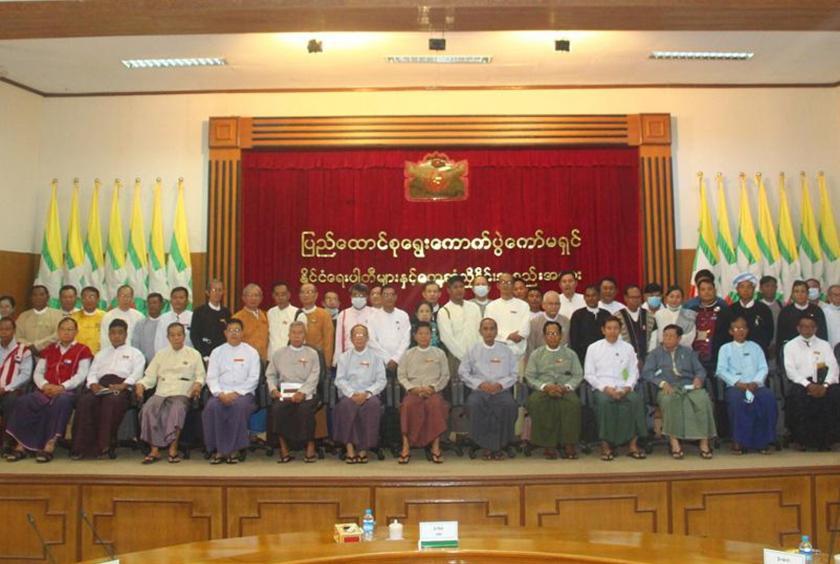
In its first meeting with over 50 political parties, the Union Election Commission (UEC) received proposals from some parties to adopt PR.
“I was the first to make this proposal to review our electoral system. There must be all-inclusiveness. I pointed out that the old system could not work to ensure multi-party system,” said U Aung Zin, secretary general of the National Democratic Force.
After other three parties supported his proposal, the UEC has taken steps to adopt PR.
It started inviting findings and suggestions about PR two days after that meeting on February 28.
Only the first-past-the-post electoral system (FPTP) was practiced in the 1990, 2015, 2010 and 2020 general elections.
There were some parliamentary proposals and discussion about PR adoption before the 2015 election. But, the plan failed and elections took place under FPTP system only.
U Aung Zin added State Administration Council (SAC) Chairman Senior General Min Aung Hlaing himself was planning to adopt PR to ensure all-inclusiveness.
The Senior General revealed his plan to exercise PR during a council meeting on August 23.
“Thanks to the current provisional government, I believe PR system will emerge in our country,” U Aung Zin said.
Some favour PR saying that it could pave the way for small parties and ethnic parties to have greater representation.
“I really like PR because I think our ethnic nationals could be in a position to have a role in parliament or administration. Rather than a large or influential party, any party having the chance to represent means impartiality, debate and criticism. I assume this is good for the country,” said Mann Aung Pyi Soe, chairman of Karen National Democratic Party.
Political analysts however say the constitution must be amended to adopt PR.
The constitution enacted in 2008 says no particular electoral system. Yet, PR cannot be exercised for lower house and regional parliamentary elections because they have to rely on townships.
“First, the constitution must be amended. PR is not possible in electing only one representative in one constituency. Proportion is possible only if a constituency has more than two candidates to compete,” said political analyst U Ye Tun (Sibaw).
Under the constitution, 330 lower house parliamentary representatives are elected from 330 townships. That means one representative from one township. For region and state parliaments, each township needs to elect only two representatives.
For upper house, each region or state has to elect 12 representatives with a maximum of 224 in all regions and states.
The SAC has announced general election will be held in accord with the 2008 constitution only after the emergency provisions.
During a press conference of the SAC on May 15, UEC member U Khin Maung Oo said there had been papers on PR system from nine parties and the ones submitted in the previous parliamentary sessions. The UEC also had its findings and reviews about the system, he added.
He pointed out different varieties in PR system saying that an amendment measure could be taken if it is compatible with the structure of Myanmar and its prevailing conditions, and serves the national interest.
“As the SAC has legislative, executive and judicial powers, the amendable laws can be amended. The commission has the power to amend the bylaw with a notification,” U Khin Maung Oo said.
Most democratic countries exercise FPTP or PR only although both systems have strong and weak points.
Research papers show that FPTP system is easier to be used in terms of vote counting.
According to a paper from the Salween Institute for Public Policy, close contact between a representative and constituency in FPTB system enables a voter to easily judge the performance of the representative he has chosen. Moreover, the voter can decide if that representative should be chosen again or not in next election.
Meanwhile, the paper mentions one clear advantage of PR system saying small parties or ethnic parties can represent as they have the chance to share legislative powers.
However, the National League for Democracy (NLD) and some powerful ethnic parties have opposed PR system citing military representatives being in parliament, constitutional amendment failure and voters being unprepared yet for such system.
“It is important that voters know how to vote. Since independence, Myanmar has held elections under FPTP system. We have to choose an electoral system most suitable for our country and people. Choosing one as we wish will not work,” said U Thar Tun Hla, chairman of Arakan National Party.
He however said a more extensive awareness campaign for voters was required to adopt PR as the majority has little knowledge of election.
“It is necessary to have high voter education level. This is why we need to create an electoral system in which the people can vote clearly and easily,” he said.
Gwan Gaung Aung Kham, former chairman of the Kachin Democratic Party, said although small parties can enjoy more rights, more heavily populated regions will have more advantages as quota is based on population ratio.
“It will be beneficial to all and our country if we go with federal system rather than electoral system,” said Gwan Gaung Aung Kham, who has run for at least two elections.
He takes the view that electoral system should be chosen only after adopting federalism.
The paper from the Salween Institute pointed out that representative democracy could not be fully created just because of PR adoption.
“PR guarantees representation of any group in human society, but small parties will still feel marginalized as a minimum vote count quota system is used to enter parliament, it said.
Apart from electoral change, traditional voting, party policy, organizational tactics and popularity of candidates influence election results, the paper added.
Political analyst and former parliamentarian U Ye Tun (Sibaw) expressed his support for electoral system change saying that the constitution has some provisions that favour the winning party to gain upper hand.
As per the constitution, the president appointed by the winning party has the power to choose election commission chair and members. When electoral debate arises, the commission’s decision is final, he added.
“Suppose the USDP (Union Solidarity and Development Party) won the next election because the NLD (National League for Democracy) could not compete, the winning party might change its mind to make amendments,” U Ye Tun commented.
The Salween paper described correct choice of electoral system as crucial as it can influence political change and stability of human society.