
"What our people realised is that we need to struggle by ourselves," Ms Zin Mar Aung, foreign affairs minister of Myanmar's National Unity Government (NUG), told The Straits Times on Friday (July 9). "We can't expect external support."
While Western nations imposed targeted sanctions on ruling military members and military-linked companies after the Feb 1 takeover, Asean has drawn flak for its inaction.
A senior Asean official recently held a video conference with an NUG minister, she revealed.
This took place only after Asean secretary-general Lim Jock Hoi and Brunei's second foreign minister Erywan Yusof had travelled to Naypyitaw to meet ruling military chief Min Aung Hlaing.
The trip last month was widely criticised for appearing to legitimise the ruling military leader, who was also invited in April for a special meeting in Jakarta with Asean to discuss the crisis.
Myanmar's post-takeover political and economic freefall has been aggravated by the surge of Covid-19 infections sweeping across the region. It logged over 4,320 new cases on Friday, and 63 deaths, figures that are most likely under-reported, given the large numbers of doctors and nurses who have walked out of their jobs in protest against the takeover.
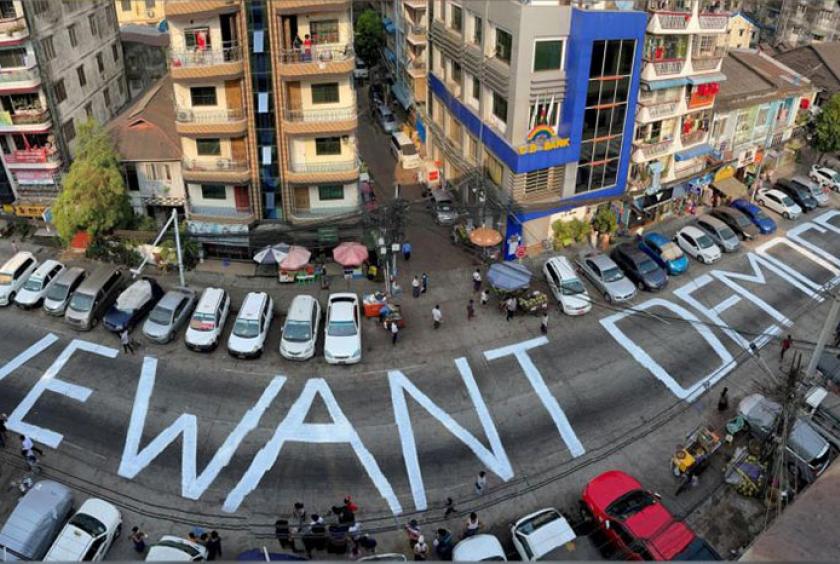
The Feb 1 putsch toppled the civilian National League for Democracy (NLD) government led by Ms Aung San Suu Kyi, who is facing charges widely seen as trumped up to end her political career. The military claims it was compelled to act because of electoral fraud.
Some 900 people have been killed by the military, according to the Assistance Association for Political Prisoners, and over 5,000 remain incarcerated. Initially peaceful protesters are now taking up arms against the regime through localised and autonomous "people's defence forces" (PDFs). Scattered insurgencies are taking hold, with some administrators working for the ruling military murdered.
Time is not on Myanmar's side, said Ms Zin Mar Aung, noting how international concerns about not infringing on Myanmar's sovereignty are giving the ruling military time to consolidate its power. The NUG is trying to get the PDFs to follow a code of conduct that will reduce unnecessary violence, but "things are very complicated on the ground", she told ST via a video link from an undisclosed location inside the country.
Unlike Japan and South Korea, which have suspended new aid and restricted export of military goods to Myanmar, the response from individual Asean member states has been comparatively low key.
Officials from Asean states that have kept channels of communication open with her colleagues were wary about making these interactions public, she said.
"They repeatedly mentioned that they are not interfering in our internal affairs," she said. "They just wanted to help and show their goodwill and friendship."
She listed Indonesia, Malaysia and Singapore as countries that have been supportive.
ST has contacted the Asean secretariat for comments.
The 10-nation bloc has made little ground since issuing a "five-point consensus" following the special meeting in Jakarta. It has yet to pick a special envoy to facilitate dialogue within Myanmar - one of the key elements of this consensus.
Division among Asean member states was most apparent during last month's vote on a resolution at the United Nations General Assembly, which called for the release of political detainees in Myanmar. While Indonesia, Malaysia, Singapore, the Philippines, and Vietnam voted for the resolution, Brunei, Cambodia, Laos and Thailand abstained.
Ms Zin Mar Aung said Thailand is "now trying to balance the relationship between the (State Administration Council) and our NUG".
"We understand their position and their difficulties. But at the same time I believe they are trying their best to help our people who are now across the border."
Meanwhile, Ms Suu Kyi, who is in detention and has had little contact with the public, retains her position as state counsellor in the NUG.
Asked if the deposed leader would agree with the NUG's decisions so far, Ms Zin Mar Aung said: "She doesn't necessarily need to agree with everything that the NUG does. But I definitely think she will agree (with our principle) of setting up a federal democratic union. I totally believe that we are on the same page.