
(1)
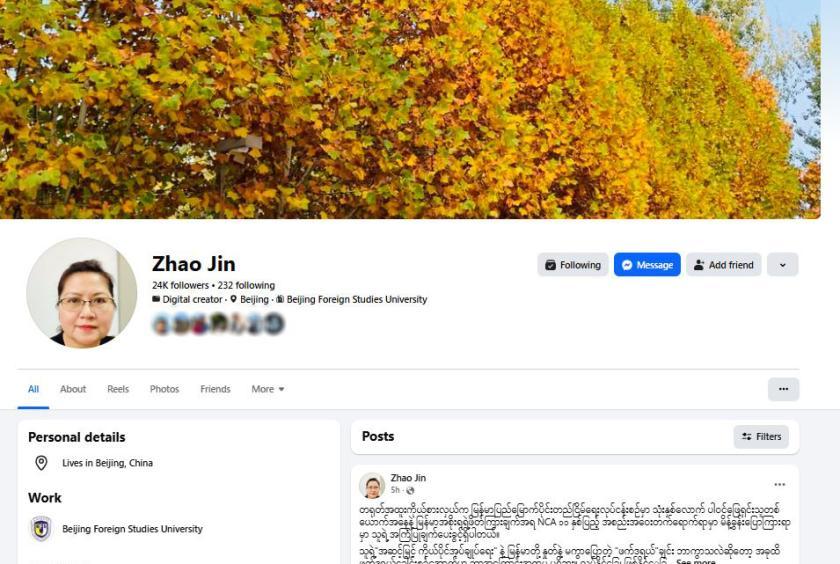
This article is a rebuttal to the unfounded allegations made by Daw Saw Kyi against Eleven Media Group. In recent times, online posts by lobbyists that could incite Sinophobia have noticeably surged. Among these Chinese lobbyists, Daw Saw Kyi is particularly prominent, as evident from the posts published on her Facebook account under the name Zhao Jin. Based on accessible records, Daw Saw Kyi is by no means an ordinary individual. According to an interview posted on CRI Myanmar's social media page on 25 December 2021, her Chinese name is Zhao Jin, while her Myanmar name is Daw Saw Kyi. She was born in Baoshan, China, in 1973. After graduating from Beijing Foreign Studies University in 1997, she began her career as a lecturer and has acquired extensive experience concerning Myanmar. She is a university lecturer teaching Myanmar language at the Department of Myanmar Language, Beijing Foreign Studies University. Furthermore, she is a researcher and scholar who has authored and published numerous books and research papers on Myanmar. In addition to her academic standing as a university lecturer and intellectual, she is also reported to have served temporarily as a staff member in the economic section of the Chinese Embassy. Despite her stature as an academic and university lecturer, Daw Saw Kyi routinely publishes disparaging and derogatory remarks against the people of Myanmar on her social media platform. For someone holding such credentials, publishing posts that demean and insult Myanmar citizens is entirely inappropriate. A review of her social media posts reveals that, despite teaching the Myanmar language at a tertiary level, her commentary regarding the people of Myanmar is consistently contemptuous. Her writings lack intellectual integrity and fundamentally violate the professional ethics and dignity expected of a university lecturer. Simply put, Chinese lobbyist Daw Saw Kyi can be considered among the worst offenders using social media to disparage the people of Myanmar while stoking anti-Chinese sentiment. As an academic and tertiary educator, she is strongly urged to adopt a more constructive and fair-minded perspective toward the people of Myanmar.
(2)
Chinese lobbyist Daw Saw Kyi published several social media posts containing unsubstantiated allegations concerning the article titled "Long Live China–Myanmar Friendship; Preserve Myanmar’s Sovereignty", published on Eleven Media Group's Facebook page. In her posts, she levelled groundless accusations, asserting that Eleven Media Group's article was inciting anti-Chinese hatred. What Daw Saw Kyi fails to grasp is that Eleven Media Group published the article with the explicit intention of safeguarding Myanmar's sovereignty and fostering enduring, cordial relations between the governments of Myanmar and China. The article refrained from defaming or harming any individual; rather, it presented comprehensive facts and articulated the necessary conditions required to uphold Myanmar’s sovereignty. Notwithstanding the well-documented presentation of facts, Daw Saw Kyi chose not to provide an objective, academic appraisal of the article, resorting instead to attacking Eleven Media Group on her social media account. In her post, she disparaged the article by claiming that "yet another green wave of Sinophobia has arrived." This reflects merely her subjective opinion, as the article contains no elements inciting anti-Chinese sentiment whatsoever. It was composed strictly on the basis of factual truths. Daw Saw Kyi ought to provide specific, verifiable evidence to clarify precisely which aspects of the article constitute anti-Chinese hatred. The point highlighted in the article regarding the MNDAA's implementation of the Chinese language, script, and currency in northern Shan State represents the actual reality on the ground. It is an undeniable fact that local ethnic residents have staged protests against the MNDAA’s forced imposition of the Chinese currency and language in occupied territories. Local ethnic organisations have issued statements of objection concerning this matter. On 23 October, the Shan State Joint Action Committee (SSJAC) released a statement strongly condemning the MNDAA’s coercive threats and domination over the fundamental rights and cultural heritage of ethnic nationalities in northern Shan State. The SSJAC statement noted that the MNDAA has forcibly mandated the use of a language unfamiliar to and unused by the local majority, making it compulsory not only as an official administrative language but also in public spaces. Furthermore, it stated that the existing land tenure systems worked and preserved by local populations for generations are being forcibly modified and confiscated without public consent. The SSJAC also stated that administrative regulations, including the land laws enacted by the MNDAA, facilitate the unhindered influx of foreigners and create both direct and indirect avenues for foreign land ownership. It added that historical names of towns and villages, along with public signage, are being forcibly replaced with names and languages entirely alien to local culture. Peaceful local dissenters against these measures are subjected to arbitrary arrests, oppression, and intimidation, representing a flagrant violation of civil rights and freedom of expression. The SSJAC affirmed that the formal and coercive enforcement of these measures directly contravenes the "Manifesto of Peaceful Coexistence", adopted and observed on 14 February 2022, as well as the fundamental principles of a federal democratic union. The committee warned that should these objections be disregarded and the enforcement persist, it would mount robust political and social responses to protect the history, culture, interests, and right to self-determination of local communities. Statements issued by local ethnic groups clearly demonstrate the severity of the situation within MNDAA-controlled territories. To cite a prominent historical example: since the feudal era, the Hsenwi domain stood as the largest, most extensive, and most powerful Shan Saopha (Sawbwa) realm in northern Shan State. Following its armed capture by the MNDAA, however, Hsenwi was redesignated by its Chinese name, "Mubang". Under the 2008 Constitution, Hsenwi is formally designated as a township within Lashio District in northern Shan State, not as part of the Kokang Self-Administered Zone. The 2008 Constitution delineates the Kokang Self-Administered Zone as comprising solely Laukkai Township, Chinshwehaw Township, Konkyan Township, and Mawhtike Sub-township. That represents the legal extent of Kokang territory. It was therefore entirely reasonable for Eleven Media Group's article to call upon the MNDAA to withdraw to its legitimate boundary. Myanmar is a nation that endured colonial subjugation under the British. Throughout its history, it suffered invasion by Fascist Japan as well as incursions by the Kuomintang (White Chinese). Consequently, Myanmar is a country that has repeatedly borne the brunt of foreign invasions, fallen victim to colonial rule, and witnessed the destruction of its royal capital by foreign powers. Given this historical experience, vigilance is paramount, for the people of Myanmar will submit to no one's dominion. Sovereignty is paramount to a nation; without it, no political system can be established—neither democracy nor a federal union. Daw Saw Kyi ought to comprehend this reality. Put plainly, starting from the post-independence external aggression by the Kuomintang and the internal insurgency of the Communist Party of Burma down to the current Three Brotherhood Alliance, it is undeniable that the armed insurgencies imperilling Myanmar's sovereignty and threatening its independence have largely operated from along the Chinese border.
(3)
Another point is that I would like Daw Saw Kyi to read the article carefully. I would also like her to study the Eleven Media Group in detail.
Having lived in Myanmar and previously worked temporarily as an employee in the economic section of the Chinese Embassy, Daw Saw Kyi has no reason not to know about the Eleven Media Group.
The Eleven Media Group is also an independent media organization. That is one reason why its relations with the Chinese Embassy and the Chinese government have remained strong to this day.
From the US Embassy in Myanmar to the embassies of other countries, everyone is already aware that the Eleven Media Group is an independent media organization.
The Eleven Media Group has followed the principle that “Nothing is right except the truth” for 27 years now. In recognition of its stance, the France-based Reporters Without Borders (RSF) awarded the Eleven Media Group the “Media of the Year” award in 2011.
In 2013, the World Association of News Publishers (WAN-IFRA) presented the Golden Pen of Freedom Award, one of the most prestigious honors in global journalism, to Dr Than Htut Aung, Chairman and CEO of the Eleven Media Group. These are milestones in the history of the Eleven Media Group that can never be erased.
Furthermore, the Eleven Media Group is a member of both WAN-IFRA, one of the most prestigious organizations in the global press industry, and the Asia News Network (ANN).
WAN-IFRA represents 18,000 newspapers in 120 countries. With representatives at the United Nations, UNESCO and the Council of Europe, WAN-IFRA is an association that brings together leading newspaper companies and technology entrepreneurs, alongside representative member associations from 80 countries.
Similarly, the Asia News Network (ANN) includes news organizations not only from Southeast Asian countries but also from other parts of Asia. Established in 1999, ANN initially had seven members from seven countries. It has since grown into a major organization with 23 members from 21 countries.
ANN members include The Daily Star (Bangladesh), Kuensel (Bhutan), Brunei Press (Brunei), The Phnom Penh Post and Rasmei Kampuchea (Cambodia), China Daily (China), The China Post (Taiwan), DataLeads and The Statesman (India), The Jakarta Post (Indonesia), The Japan News (Japan), Vientiane Times (Laos), Sin Chew Daily and The Star Online (Malaysia), Gogo Mongolia (Mongolia), Eleven Media Group (Myanmar), The Kathmandu Post (Nepal), Dawn (Pakistan), Philippine Daily Inquirer (the Philippines), The Straits Times (Singapore), The Korea Herald (South Korea), The Island (Sri Lanka), The Nation (Thailand) and Vietnam News (Vietnam). ANN board meetings are held annually, with member countries taking turns hosting them. A look at ANN's membership also shows that China's China Daily is a member of the network.
On September 4, 2023, an executive director of the Eleven Media Group personally attended an ANN board meeting in Beijing, China. The group also maintained good relations with Chinese government officials at the event. In fact, the Eleven Media Group enjoys good relations with China and Chinese media organizations in general.
Against this backdrop, Daw Saw Kyi's accusation that an article published by the Eleven Media Group was anti-China is nothing more than an unfounded allegation. The article was written with comprehensive supporting facts. By accusing the group of being anti-China without presenting any sound evidence, Daw Saw Kyi, an academic and university lecturer, is effectively undermining the reputation of the Eleven Media Group.
The Eleven Media Group's position on China is clear. Its stance toward China has already been explicitly set out by its editor-in-chief, Ko Kyaw Zaw Lin, in an article titled “U Min Zin, China and Eleven Media's Position.”
To help Daw Saw Kyi, whom the writer describes as a pro-China lobbyist, understand the group's position, I would like to quote several passages from the article “U Min Zin, China and Eleven Media's Position” by Eleven Media Group Editor-in-Chief Ko Kyaw Zaw Lin.
“Another point is our position. We are an independent media organization. Our belief is that we are a media organization that believes in democracy. We respect press freedom and the freedom of the independent press. Despite the many difficulties arising from the current situation, security conditions and political systems, our beliefs have not changed. Another point is that we believe our country must become a peaceful, stable and secure nation, as well as a sovereign state. These are our two core beliefs: we believe in democracy, and we believe in building a peaceful, stable and sovereign nation. I want to make it clear that we continue our work as a media organization guided by these two beliefs. It is on the basis of these two beliefs that we maintain friendly relations with China as well. We are not subordinate to anyone, nor are we anyone's proxy. We are independent, and we have consistently followed this course. Despite the circumstances and various challenges, times have changed. The year 1988 was different from 2011, just as 2011 is different from 2026. Everything has changed. We must move forward steadily in response to these changes. The main point is that, regardless of the divisions within our country, differences in political views, or which government comes to power, Myanmar must not foster hostility toward China or promote anti-China sentiment. When we write about China, we do so from the perspective of a friend, not an enemy. In particular, the commentary published by Eleven Media reflects the words of one friend speaking to another friendly nation”.
I believe this should be sufficient for Daw Saw Kyi to understand the Eleven Media Group's position toward China.
Since this article has already become quite lengthy, I will bring it to a close.
In conclusion, Daw Saw Kyi cannot make baseless allegations that the Eleven Media Group, a respected media organization with a 27-year history, is promoting hostility between China and Myanmar. She should instead identify which specific statements in the group's article are inaccurate and explain how they allegedly contribute to anti-China sentiment or hostility between the two countries.
It is inappropriate for a university lecturer and academic like Daw Saw Kyi to accuse and discredit a media organization without presenting supporting evidence, as an ordinary person might do.
Dear Daw Saw Kyi,
The people of Myanmar do not hate the Chinese people. Nor do they regard China as a country that should be hated or treated as an enemy. However, they do deeply resent lobbyists like you who tend to treat Myanmar people condescendingly. Therefore, I would like to ask you, please, to keep your distance from Myanmar–China relations.