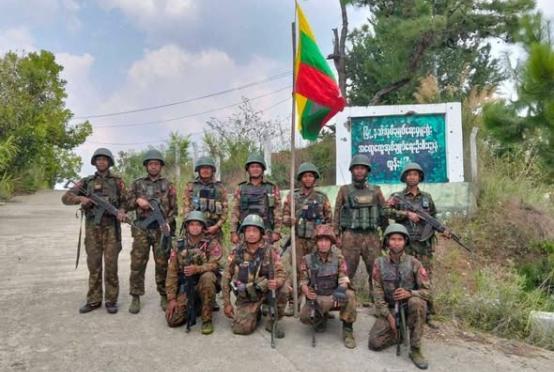

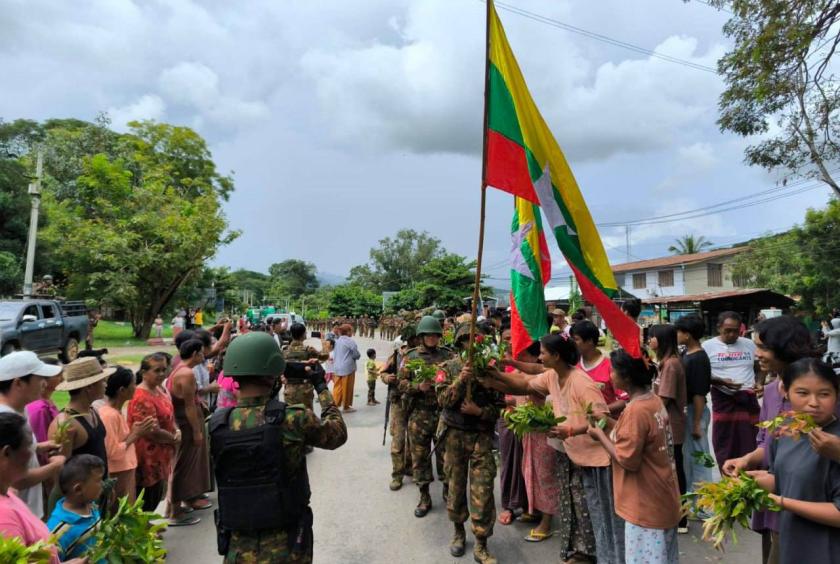
Tatmadaw has regained full control of Hsipaw from the TNLA on October 17, according to sources.
Tatmadaw columns has reached the vicinity of Hsipaw, which was temporarily controlled by the TNLA, DPLA, and PDF on October 15 and Tatmadaw has continued its action to take full control of Hsipaw. As the TNLA coalition forces withdrew from the town, they burned down departmental office buildings and houses on October 16.
The departmental buildings that were burned down include the Hsipaw Prison Department, the General Administration Office, the Land Registry Office, and Hsipaw Hotel, other departmental buildings and houses.
As a result of the fire that had engulfed some office buildings and houses, some military columns entered the Hsipaw area on the evening of October 16 to conduct a clearance operation and to prevent the spread of fire to other buildings and to carry out necessary security operations.
Some exile media outlets that support the TNLA have reported that the fires in Hsipaw were caused by heavy weapons during the fighting.
On September 30, a day before Tatmadaw entered Kyaukme, the TNLA had also set fire to some government office buildings in Kyaukme to prevent the Tatmadaw from easily carrying out administrative tasks if it returned.
Currently, Tatmadaw columns have arrived in Hsipaw and are conducting military operations in the surrounding area.
The Tatmadaw is continuing to exert military pressure on the TNLA, and although military columns have not yet arrived in other towns temporarily controlled by the TNLA, they are launching operations through airstrikes.
"Since the Kyaukme attack, the local people have predicted that the army will take Hsipaw in a short time. All we are praying for is that Hsipaw will not be seriously damaged. We want the two governments to reopen the Muse-Mandalay Road so that it can be used safely for trade. In addition, the TNLA leaders are aware of other geopolitical factors, Tatmadaw’s growing military strength, and the problems among the locals, some allies, and the TNLA's lower ranks but it seems that there are many imaginary scenarios from the TNLA upper ranks. The more they fight back, the more casualties they will suffer. The result will be the loss of human resources, infrastructure, and resources. There is also the side effect of civilian casualties. It’s timing. The war is already started. In local terms, The TNLA is showing great strength and lacks intelligence, so it cannot stand for long. After Hsipaw, Tatmadaw will come to other towns. We just have to pray that the people will be minimally affected," said a local from northern Shan State who is monitoring the military situation.
In northern Shan State, the TNLA, along with the Northern Alliance, under the name of Operation 1027, has been waging battles and has attacked Namsang, Mantung, Namtu, Namhkam, Mogok, Kyaukme, Hsipaw, Nawnghkio, and Kutkai, and has taken control of the towns.
In order to regain control of the towns that the TNLA had taken control of, Tatmadaw has resumed operations using air support and ground offensives. Tatmadaw took control of Nawnghkio, which was controlled by the TNLA, on July 16, 2025, and took control of Kyaukme, about two and a half months later on October 1. They continued their offensive to retake Hsipaw, and now they have regained control of Hsipaw.
The TNLA, a Palaung terrorist group, destroyed the 125-year-old World Heritage-listed Goteik Viaduct (Kyaukme side) on August 24, 2025, when they controlled the 125-year-old World Heritage-listed Goteik Viaduct connecting Mandalay-Lashio at the junction of Nawnghkio and Kyaukme townships in northern Shan State. The bridge was damaged by a mine on August 24, 2025, destroying more than 30 feet of the bridge. The bridge is now being repaired by the Myanma Railways.