
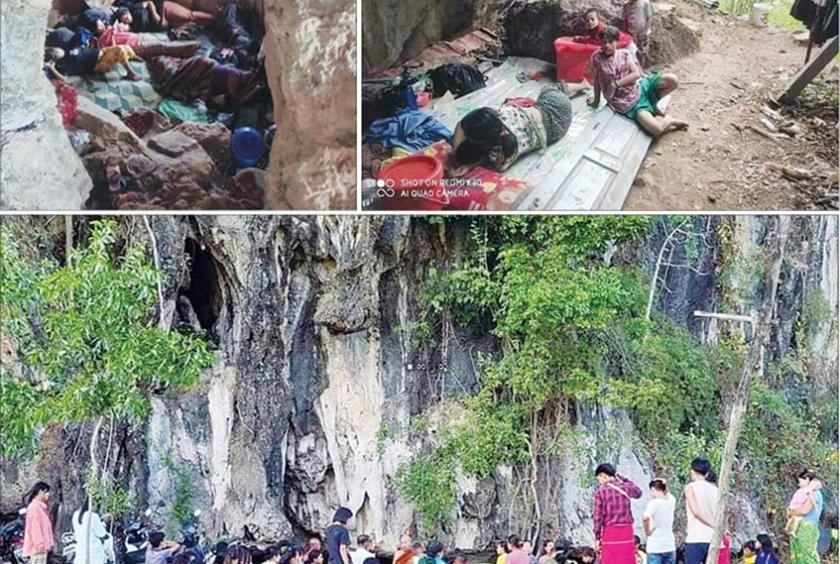
The armed conflicts in Myanmar, especially in Shan State, have caused the number of internally displaced persons to rise.
Many people have fled their homes since the political change on February 1, 2021 and have not been able to return.
On October 27, 2023, the Northern Alliance, composed of three ethnic armed groups, launched 1027 operations in northern Shan State. They attacked the border areas, such as Lashio, Hsanwi, Kutkai, Muse, Kukot, Kyugok, Moneko, Phaungsai, Kunlon, Chinshwehaw and Laukkai, targeting the local battalions and security posts.
The Myanmar National Democratic Alliance Army (MNDAA) fought in Kunlon, Chinshwehaw and Laukkai, and joined forces with the Ta’ang National Liberation Army (TNLA) and the Arakan Army (AA) around Lashio and Hsenwi.
The “1027” operation of the Northern Alliance resulted in the abandonment of three locations, such as Chinshwehaw, Phaungsai and Kyungok, by the administrative and security organizations. Moreover, the MNDAA reported that after nearly two months of the “1027” operation of the Northern Alliance, they had taken over more than 200 strategic hills, camps, checkpoints, and police and administration posts. They also reported that they had captured five towns, such as Chinshwehaw, Moneko, Kampala, Panhsai and Kongyan, and four border gates by December 3.
Northeastern Status
The Myanmar military and the northern three allies have been negotiating for a ceasefire in northern Shan State, but some townships are still witnessing violence.
The United Nations reports that the intensified fighting in northern Shan State has killed 130 civilians, injured 210, and damaged about 430 homes.
The United Nations also reports that nearly 120,000 people have been displaced by the fierce armed conflict between the military and the three northern allies since October 27. Only about 20,000 of them have been resettled, and the rest have been moved to 187 refugee camps in northern Shan State, Kachin State and Mandalay Region, which share borders, according to the United Nations.
The United Nations says that the refugees are mainly sheltering in religious and residential communities, temporary shelters in the mountains, and fields near the Chinese-Myanmar border.
Although humanitarian partners have reached 139 evacuation sites, there are ongoing wars, travel restrictions, and bureaucratic hurdles that hamper the rapid assessment of critical needs, according to the United Nations.
The United Nations says that nearly 82,000 evacuees (82 percent of the total IDPs) in northern Shan State have received cash, food, relief supplies, and services. However, 30,000 war refugees on the Chinese-Myanmar border are still lacking humanitarian assistance.
The United Nations also reports that conflicts are still occurring in some townships, including Myitkyina, and that security conditions in Kachin State remain unstable. Since December 13, there have been severe clashes between the military and the Kachin Independence Army (KIA) in the township of Momauk on Bhamo-Myitkyina Road. The frequent blockades of two major highways between Mandalay and Myitkyina have caused the prices of basic commodities, such as food and fuel, to rise.
Southeastern Status
Many townships in almost all regions and states in the southeast of Myanmar have witnessed fierce fighting since November 11. The violence has lasted for over a month in eastern Bago Region, southern Shan State, Kayah State, Mon State, Kayin State and Taninthayi Region.
The United Nations says that the fighting has claimed the lives of 93 civilians and injured 101 others, mainly along the Shan-Kayah border, since November 11. More than 136,000 people have been forced to leave their homes from October 31 to December 11.
The United Nations also says that humanitarian access is severely limited in most places in the southeast, and that the movement of people and essential goods is restricted, especially in Kayah State.
Northwest and Central Status
In the northwest and central parts of Myanmar, violence erupted in Ayadaw and Indaw townships in Sagaing Region, Pakokku and Pwintphyu townships in Magway Region and several townships including Kyaukse, Ngetogyi and Taungtha in Mandalay Region. The fighting has caused the number of refugees to increase to more than 314,000. They include 130,000 refugees from the towns of Kawlin and Htigyaik, and more than 7,000 displaced people in Khampat in Sagaing Region and Htilin and Yaw townships of Magway Region since early December.
The United Nations reports that the fighting has killed 118 civilians and wounded 73 others, and damaged 553 buildings, including homes, religious places and schools.
Humanitarian partners have given emergency assistance to about 50,000 refugees in Chin State, Mandalay Region and Sagaing Region. However, the United Nations says that the needs of war refugees are still much higher than their capacity. The United Nations also reports that about 150,000 war refugees in Kawlin and Htigyaik townships in northern Sagaing Region have not received any humanitarian assistance yet.
Situations in Rakhine State and southern Chin State
In the last week, the military and the AA have clashed more intensely in the towns of Maungdaw, Mrauk-U, Pauktaw and Paletwa in Rakhine State and southern Chin State. The United Nations reports that the civilian casualties have also increased with 37 deaths and 120 injuries from November 13 to December 11. More than 111,000 residents have been displaced by the continuing fighting. All waterways in and out of Rakhine State and Chin State are still closed, and all public and private transportation services are stopped. As a result, local residents are facing a shortage of commercial goods, such as fuel, food, and medical equipment.
A record number of IDPs
Many parts of Myanmar are facing civilian casualties, evacuations, and damage due to the clashes, airstrikes, and heavy artillery between the military and ethnic armed groups. More than 660,000 people have left their homes in northern Shan State, southern Shan State, Kayah State, Rakhine State, Chin State, Sagaing Region, Mandalay Region, eastern Bago Region, Kayin State, Mon State and Taninthayi Region since the fighting worsened after October 27.
The United Nations says that at least 378 civilians, including men, women, and children, have died and 505 have been wounded since the fighting intensified after October 27.
Local residents say that the armed conflict and insecurity have led to more civilian casualties, illegal arrests, exploitation, forced recruitment, and violence. Myanmar now has 2.6 million internally displaced persons, which is the highest number ever in Myanmar.
In the areas of armed conflict, travel and transportation of goods are severely limited, and telephone and Internet services are cut off. The United Nations says that this affects the sharing of safety information and the delivery of humanitarian activities. War-torn areas are facing shortages of food and essential household items due to the lack of access to transportation routes for humanitarian and commercial activities.
The United Nations reports that this also causes the prices of consumer goods and fuel to rise. In this situation, the United Nations reports that nearly a third of Myanmar’s population (18.6 million) need humanitarian assistance. The United Nations says that this is a million more than last year, and almost 19 times higher than three years ago before the political change.
The armed conflicts have caused children to suffer from this crisis and homelessness, and lose health care and education. The United Nations reports that six million children need help due to factors such as loss, inadequate food, and malnutrition. It also warns that many of these children need to be protected from various dangers, such as recruitment and trauma.
Many families are struggling financially due to economic hardships and agricultural challenges and inflation. Malnutrition is rising due to high commodity prices.
The United Nations reports that the health care system is also in a crisis, and millions of people lack safe shelter or drinking water. The United Nations also says that women and disabled people are the most affected by these bad situations.
The United Nations has announced that humanitarian organizations plan to give emergency priority to 5.1 million people by 2024, and that US$994 million is needed for such assistance.