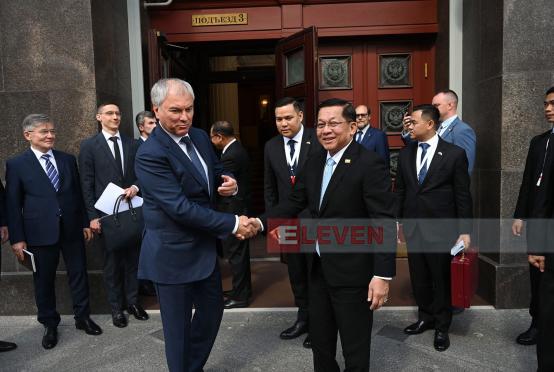

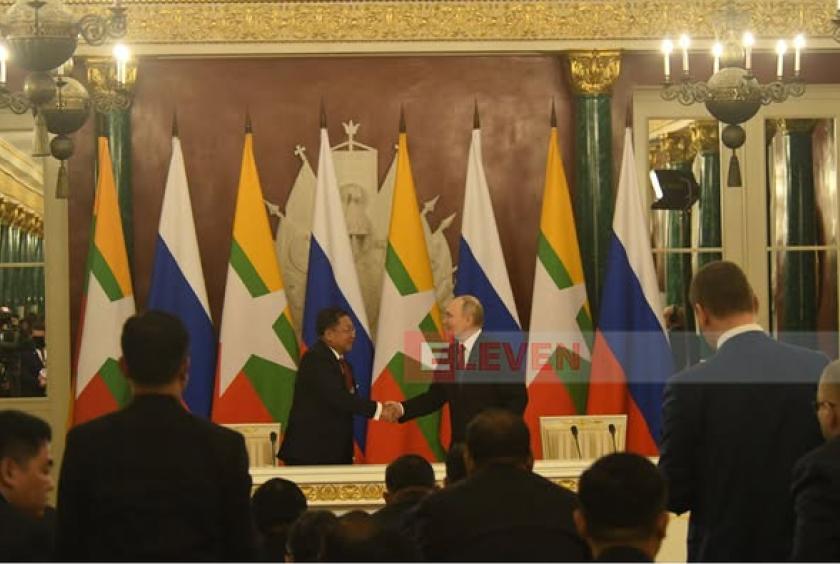
During an official visit to Russia at the invitation of Russian President Vladimir Vladimirovich Putin, Chairman of the State Administration Council (SAC) Senior General Min Aung Hlaing, held a bilateral meeting with the Russian President at the Kremlin in Moscow on March 4.
The two leaders had a private discussion, during which President Putin warmly welcomed Senior General Min Aung Hlaing. The meeting was attended by high-ranking officials from both countries, including Myanmar's Foreign Minister U Than Swe, other Union Ministers, and Myanmar’s Ambassador to Russia, as well as Russian ministers and senior government officials.
Following the discussions, both sides exchanged views on strengthening bilateral relations and cooperation in various sectors, including investment, education, defense, healthcare, and other key areas. The leaders also participated in an extended meeting where ministers from both countries deliberated on economic collaboration, trade, scientific and technological cooperation, space exploration, and other potential joint initiatives.
As part of the visit, Myanmar and Russia signed and exchanged 10 agreements and memoranda of understanding (MoUs) between their respective governments. These included agreements on mutual recognition of academic degrees and qualifications, customs cooperation, healthcare collaboration, cultural and sports partnerships, and peaceful nuclear energy cooperation. A key MoU focused on nuclear safety regulations and radiation protection in the peaceful use of atomic energy. Additional agreements covered joint geological exploration, mining cooperation, peaceful space exploration, and increased investment protection.
Myanmar’s Ambassador to Russia and relevant Union Ministers signed these agreements alongside their Russian counterparts in the presence of Senior General Min Aung Hlaing and President Putin. Following the signing ceremony, both leaders addressed the media, highlighting the significance of their agreements and reaffirming their commitment to strengthening bilateral ties.