
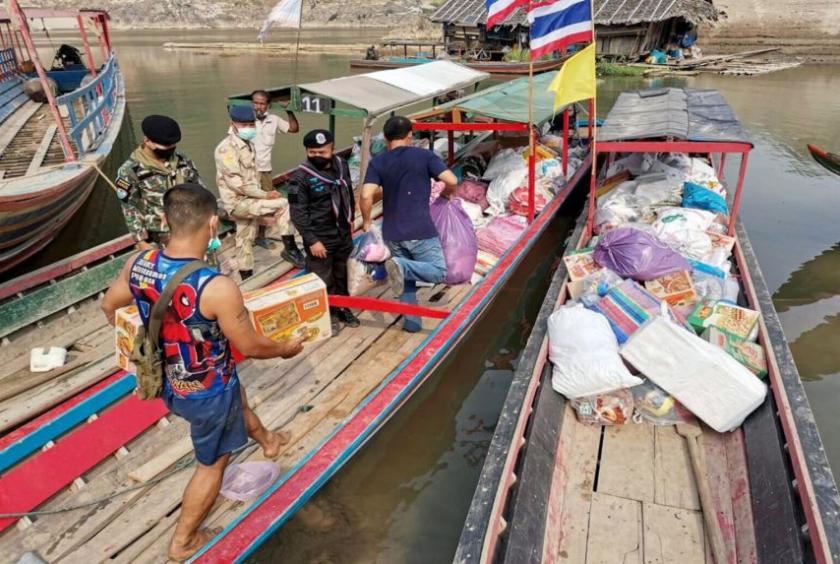
As a 'front-line state, Thailand has much at stake. PM Prayut can do more with his shared bonds and experience to help Asean find a political compromise in Myanmar.
Few countries have more at stake in the intensifying political crisis in Myanmar than Thailand.
As the birthplace and co-founder of Asean, Thailand finds itself being pushed into an increasingly pressing diplomatic and humanitarian role. As an immediate neighbour, Thailand will find it hard to escape the fallout as the death toll rises and the Myanmar economy collapses in the growing confrontation between the civilian opposition and the Tatmadaw following the Feb 1 coup by Senior General Min Aung Hlaing.
In similar crises in the past, Thailand, together with Indonesia, has led the way for Asean to play an instrumental regional role.
The political settlement in Cambodia's long-running conflict in the early 1990s and the more recent international intervention for humanitarian assistance during Myanmar's devastating Cyclone Nargis in 2008 - the latter mediated by the late Mr Surin Pitsuwan, then Asean secretary-general and former Thai foreign minister - come to mind.
But this time, no such diplomatic breakthroughs appear as yet in the offing, even though the Tatmadaw and Thai army enjoy close and deep bonds.
Cut from the same cloth
There are two main reasons why Thailand has not fully deployed its time-tested diplomatic skills in this crisis.
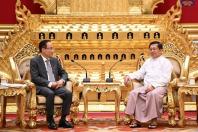
First, Thai Prime Minister Prayut Chan-o-cha is cut from the same army cloth as Gen Min Aung Hlaing. In May 2014, as then commander in chief of the army, Mr Prayut led Thailand's most recent coup. Since then, Thailand may have returned to civilian rule and held an election in 2019, but this was done under a military-drafted 2017 Constitution with a facade of democratic legitimacy.
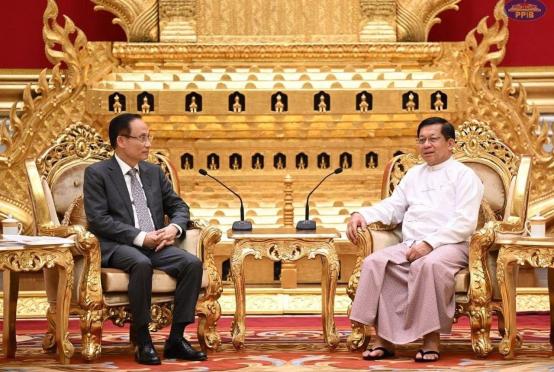
Unsurprisingly, Gen Min Aung Hlaing visited Bangkok less than two months after the Thai putsch and later reached out to Mr Prayut with a written request for support just days after Myanmar's coup.
Less well known perhaps is that the Myanmar junta boss considers himself an adopted son of the late General Prem Tinsulanonda, former Thai prime minister and president of the Privy Council. In 2012, after becoming chief of the armed forces and a decade since his own father had died, Gen Min Aung Hlaing sought tutelage from the nonagenarian Gen Prem, forming a father-son rapport. The Myanmar general visited Gen Prem regularly and flew in for a same-day remembrance at the latter's funeral in May 2019.
With its close ties to Gen Min Aung Hlaing, the Thai military establishment should be able to find receptive ears in Naypyitaw.
But the government under Mr Prayut has so far held off from any strong response to Tatmadaw-perpetrated violence against unarmed protesters. It is a "pot and kettle" situation as Mr Prayut's military-backed government has locked up young pro-democracy protesters on dubious charges and suppressed civil liberties.
The only difference is that Thailand's crackdown on civil society is less raw and brutal, and it is dressed up with a semblance of legal and constitutional processes and passable political arrangements that the Myanmar brass would like to replicate.
The other restraining factor on Thailand is its reliance on Myanmar's natural gas - nearly 30 per cent of Thai electricity derives from imported gas from next door. Close military-military relations notwithstanding, the Thai authorities cannot afford to alienate Myanmar's military regime because Thailand's energy security depends on it. The same logic applies to China's southern region up to a point.
The upshot is that the Tatmadaw is not only able to hold the ground at home, but it also has considerable clout in its immediate neighbourhood to withstand sanctions and other forms of foreign pressure.
Given the constraints, what can Thailand do? For starters, the Thai foreign policy establishment needs to be more assertive in persuading and prevailing on the Thai military to fulfil the country's moral obligation on humanitarian grounds by letting Myanmar asylum seekers and refugees into the country rather than turning them away.
Mr Prayut can also make better use of his links to the Tatmadaw leadership and his coup experience to help Myanmar find a way to get off a path that leads to more violence. If the Thai leader were to play a more active role, he could create diplomatic space for Asean to wiggle a face-saving bargain for Myanmar's military forces and civilian defenders to step back from the brink.
Professor Thitinan Pongsudhirak is director of the Institute of Security and International Studies at Chulalongkorn University's Faculty of Political Science in Bangkok.