
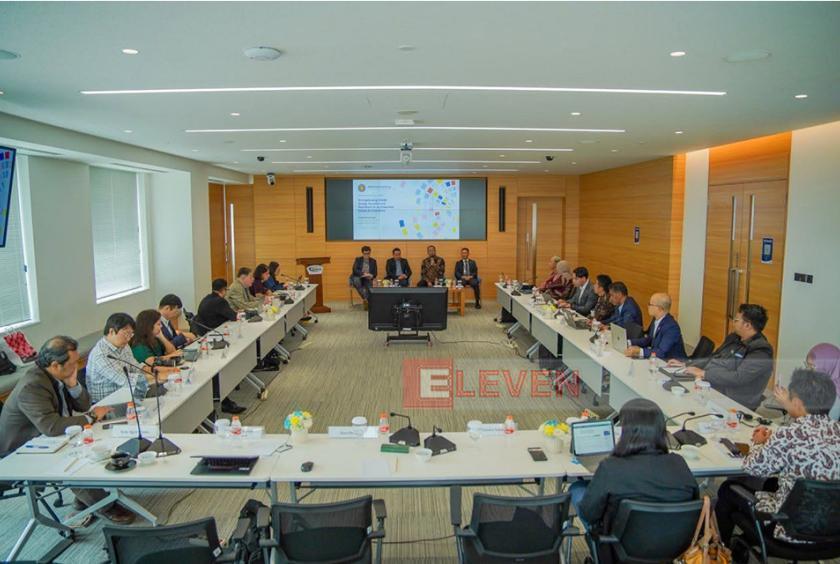
The second East Asia Media Caucus, organized by the Economic Research Institute for ASEAN and East Asia (ERIA), was held in Jakarta, Indonesia, on November 6, with Eleven Media Group Senior Editor Ko Aung Min Thant attending and covering the event.
The forum, titled “Enhancing ASEAN Energy Security and Advancing Green Economic Development,” was held at ERIA headquarters on the 15th floor of Sentral Senayan II Tower in Jakarta. A total of 32 journalists were invited to attend and cover the event, including 17 media representatives from ASEAN and ERIA member countries and 15 local journalists based in Jakarta.
The forum featured three sessions covering the following topics: (1) “Strengthening ASEAN Energy Security and Resilience in an Uncertain Global Landscape”; (2) “Green Economic Development, Digital Transformation and Corridors of Prosperity in ASEAN”; and (3) “The Role of Media in Communicating ASEAN’s Challenges and Opportunities.”
ERIA Chief Operating Officer Mr. Takayuki Yamanaka delivered the opening remarks, highlighting that recent disruptions to global energy supplies had underscored the importance of preparedness and regional cooperation. He also noted that green economic development and digital transformation had the potential to strengthen ASEAN’s competitiveness and regional economic integration.
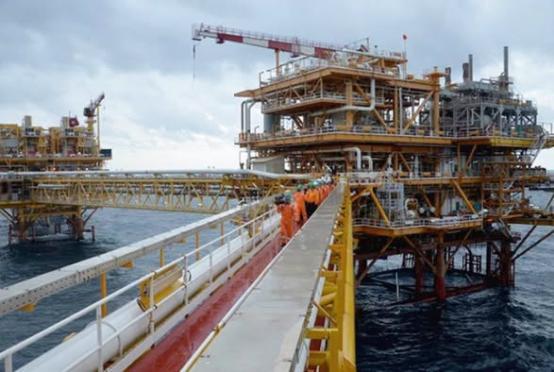
The first session, titled “Strengthening ASEAN Energy Security and Resilience in an Uncertain Global Landscape,” was held from 9:15 am to 10:30 am. Dr. Nuki Agya Utama, Director of Energy Policy at ERIA and Head of the Asia Zero Emission Center, served as moderator. The panelists included Mr. Yudiandra Yuwono, Senior Energy Systems Modelling Analyst at the ASEAN Centre for Energy; Mr. Sri Konsep Harum Wicaksono, Head of the ASCOPE Secretariat, an organization promoting cooperation among ASEAN countries in the oil and gas sectors; and Dr. Han Phoumin, Senior Energy Economist at ERIA.
Dr. Han Phoumin said that having access to emergency oil stockpiles was only the first step. He emphasized that countries needed clear procedures governing when and how to release oil reserves, appropriate fuel types and the capacity to transport supplies to areas where they were needed. He also recommended that governments and industry operators conduct voluntary pilot programmes to test these arrangements before energy disruptions occurred.
Journalists and energy experts subsequently exchanged views on verifying information during energy supply disruptions, presenting research findings in ways that the public could understand, assessing how regional policy proposals might affect local communities, and monitoring and reporting on the impacts of policy implementation on businesses and consumers. Journalists and editors also discussed the importance of continuing to monitor and report on policies beyond their announcement stage and throughout their actual implementation.
The second session, titled “Green Economic Development, Digital Transformation and Corridors of Prosperity in ASEAN,” was held from 10:30 am to 11:30 am. The discussion featured Dr. Intan Murnira Ramli, Senior Policy Researcher at ERIA, and Dr. Ahmad Zafarullah Abd Jalil, Director of the ASEAN Integration Monitoring Directorate at the ASEAN Secretariat.
The third session, titled “The Role of Media in Communicating ASEAN’s Challenges and Opportunities,” took place from 1:30 pm to 3:30 pm. Kavi Chongkittavorn, Senior Communications Advisor at ERIA, served as moderator. Panelists included Franc Han Shih of Thailand-based The Nation newspaper, Ko Hirano of Japan-based Kyodo News, Evgeny Belenkiy, Editor-in-Chief of Russia-based Rossiya Segodnya Media Group, and Ismira Lutfia of Malaysia-based Berita Harian newspaper.
During the session, journalists from the Philippines, Brunei, Myanmar, Indonesia, Vietnam, Australia and Timor-Leste exchanged views on how traditional media could continue delivering accurate and reliable information in accordance with journalistic ethics, despite facing competition from widely circulated popular content on social media platforms such as TikTok and Instagram. They also discussed the growing reliance on artificial intelligence (AI) and the importance of maintaining on-the-ground reporting, which AI cannot do, including gathering local perspectives and producing well-verified news reports.
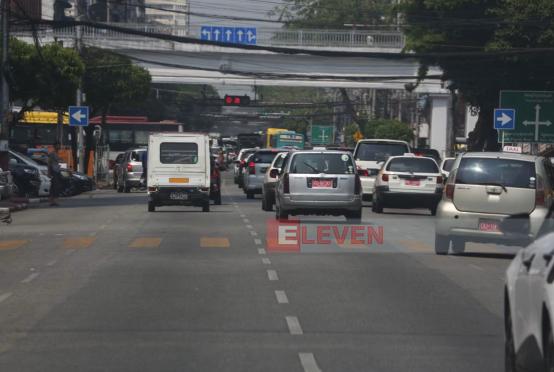
Speaking about Myanmar’s response to energy crises, Ko Aung Min Thant shared his country's experience, saying:
“Based on Myanmar’s experience, we have found that fuel shortages cannot be addressed solely through consumption restrictions. During periods of fuel scarcity, government authorities introduced measures such as fuel rationing, QR code-based fuel distribution systems and vehicle-use restrictions based on odd and even number plates. However, if a country is heavily dependent on imported fuel and lacks sufficient storage capacity, it cannot fully resolve the underlying problem. Myanmar’s experience demonstrates the importance of combining immediate crisis response measures with long-term energy security planning.”
ERIA is a prominent international research organization in Southeast Asia and East Asia. Its establishment was agreed upon by 16 national leaders at the Third East Asia Summit, held in Singapore on November 21, 2007, and it began operations in 2008.
ERIA's member countries include Australia, Brunei, Cambodia, China, India, Indonesia, Japan, Laos, Malaysia, Myanmar, New Zealand, South Korea, Singapore, Thailand, Timor-Leste, the Philippines and Vietnam. Its headquarters is located in Jakarta, Indonesia.
ERIA has three main objectives: promoting trade, investment and economic cooperation among ASEAN and East Asian countries; narrowing the development gap between developed and developing countries; and advancing energy security, climate change initiatives, environmental protection and sustainable economic development. Its research areas include energy security, oil, natural gas, economic development, trade, investment, climate change, the digital economy, food security and healthcare.