
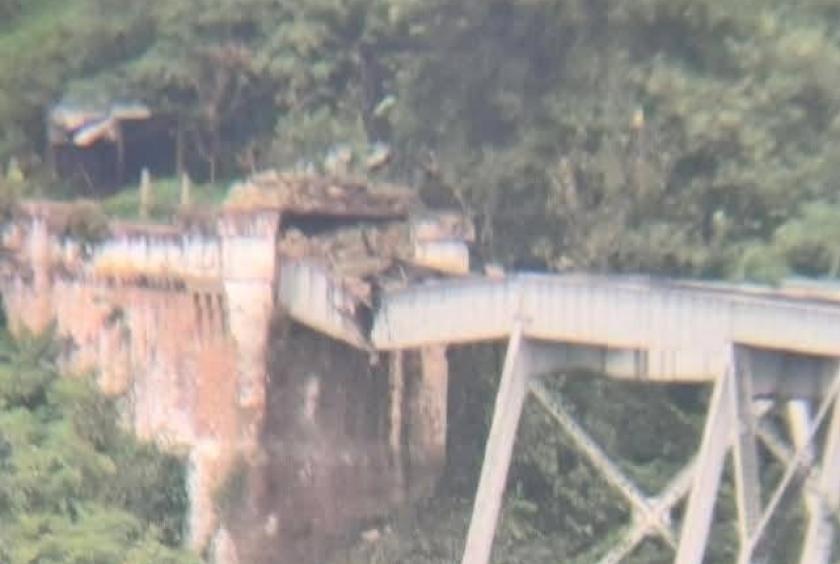
Criticism is mounting against the Ta’ang National Liberation Army (TNLA), labeled as a terrorist insurgent group, for detonating explosives that destroyed the 125-year-old Gokteik Bridge, a world heritage site located in northern Shan State.
It has been reported that the TNLA carried out the bombing of the Gokteik Bridge, a historical landmark, in the early morning of August 24. According to investigations by Eleven Media Group, the TNLA had pre-planned the attack, planting explosives to demolish the bridge.
The destruction of the 125-year-old world heritage Gokteik Bridge by the TNLA has sparked intense condemnation, particularly among social media users.
Thein Win Oo, a social media user, wrote, “It has been reported that the Palaung (Ta’ang) insurgents planted explosives and destroyed the 125-year-old world heritage Gokteik Bridge.”
Another user, Ye Min Thant, commented, “Since independence, no armed group has ever touched this world-famous bridge, which is over a century old. Now, reports indicate that the TNLA Palaung group is responsible for this act. They should not have targeted a historically significant, world-renowned bridge. Insurgents do what they do, but on the other hand, this incident also stems from those who failed to fulfill their responsibilities and neglected their duties, allowing such acts to occur. Those in charge also bear responsibility for the rise of insurgents in the country.”
Similarly, social media user Khin Maung Tun wrote, “The Gokteik Bridge has been destroyed. No armed group has touched this world-famous, 125-year-old bridge since independence. Reports suggest that the TNLA is behind this act. Losing groups often destroy infrastructure, but they should not have targeted this historically significant, world-renowned bridge.”
Another user, Sawnilar Than, expressed outrage, stating, “This is directed at those who don’t deserve to be called human. You shouldn’t touch what shouldn’t be touched. To think that you dared to destroy such a beautiful and magnificent bridge!”
Local sources indicate that the TNLA carried out the bombing in response to the Myanmar military’s preparations for an offensive in Kyaukme.
A political analyst commented, “The destruction of the Gokteik Bridge is an utterly unacceptable terrorist act by the TNLA. No ethnic revolutionary organization (ERO) has ever done something like this in over 100 years. This cannot be tolerated. I believe the TNLA should be designated as a terrorist organization, and their bases and headquarters in places like Mantong and Namhsan should not be left untouched.”
In February 2025, the TNLA also faced strong condemnation from Shan civil society organizations for replacing a Shan cultural symbol at the entrance to Hsipaw town with a Palaung (Ta’ang) symbol. This replacement took place starting February 7, 2025, when the TNLA substituted the Shan symbol with a Ta’ang ethnic symbol.
The Shan State Joint Action Committee (SSJAC) reported on February 10 that the TNLA has been involved in destroying the historical heritage of the Shan people in Shan State, including similar actions in previous years in areas such as Mongyu in Kutkhai Township and Mongyin in Namtu Township.
Additionally, on August 7, 2023, the TNLA demolished the old palace walls of Sao Hsen Khan Pha, a revered Shan leader, in Sailan village, Muse Township, using bulldozers, according to SSJAC’s statement.
In 2024, the TNLA also reportedly attempted to revise household registration records in the Ta’ang language in 10 townships under their control, despite the majority of residents being Shan and Bamar (Burman). Local residents expressed concerns about potential language barriers due to these actions.
During the 1027 Operation (Part 1), the TNLA seized control of Namtu, Namhsan, Namkham, Kutkhai, Mantong, Monglong, and Mongngaw townships. In Part 2 of the operation, which began on June 25, 2025, the TNLA took control of Nawngkhio , Kyaukme, Hsipaw, Mogok, and Momeik townships, according to their statements.
In Namhsan and Mantong townships, which are part of the Palaung Self-Administered Zone, approximately 90% and 70% of the population are Palaung, respectively, with Kachin making up about 12% in Mantong, according to the Township General Administration Department.
The TNLA, during Operation 1027 Parts 1 and 2, reportedly seized 12 towns, though in terms of townships, they control only 10.
Additionally, in Mogok Township, Mandalay Region, which is controlled by the TNLA and the Mandalay People’s Defense Force (MDY PDF), records from the Township General Administration Department show no Palaung (Ta’ang) population listed among the residents.
In Mogok Township, the majority of residents are Bamar (42%), Kachin (21%), and Shan (19%), with smaller percentages of Kayah, Karen, Chin, Mon, and Rakhine populations, according to the Township General Administration Department.
However, in other controlled townships like Namtu, Namkham, Kutkhai, Kyaukme, Nawngkhio, Hsipaw, and Momeik, the Palaung population is minimal.
Therefore, regarding reports that the TNLA is revising household registration records in the Ta’ang language in the townships it controls, other ethnic groups residing in these townships are expressing concerns about potential language barriers.
Similarly, in Lashio Township, controlled by the Myanmar National Democratic Alliance Army (MNDAA), a member of the Northern Alliance, 30% of the population is Shan, 18% is Bamar, approximately 23% is Kokang, and 9% is Palaung.
The TNLA, in collaboration with Northern Alliance groups, initiated conflicts in northern Shan State on October 27, 2023, and seized several towns, including those in the Palaung Self-Administered Zone.
The MNDAA, TNLA, and Arakan Army (AA) were designated as terrorist organizations by the Central Committee for Counter-Terrorism on September 2, 2024.