
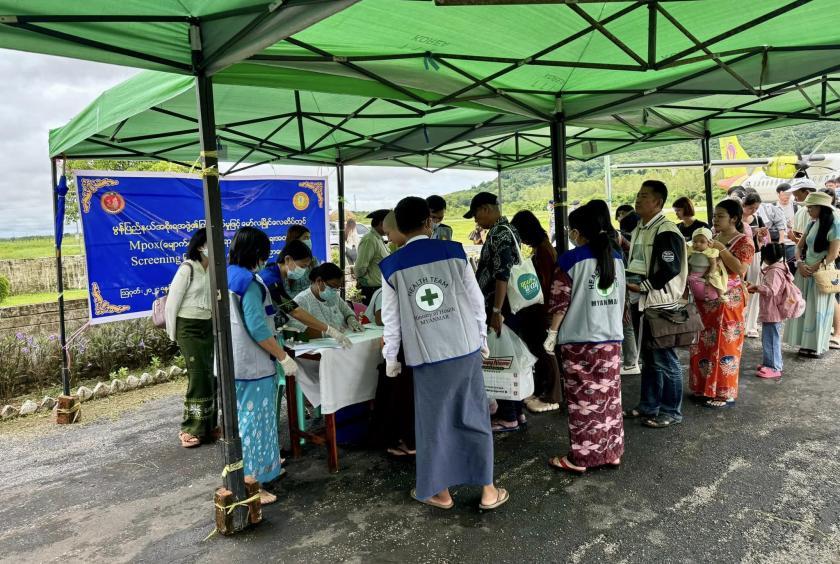
All returnees from abroad must fill out their travel history to prevent Mpox (monkey pox) infection, according to those returning from abroad.
Since August 21, all returnees from abroad have been asked to fill in their travel history to prevent Mpox infection, said some returnees.
"I had to fill out the forms on August 22. In the past, it was for Covid-19 and now for monkey pox. When I asked the person responsible, they said it started on August 21," said a returnee from abroad.
In addition, those travelling by domestic airlines also undergo a health check-up at the airport upon arrival, and health education related to monkey pox is being done by relevant authorities, said a person who travelled by air to Mawlamyine.
"When I returned to Mawlamyine from Yangon, they took my temperature at Mawlamyine Airport. It is also in Yangon. In Yangon, you will see a body temperature gauge. In Mawlamyine, I saw ambulances ready. They measured body temperature. And they also gave us handouts. If there is someone with a high temperature on the plane, everyone will be quarantined," said a person who travelled to Mawlamyine on August 23.
During 2024, due to the increase of the epidemic rate of MPox in Congo (DRC) and African countries, the rapid spread of a new strain (Clade lb) in eastern Congo and the presence of cross-border and international transmission, the World Health Organization (WHO) has announced that the outbreak of Mpox was declared an international public health emergency on August 14, 2024.
The Ministry of Health (MOH) announced that the Mpox can be spread mainly through sexually transmitted, skin contact, transmission through close face-to-face contact, handling and touching infected objects, and direct contact with an infected animal.
The MOH announced to avoid close contact with a person suffering from suspected symptoms of MPox, to wear glove and mask if close contact cannot be avoided, to wash hands properly using soap and water or waterless hand sanitizer, and to wear gloves and mask to touch personal items of people with suspected symptoms.
The MOH has announced that people who get sick and have blisters with red spots on face, hand, leg, mouth and genitals, swelling of lymph nodes, headache, muscle pain, and having symptoms such as tiredness and fatigue, and people, who have come into contact with people suffering from symptoms of fever and red spots and blisters (especially those who have returned within the last 21 days from countries and areas where the infection was detected), should avoid international or domestic travel and report to the nearest health center as soon as possible for treatment.