
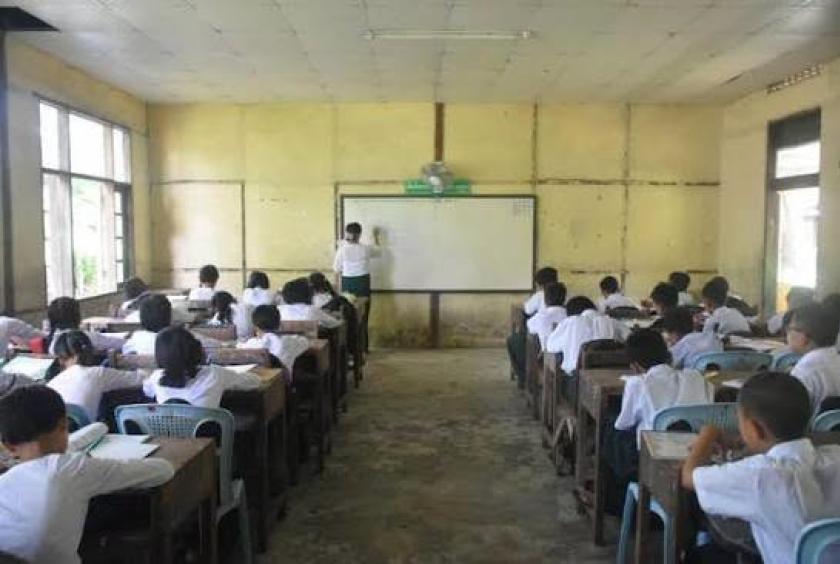
Education authorities have issued 44 directives for private schools, including a ban on operating in apartment buildings and detached houses, requirements for playgrounds, and a minimum separation of 1,000 yards between government and private schools, as well as between private schools, according to education sector sources.
Education-related meetings were held in several districts of Yangon Region in recent days, where these matters were reportedly discussed.
“Forty-four directives have been issued. They include requirements for playgrounds and minimum building dimensions. For example, science laboratories must also meet specified space requirements. Government schools and private schools must be at least 1,000 yards apart, meaning schools cannot operate within that distance of one another. These are among the requirements. Official notifications have been issued through the administrative chain, from the head office to the region, then to districts and townships,” a district education officer said.
The directives were issued about two weeks ago, and the relevant education departments have since been notifying private schools of the requirements, according to education sector sources.
“There are schools operating in detached houses and apartment buildings in Yangon. Under these regulations, many schools could fail to qualify for licences and may have to close. The 1,000-yard distance requirement will also apply,” an official from a private school said.
Previously, the Ministry of Education had granted private schools permitted to operate in the 2026–2027 academic year a one-year grace period to make adjustments to comply with requirements concerning school facilities, building standards, premises size and classroom capacity. In the 2027–2028 academic year, township, district and regional education officers, local supervisory bodies and private school supervisory committees will inspect schools to determine whether they comply with the Ministry of Education’s standards. Only private schools that meet the requirements will be allowed to register, according to reports.
“If schools apply for permission to operate next year, the requirements are likely to become stricter. Schools that have already been granted permission will retain their existing status, while those that have completed registration can continue operating until their registration expires,” an education expert said.
Private school registration licences are issued for specified periods, such as five years or two years. When schools apply for renewal, Ministry of Education officials conduct further inspections to determine whether they meet the prescribed requirements before extending their licences.
A total of 252 international schools teaching international curricula have been authorised to operate across Myanmar, including in Yangon. The Ministry of Education began reviewing and approving these institutions as private schools offering international curricula starting from the 2024–2025 and 2025–2026 academic years.
Of the authorised international schools, 161 are listed in Yangon. However, some operate multiple campuses in different townships under the same name, meaning the actual number of international school operators or campuses in Yangon Region is estimated at just over 130. Mandalay Region has 49 international schools, while Nay Pyi Taw has six. Schools have also been authorised to operate in Kachin, Shan, Sagaing and Magway, among other regions and states. In addition, a total of 1,749 private basic education schools following the national curriculum had been authorised to operate nationwide as of the 2026–2027 academic year. Of these, 360 were newly opened in the current academic year.