
Parents and members of the public are calling for private and international schools that fail to meet regulations, particularly those operating in residential buildings, narrow neighbourhood streets, no-parking zones and shopping centres, to be barred from operating, while government schools should be upgraded, according to reports.
The Ministry of Education has announced that private schools that exceed their approved capacity based on school facilities and floor-space requirements, or that have insufficient classrooms, will be granted a temporary one-year period to make improvements. Only schools that meet the prescribed standards will be allowed to register as private schools.
“Some schools are operating inside neighbourhoods and detached houses. During the dismissal times, cars can no longer get through. Drivers also have to be extremely careful of the children,” said a motorist in Yangon. Some schools have drawn criticism from residents for operating in narrow residential streets and apartment or condominium buildings, failing to meet school standards and causing traffic congestion during dismissal times.
The Ministry of Education has also announced that private schools must meet specific requirements to obtain registration for the next academic year, and those that fail to fulfil the requirements will not be granted registration.
According to the ministry, private schools authorised to operate in the 2026–2027 academic year that have exceeded the prescribed standards for facilities, floor space and student capacity, or that have insufficient classrooms, have been granted a temporary one-year period to make improvements during the current academic year. For the 2027–2028 academic year, township, district and regional education officers, local supervisory teams and private-school supervisory bodies will inspect schools to determine whether they comply with ministry standards. Only those meeting the requirements will be permitted to register as private schools. However, some private schools in Yangon are reportedly operating in residential buildings, narrow neighbourhood streets, no-parking zones and shopping centres, despite failing to meet the ministry's requirements, according to sources in the private education sector.
“There are many schools in Yangon operating in shopping centres. Others rent detached houses and run schools there. They do not meet the requirements. There are quite a lot of them, and whether they even have licences is a question. If there are around 100 licensed schools, the number operating without licences could be even higher,” said an education expert.
The ministry's requirements for private basic education schools following the national curriculum and private international schools stipulate that primary-level classrooms must provide at least 12 square feet of floor space per student and be at least 15 feet wide, with no more than 40 students per classroom.
Similarly, at middle and high school levels, classrooms must provide at least 18 square feet of floor space per student and be at least 20 feet wide, with no more than 40 students per classroom.
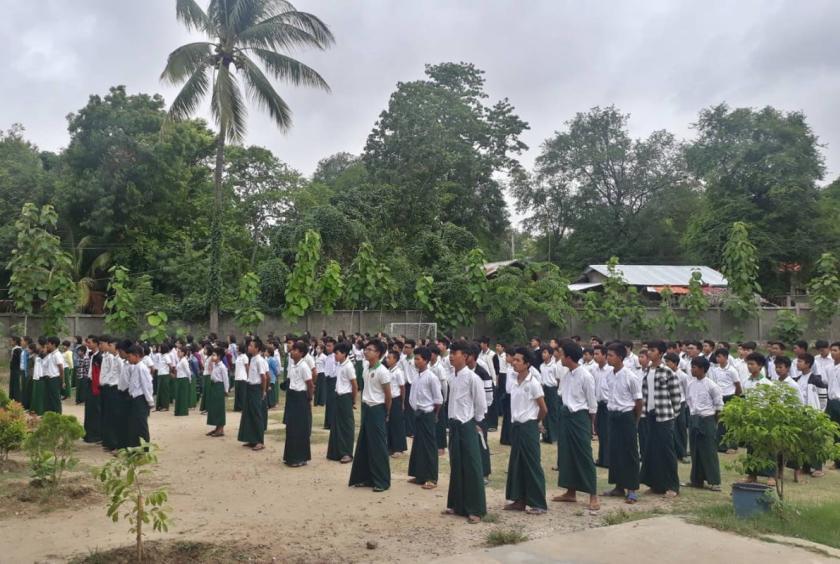
Private basic education schools following the national curriculum must salute the national flag and sing the national anthem, while adhering to the opening and closing dates and teaching schedules of government schools.
International schools must also comply with the provisions of the Private Education Law. Students must salute the national flag and sing the national anthem at daily school attendance. To promote national spirit among Myanmar students and preserve Myanmar culture, international schools must teach Myanmar language, Myanmar history and Myanmar geography in accordance with curricula developed by the National Curriculum Committee.
Foreign students at international schools who wish to study Myanmar language must also be taught according to the National Curriculum Committee's curriculum appropriate to their educational level. In addition, private schools must provide facilities including classrooms, laboratories, libraries, sports halls and dining halls within their premises.
The Ministry of Education has authorised 252 private international schools across Myanmar, including Yangon and other regions and states. These schools were vetted and approved to operate as private schools offering international curricula beginning in the 2024–2025 and 2025–2026 academic years.
Of the 252 international schools, 161 are in Yangon. Some operate multiple branches under the same name in different townships, meaning the actual number of international school operators in Yangon Region is estimated to be just over 130. Mandalay Region has 49 schools, Nay Pyi Taw has six, and international schools have also been authorised to operate in other areas such as Kachin, Shan, Sagaing and Magway.
As of the 2026–2027 academic year, a total of 1,749 private basic education schools following the national curriculum have been authorised to operate nationwide, including 360 newly opened schools this year. A parent said the authorised private and international schools should be inspected to determine whether they comply with the prescribed regulations, with inspections involving ward administrators, township education officials and other responsible authorities. The parent also called for oversight to prevent corruption during the inspection process.
“Recently, there have been reports circulating online about fights at some schools. Just the other day, allegations involving rape at an international school also surfaced online, although it is not clear whether they are accurate. There must be measures to prevent such incidents and proper procedures for dealing with them if they occur. As schools become more numerous, parents need to know what is happening at each school. They need to know whether schools are genuinely committed to education or are simply operating to make money. Parents want to send their children to schools that provide proper education and comply with regulations,” the parent said.
An owner of a private school said government schools, which provide free education, often lack adequate teaching resources and facilities, leading parents to favour private and international schools. However, he stressed that children born in Myanmar should not be deprived of important elements of national identity, including Myanmar language, geography, history, culture and the national anthem. He said a parent who had approached his school while considering transferring a child from a school in Upper Myanmar had asked whether the school taught Myanmar language, history and culture and required students to sing the national anthem. After being told that these subjects and activities were properly included, the parent chose not to enrol the child there. Instead, the child reportedly enrolled at another nearby school. He said such developments were detrimental to children's future and the country, and called for closer scrutiny of international schools that do not properly teach the national anthem, Myanmar language, history, geography and culture. He also urged relevant ministries and, where necessary, joint inspection teams to investigate reports of psychological and teaching-related problems involving some teachers, as well as allegations concerning drugs and sexual harassment. He added that dual-curriculum and international schools should not be left without oversight.
Looking at Thailand, Myanmar's neighbour, secondary schools are divided into government and private institutions. Most students attend government schools, although some are enrolled in private schools.
According to student enrolment figures for Thailand's 2024 academic year, approximately 85 per cent of lower-secondary students attended government schools, while more than 14 per cent attended private schools. At upper-secondary level, more than 79 per cent attended government schools and over 20 per cent attended private schools.
Students at government schools in Thailand can attend tuition-free, although they still incur expenses for uniforms, teaching materials and other services.
International schools in Thailand are also required to teach Thai language, culture and history, with differences in curricula and teaching levels for Thai and foreign students.
Similarly, IGCSE schools in Thailand place emphasis on Thai reading, writing and speaking skills, while foreign students are taught language, culture and history useful for living in Thailand.
As private and international schools continue to increase in Myanmar year after year, enrolment at government schools is declining. When international and private schools that fail to meet prescribed standards are denied registration and permission to operate, the government should arrange alternative placements for affected students and give schools and parents sufficient time to prepare for the transition, sources said.
An education expert said parents should check not only whether schools have licences but also whether they meet the Ministry of Education's requirements, including the availability of playgrounds, assembly areas, sufficient classrooms and adequate capacity for students. Parents should also verify whether schools require students to sing the national anthem and teach Myanmar language. If parents enrol their children and the school is later found to be non-compliant and has to close, both parents and children will suffer.
A Yangon resident also criticised the rapid proliferation of private schools, saying, “Private schools are now springing up everywhere, in narrow streets and residential neighbourhoods. Education is being treated as a highly profitable business. Travelling during school opening and dismissal times is extremely difficult because of traffic congestion, with vehicles sometimes stuck for hours. In areas such as Shwe Taung Kyar in Bahan Township, there are numerous international schools, and traffic becomes heavily congested when students leave school. The situation is even worse during heavy rain and flooding. Schools in downtown areas such as Bahan, Kamayut, Tamwe and Sanchaung should be thoroughly inspected. Some are operating on roads where parking is prohibited, without providing parking facilities or playgrounds for children. It is inappropriate to allow international schools to operate under such conditions. These schools should be carefully inspected, and even those that have been granted licences should not be allowed to operate if they fail to meet the required standards.”
President U Min Aung Hlaing has said that spending on the education sector will be increased to more than 10 per cent of the national budget in the coming fiscal year.
During the current 2026–2027 fiscal year, the Ministry of Education has been allocated 6.92 per cent of the national budget. Including education-related expenditures by other ministries, total spending on education is reportedly 9.22 per cent.
Education sector sources said government schools should be upgraded, school buildings renovated, teachers' salaries increased and refresher training courses provided to improve enrolment at free government schools.
An owner of a private school said the Ministry of Education should develop short- and long-term plans to significantly upgrade free government schools. Teachers should receive refresher training to improve their teaching quality, while facilities at government schools should also be upgraded. The President had stated in his inaugural address that education spending would be increased to more than 10 per cent of the national budget, with plans to raise it to as much as 15 per cent in the near future. The owner also called for stricter enforcement of regulations governing private schools, saying that unlicensed schools and those that fail to comply with the rules should be thoroughly inspected, and schools facing closure should be notified in advance so they can prepare for the following academic year. He criticised private schools that do not properly teach the national anthem or Myanmar language, noting that even in Thailand, students are taught Thai language and culture, as is the practice in other countries. He stressed that citizens should learn their own national anthem, language and culture, and said enforcement in these areas appeared to be weak. He also alleged that some school operators failed to make adequate investments, instead charging high fees to the public and parents while seeking to profit from education. Some, he said, had formed private school associations not to seek concessions from the government or ministries, but should first ensure that their own schools comply with the regulations. He added that reports of some schools operating merely to prepare students for examinations, without providing a proper education, should be investigated and such practices should not be permitted. Some schools, he said, were operating in cramped premises along narrow streets without licences. However, he acknowledged that some private schools performed very well, achieving annual pass rates of more than 90 per cent and providing spacious campuses, playgrounds and good teaching facilities that in some cases surpassed those of international schools.
While some have called for restrictions or bans on the establishment of private and international schools, others stressed that these schools contribute to the education sector and that the Ministry of Education should focus on ensuring that they are properly inspected and authorised in accordance with regulations.
A private school owner said the Ministry of Education and relevant organisations must systematically inspect private and international schools. He also cautioned that some officials should not exert pressure on or harass school founders who genuinely invest in education and seek to contribute to the country. Establishing a school, he said, is a worthwhile contribution to the nation and should not be treated like an illegal online scam operation. He added that it was inappropriate to threaten prospective school operators with prison terms under various laws before their schools had even been established. In particular, corruption must be prevented, as the promotion or appointment of corrupt officials would undermine the system. He said free government schools should also receive sufficient budgetary support to improve their standards, while private and international schools should be effectively inspected and supervised. Such inspections, he stressed, should be conducted systematically and free from corruption at every level, from ward administrators and township education officers to district and regional education officials and the General Administration Department. He also called for anti-corruption bodies to participate in the inspections, noting that the private education sector is important to the country and requires transparent and accountable oversight.