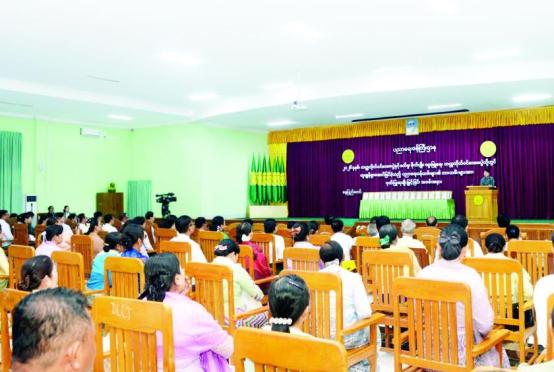

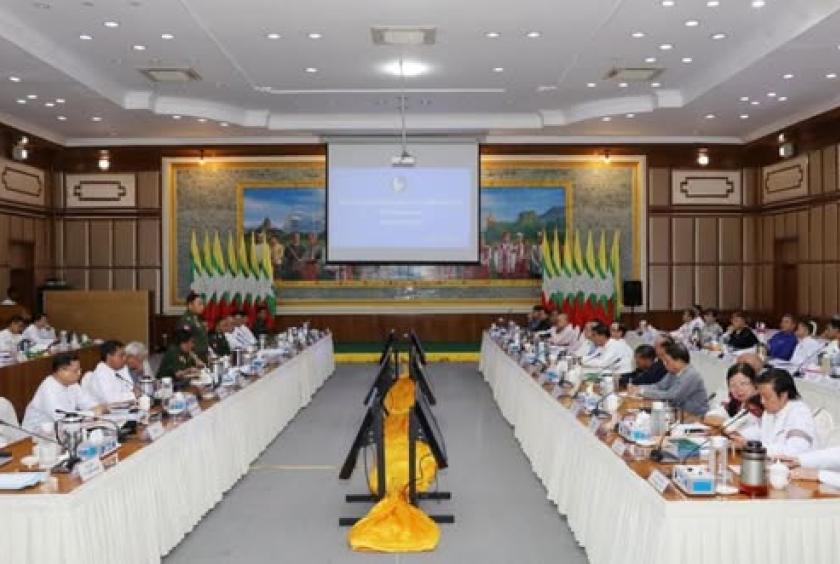
The second day of a meeting between the National Solidarity and Peacemaking Negotiation Coordination Committee (NSPNC) and representatives of a grouping of political parties was held in Nay Pyi Daw on September 18.
The meeting was held at the NSPNC, Office No. 20, with the aim of discussing and coordinating with political parties on the peace process, as well as efforts to achieve lasting peace and build a Union based on democracy and a federal system.
During the meeting, NSPNC Chairman Lieutenant General Yar Pyae discussed the arrangements for upcoming talks between the NSPNC and political parties, the issues to be discussed and coordinated, and the peace process to be carried forward.
NSPNC member retired Lieutenant General Aye Win also explained the selection of the working group for the political parties’ grouping and the voting process. Representatives from the 32 political parties attending the meeting exchanged views and made recommendations on the proposed voting arrangements.
The meeting subsequently confirmed the selection of 16 representatives for the permanent working group and 16 representatives as rotating members of the political parties’ grouping.
In the afternoon, the participants discussed issues related to the continuation of the working group of the political parties, ways for political parties to participate in political dialogue, the return of conflict-affected areas to their previous form, the transformation process for the future peace process, issues related to the amendment of the (2008) Constitution, relations between the Union Government and the Region/State Governments, the role of political parties in enhancing engagement with organizations that have not yet participated in the peace talks, and the issue of implementing the Ceasefire through bilateral meetings.
Then, the Secretary of the National Unity and Peacemaking Coordination Committee, Lt. Gen. Min Naing, highlighted the two-day discussions on constitutional and federal issues, the role of political parties, the connection between the Ceasefire and the Political Dialogue, the security and socio-economic needs of the local population, the participation of women in the peace process, and the re-deployment of those with experience from previous peace mechanisms. International and diplomatic relations, and ways to engage with new armed groups emerging in the current conflict were reviewed and discussed.
The working group leader of the political parties’ group, Dr. Aung Myat Oo, member of the Central Executive Committee of the Union Solidarity and Development Party, and the Chairman of the National Unity and Peacemaking Coordination Committee, Lt. Gen. Ya Pyae, delivered concluding remarks.
The meeting was attended by the Chairman of the National Unity and Peacemaking Coordination Committee, Lt. Gen. Ya Pyae, members of the Coordination Committee, members of the Union Election Commission, chairmen, vice chairmen, general secretaries, members of the Central Executive Committee and officials from 32 political parties’ groups.