
Sri Lanka is in urgent need of foreign assistance as it faces the worst economic crisis throughout history.
Schools had to be closed due to severe fuel shortages. The prime minister of Sri Lanka said there was a problem with seeking IMF loans amid the country’s financial crisis.
Not Sri Lanka alone is facing skyrocketing prices of food and fuel stemming from the Ukraine war. Alarm bells are ringing for many economies around the world, from Laos and Pakistan to Venezuela and Guinea.
Some 1.6 billion people in 94 countries face at least one dimension of the crisis in food, energy and financial systems, and about 1.2 billion of them live in “perfect-storm” countries, severely vulnerable to a cost-of-living crisis plus other longer-term strains, according to a report last month by the Global Crisis Response Group of the United Nations Secretary-General.
The exact causes for their woes vary, but all share rising risks from surging costs for food and fuel, driven higher by Russia’s war on Ukraine. But for those countries struggling with their economic recovery, food and fuel price hikes resulting from the Ukraine war is a great blow to them.
More than half of the world’s poorest countries are in debt distress or at high risk of it, according to the U.N.
Quoting the reports of AP news agency, here’s a look at a few of the economies that are in dire straits or at greatest risk.
Laos
Tiny, landlocked Laos was one of the fastest growing economies until the pandemic hit. Its debt levels have surged and like Sri Lanka, it is in talks with creditors on how to repay billions of dollars’ worth of loans. That’s an urgent issue given the country’s weak government finances. Its foreign reserves are equal to less than two months of imports, the World Bank says. A 30% depreciation in the Lao currency, the kip, has worsened those woes. Rising prices and job losses due to the pandemic threaten to worsen poverty.
Lebanon
Lebanon shares with Sri Lanka a toxic combination of currency collapse, shortages, punishing levels of inflation and growing hunger, snaking queues for gas and a decimated middle class. It, too, endured a long civil war, its recovery hampered by government dysfunction and terror attacks.
Proposed taxes in late 2019 ignited longstanding anger against the ruling class and months of protests. The currency began to sink and Lebanon defaulted on paying back worth about $90 billion at the time, or 170% of GDP — one of the highest in the world. In June 2021, with the currency having lost nearly 90% of its value, the World Bank said the crisis ranked as one of the worst the world has seen in more than 150 years.
Turkey
Worsening government finances and a growing trade and capital account deficit have compounded Turkey’s troubles with high and rising debt, inflation — at over 60% —and high unemployment. The Central Bank resorted to using foreign reserves to fend off a currency crisis, after the beleaguered lira fell to all-time lows against the U.S. dollar euro in late 2021. Tax cuts and fuel subsidies to cushion the blow from inflation have weakened government finances. Families are struggling to buy food and other goods, while Turkey’s foreign debt is about 54% of its GDP, an unsustainable level given the high level of government debt.
Pakistan
Like Sri Lanka, Pakistan has been in urgent talks with the IMF, hoping to revive a $6 billion bailout package that was put on hold after Prime Minister Imran Khan’s government was ousted in April. Soaring crude oil prices pushed up fuel prices which in turn raised other costs, pushing inflation to over 21%. A government minister’s appeal to cut back on tea drinking to reduce the $600 million bill for imported tea angered many Pakistanis. Pakistan’s currency, the rupee, has fallen about 30% against the U.S. dollar in the past year. To gain the IMF’s support, Prime Minister Shahbaz Sharif has raised fuel prices, abolished fuel subsidies and imposed a new, 10% “super tax” on major industries to help repair the country’s tattered finances. As of late March, Pakistan’s foreign exchange reserves had fallen to $13.5 billion, equivalent to just two months of imports.
Myanmar
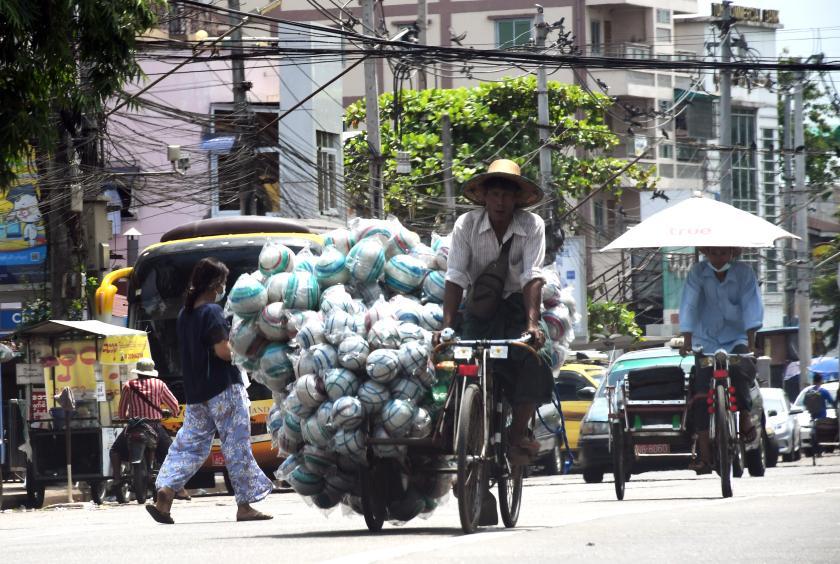
The pandemic and political instability have buffeted Myanmar’s economy. The economy contracted by 18% last year and is forecast to barely grow in 2022.
The situation is so uncertain, a recent global economic update from the World Bank excluded forecasts for Myanmar for 2022-2024.
Myanmar has to repay local and foreign loans of around US$700 million including interest every year, Major General Zaw Min Tun, spokesperson for the State Administration Council, told a press conference held in Nay Pyi Taw on July 1.
There was a total loan of over 22,000 billion kyats—over Ks16,000 billion in domestic loans and over Ks5,000 billion in foreign loans—from 2011-2012 fiscal year to 2018-2019 FY. From 2016-2017 to 2020-2021, the domestic loans were on the increase, he added.
“This is due to the fact that we see the budget deficit increase every year,” Maj-Gen Zaw Min Tun said.
He also pointed out problems with sales of government bonds.
Myanmar’s GDP rate increased from 2016-2017 to 2018-2019 but declined by half in 2019-2020, he commented.
The SAC spokesperson said the country had already experienced economic decline over the past few years with the largest budget deficit in 2019-2020.
“It was found that in that budget deficit crisis, government securities and bonds were both sold and added while the Central Bank of Myanmar continued to seek loans. Consequently, the local and foreign loan balances have increased year by year. It is necessary to review our debt resistance in the long run,” Maj-Gen Zaw Min Tun said.
He also blamed successive wrong policies on encouraging import rather than local products and businesses for the economic decline.
He said the incumbent government was trying to improve national economy through domestic products by boosting agricultural produce and livestock breeding, improving human resources and employing the country’s natural resources.