
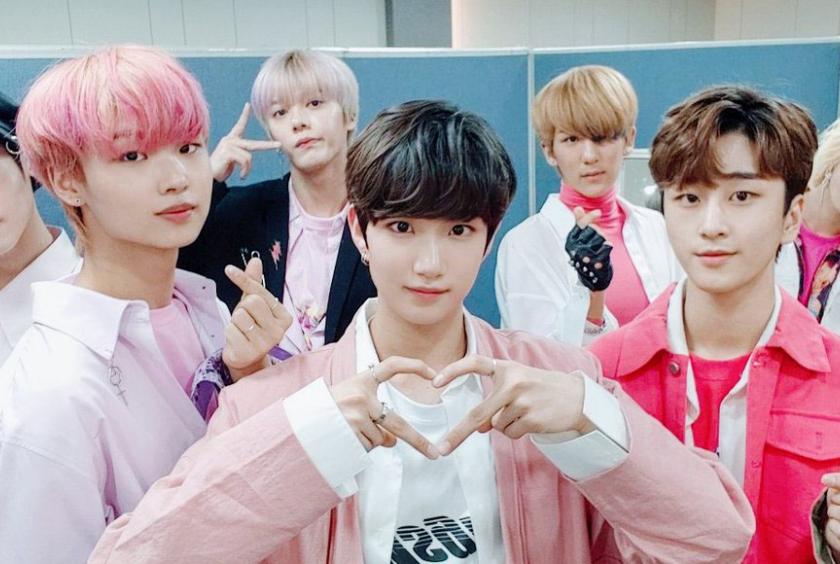
BANDAR SERI BEGAWAN (Borneo Bulletin/ANN) - This South Korean boy band shares insight into world of K-pop.
South Korean boy band NewKidd’s track ‘Tu Eres’ (translated as ‘You Are’ from Spanish) off their first album, has hit one million views from around the world since its debut a year ago.
Leader and sub-vocalist Jinkwon of the seven-member band said that since their debut, they have gained good repute among fans from various parts of the world. It only took them two months to enter the South American market.
The group - composed of Jinkwon, Hansol, Woochul, Hwi, Yunmin, Ji-ann and Seungchan spoke to the Bulletin and other Asian media under the Kwanhun-Korea Press Foundation (KPF) Press Fellowship at their agency, J-Flo Entertainment, situated at the upscale Gangnam in Seoul. Four of its members, aged 18-24, discussed their journey so far as K-pop ‘idols’ and their plans. It took NewKidd four years of training, which included a one-and-a-half year debut period.
They said that popular boy band BTS are the best role models to look up to, and they hope to be able to replicate the success of BTS and spread the message of peace and self-love through music.
J-Flo Director Hyobin Oh said NewKidd used foreign language in their debut song title “because they wanted to communicate with fans abroad.”
Like other idol groups, NewKidd members spend time practising their skills and watching their weight.
Shedding more light on their strict training routine, Oh said “If we have a schedule, we move based on the schedule. If we don’t, we come to the office at 10am and dance until 10pm, seven days a week. Other than that, members are free to practise more on their own.”
Jinkwon said he likes bread and tteokbokki but he substitutes this with other food like rice crackers to keep check on his weight and to prevent any unwanted breakouts on his face.
Oh said NewKidd members trained for four years and spent one-and-a-half years for their pre-debut period so they were well-trained in vocal and dancing skills, and the boy group gained reputation as they entered the South American market in just two months.
Three of the band members are still in high school. Woochul shared that often, before major shows, they will have to practise together on their own until 4am to ensure that they can deliver perfect performances. The boys, who also live together in a dorm have strict routines. All their moves are carefully monitored by the agency.
To demonstrate this fact, the boys can only meet their parents once a month. They are not allowed to have their own mobile phones and share one phone among them.
Asked what sets NewKidd apart from other boy bands, Hwi said that they intend to showcase various types of colourful music. “We want to communicate (with) and grow up with our fans, just like a friend. We promise to make greater effort to be better than before.”
Oh added that they had received many videos, including of singing and dancing, from people from different countries seeking to join the group.
Yunmin said it has always been their dream to perform, even from middle school, a sentiment echoed by other group members. The agency’s objective is to quickly reach more foreign fans. NewKidd covered Indonesian singer Siti Badriah’s hit song Lagi Syantik (Pretty Full), which has garnered 546 million views on YouTube since March 2018. The NewKidd cover was released on September 29 and as of October 24 had reached 203,000 views on YouTube.
“We had the chance to shoot a cover of ‘Lagi Syantik’ and it was a good opportunity to know foreign songs and good artistes around the world,” said Jinkwon.
They are currently implementing a project of singing the songs in the language of foreign fans, Jinkwon said, adding that “we are ready to communicate with fans around the world and we are looking forward to make songs and to create song covers.”
The members shared that they have always dreamed to become idols. Jinkwon said when he was in middle school, he saw EXO on TV and “I saw the glamorous stage and the chemistry between the members. So I thought that’s very amazing so I decided to become a singer.”
NewKidd members revealed that they are currently in the thick of preparing for their return with new music. “Now we are preparing ourselves to come back and our goal is to show many types of colours in our music and to become the singers that communicate with fans. We promise to continue making our utmost effort. Please watch how we do,” said Jinkwon.
Meanwhile, in light of the recent suicides of Korean pop stars that have shocked a nation already grappling with one of the highest rates of suicides in the world, Oh told the media that they are very aware of the mental health of the members and keep check on them all the time. “We ensure that they receive the right counselling and advice and we are always open to hear any of their problems or challenges,” he said.
Korean pop stars are heavily scrutinised for every action, their looks, their gestures and conduct in public and private by Korean media and social media users. Social media users routinely gang up on artistes and even bloggers, critics, writers and journalists whom they do not agree with and use digital platforms to urge and recruit other social media users to engage in similar behaviour, directing a flood of abuse against their targets.
The artistes also face pressure regarding the kind of content they post on their social media platforms from their fans who expect specific conduct that is an extension of their professional identity as Korean pop stars. When this harassment and abuse gets extreme, some Korean entertainment companies and sometimes the artistes themselves release statements condemning such behaviour and also file legal complaints against malicious social media users and stalkers.
Byung Kee-suh, a writer based in Seoul who has written extensively about K-pop for over 30 years said that some people behind the malicious comments online are surprisingly in their 40s and even school kids. “This is common,” said Byung. The reason behind the hatred online against Korean pop artistes may be linked to the easy access to cell phones, computers and Internet connectivity in South Korea.
“So we have an immature online culture (in South Korea) and it is based on smartphones, computers and social networking sites,” Byung explained.