
Vietnam War or Second Indochina War
The Vietnam War also called the Second Indochina War was the biggest loss to and greatest embarrassment for the United States. U.S. troops entered Vietnam with main intent of curbing communist influence. However, the two Vietnams unified in July 1976 under the title of communism. Neighbouring Laos and Cambodia also fell under the rule of communism. Essentially, all three Indochina countries fell under communist rule. The U.S. had to withdraw its troops as a result of domestic antiwar protest due to heavy military spending and war effort. Consequently, the American troop occupation in Vietnam became untenable and the United States was forced to withdraw its troops.
According to various estimates, the war took away the lives of at least 1 million or 3 million Vietnamese soldiers and civilians. Between 200,000 to 300,000 Cambodians and an estimated 20,000 to 200,000 Laotian people were also killed. Likewise, 58,220 US soldiers were also killed. The number of civilian deaths was 195,000 to 430,000 in South Vietnam and 65,000 in North Vietnam.
Most tragically, the Khmer Rouge also came into power in Cambodian following the Cambodian Civil War. After the Vietnam War, the U.S. even recognized the communist Khmer Rouge government, which committed numerous extrajudicial killings on innocent civilians. In total, the Khmer Rouge committed genocide on 1.5 to 3 million people. Even 2 million deaths, a figure cited by most experts, accounted for one eighth of the Cambodian population in the present day (2022). The Indochina war can be seen as a good lesson for Myanmar where extrajudicial killings are happening on a regular basis.
After reviewing the majority of the countries in which the United States has interfered over the past 80 years since the end of World War, these countries have witnessed prolonged dictatorships, internal divisions, and prolonged civil wars in those countries. Despite the United States’ calls for democracy and human rights, the facts and data left behind in global history tell a different story. This is a worrying fact and situation for Myanmar as well.
When it comes to Myanmar’s affairs, we should be aware that the US is exacerbating the issue. Instead of pushing for political solutions for the emergence of a free and fair election, the US is instigating indirectly so that the Myanmar’s issue is compounded. Its action is like plunging Myanmar into a Khmer Rouge-style age. The three most significant points are US President Joe Biden’s signing of the NDAA including Burma Act, a statement issued by the US embassy in Myanmar, and the US and its allied media’s biased reporting on lawless acts being committed by respective groups in the country.
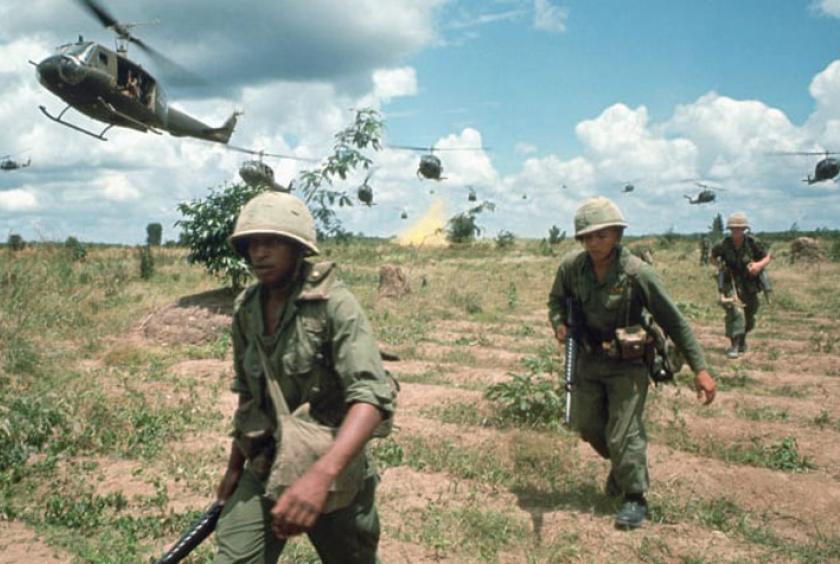
American troops in 1967 v3.jpg
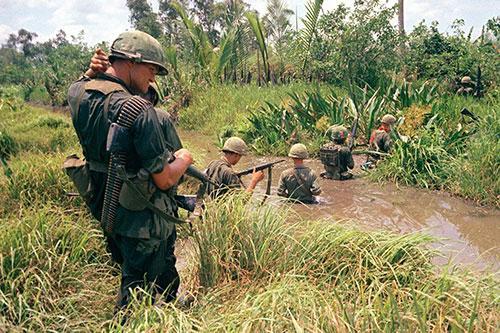
The U.S. President signed the National Defense Authorization Act, or NDAA, into law on December 23. As per the law, the US will provide technological support and materials that cannot cause human death to the organizations fighting for democracy, including the National Unity Government (NUG), People Defense Force (PDF), and ethnic armed organizations (EAOs). Yet, it is an act of instigating more violence.
The U.S. and British embassies in Yangon issued warnings about three days after the passing of the law. The warnings were that members of the public were not go to busy places such as Shangri-la Hotel, Lotte Hotel and the military-backed restaurants and bars on significant days including Independence Day and Union Day. Warning against going to identified places can be considered tantamount to indirectly instigating terrorist acts. Particularly, singling out Shangri-la Hotel and Lotte Hotel seems suspicious even though there are many hotels in Nay Pyi Taw and Yangon that are usually crowded with weddings and receptions.
Since February 1, 2021, Myanmar has experienced series of extrajudicial killings. There have also been beheadings in some places like Khmer Rouge and ISIS leaders. Such incidents began with such movements as “social punishment” and “kill military informants.” The conflict has since claimed an estimate of 6,000 lives from both sides.
The State Administration Council announced that a total of 4,037 ward administrative officials, staff, monks, nuns, members of the Union Solidarity and Development Party and civilian accused of being military informers had been killed till October 31, 2022. Meanwhile, the Assistance Association for Political Prisoners (AAPP) announced that 2,641 people had been killed by security forces till December 23, 2022, which the SAC denied.
Data for Myanmar also reported that since February 2021 after the military takeover, 38,383 houses were incinerated in the country with most in Sagaing Region, which lost 27,496 homes. Magway Region lost 7,818 homes and Chin State 1,475. SAC has already denied that there were incinerated by security forces. However, those homes seemed to be destroyed by both sides, according to local sources. Moreover, those detained at interrogation centers were severely tortured and some died, according to some escapees. (This is the point authorities concerned should take notice of.)
As such, the U.S. and the media outlets close to it are imposing a news blackout on the world and releasing biased news without mentioning lawless acts committed by respective groups.
Going back to the Vietnam War, it was actually a conflict in Vietnam, Laos, and Cambodia during the Cold War. It began 1 November 1955 and ended on 30 April 1975 when Saigon fell. It was officially fought between North Vietnam and South Vietnam. The north was supported by the Soviet Union, China, and other communist states, while the south was supported by the United States and other anti-communist allies. The Viet Cong (VC), a South Vietnamese common front under the direction of the north, initiated a guerrilla war in the south. The People's Army of Vietnam (PAVN), also known as the North Vietnamese Army (NVA), engaged in more conventional warfare with U.S. and South Vietnamese forces (ARVN). U.S. and South Vietnamese forces relied on air superiority and overwhelming firepower to conduct search and destroy operations, involving ground forces, artillery, and airstrikes.
Background
Indochina had been a French colony from the late 19th century to the mid-20th century. When the Japanese invaded during World War II, the Viet Minh, a Communist-led common front under the leadership of Ho Chi Minh, opposed them with support from the US, the Soviet Union and China. They received some Japanese arms when Japan surrendered. Then, the Viet Minh led by Ho Chi Minh started to rise against French rule. Hostilities escalated into the First Indochina War (beginning in December 1946). By the 1950s, the conflict had become entwined with the Cold War. In January 1950, China and the Soviet Union recognized the Viet Minh's Democratic Republic of Vietnam, based in Hanoi, as the legitimate government of Vietnam. The following month the United States and Great Britain recognized the French-backed State of Vietnam in Saigon, led by former Emperor Bảo Đại, as the legitimate Vietnamese government.
Military advisors from China began assisting the Viet Minh in July 1950. PRC weapons, expertise, and laborers transformed the Viet Minh from a guerrilla force into a regular army. In September 1950, the United States created a Military Assistance and Advisory Group (MAAG) to screen French requests for aid, advise on strategy, and train Vietnamese soldiers. By 1954, the United States had spent $1 billion in support of the French military effort, shouldering 80 percent of the cost of the war.
On 7 May 1954, the French garrison at Dien Bien Phu surrendered. The defeat marked the end of French military involvement in Indochina. At the Geneva Conference, the French negotiated a ceasefire agreement with the Viet Minh, and independence was granted to Cambodia, Laos, and Vietnam.
At the 1954 Geneva Conference in July 1954, Vietnam was temporarily partitioned at the 17th parallel. The North was controlled by Ho Chi Minh and the South by Bảo Đại. Under the agreement, clams were made to hold elections in 1956 for reunification. However, anti-communism politician Ngô Đình Diệm pressured Emperor Bảo Đại in 1955 to make sure he became President of GVN government. Through a referendum that some historians shammed as a coup, Emperor Bảo Đại was overthrown and Ngô Đình Diệm came to power. Then, the South Vietnam was declared as the republic.
The Ngô Đình Diệm government became a real dictatorship with the support of the US. His first aim was to cancel the elections scheduled in 1956 as he feared that the communist parties would win.
Soon after that, the government of South Vietnam faced public opposition. The country could not have been recognized as an independent one while corruption was rampant. As the majority of the people were Buddhists, another reason why they were unhappy with government was that many of the cabinet members were Catholics. Authorities used force to suppress the Buddhists who protested by setting fire to themselves. The situation then led to a systematic resistance movement.
North Vietnam helped the movement with guns and military equipment in aid. The US provided aid worth US$1.2 billion to the Diệm government. US President Eisenhower sent 700 military advisers. His successor Kennedy maintained the same policy as well.
■ Viet Cong
Diem's security forces, armed with military equipment and training from the US military and CIA, arrested about 100,000 supporters of the Viet Communists, nicknamed the "Viet Cong" in the south, most of whom were brutally tortured and executed.
In 1957, the Viet Cong and other opponents of the repressive Diem regime began to respond by attacking government officials and other targets, and in 1959, they began attacks on the South Vietnamese army.
In December 1960, many communist and non-communist dissidents in South Vietnam formed the National Liberation Front (NLF) to resist the government. The NLF is self-governing and claims that most of its members are not communists, but many in Washington consider it a puppet force of Hanoi.
The domino theory
In 1961, a team sent by US President John F. Kennedy to help Diem face the threat of the Viet Cong, advised the establishment of the military, economic and technical assistance in reporting on the situation in South Vietnam.
Acting on the domino theory that if one Southeast Asian country fell under Communism, many others would follow suit, Kennedy reduced large-scale military intervention but increased the US aid.
In the 1950s, South Vietnam had less than 800 American troops, but by 1962 there were about 9,000.
■ Gulf of Tonkin
In November 1963, three weeks before the assassination of US President Kennedy in Dallas, Texas, some of the generals succeeded in a coup d'état by overthrowing and assassinating Ngô Đình Diệm and his brother Ngo Dinh Nhu.
Subsequent political turmoil in South Vietnam convinced Kennedy's successor, Lyndon B. Johnson, and Secretary of Defense Robert McNamara to further increase US military and economic aid.
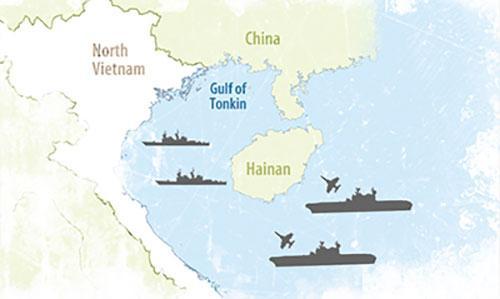
In August 1964, after North Vietnamese torpedo boats attacked two American destroyers in the Gulf of Tonkin, Johnson ordered retaliatory bombing of military targets in North Vietnam. Soon after, Congress passed the Gulf of Tonkin Resolution, which gave Johnson broad military powers, and the following year, American planes began regular bombing raids namely “Operation Rolling Thunder”.
The bombing was not limited to Vietnam, but during the CIA-led "secret war" in Laos between 1964 and 1973, its neighbor, the US secretly dropped two million tons of bombs on neutral Laos. The bombing was intended to disrupt the flow of supplies into Vietnam along the Ho Chi Minh trail and to prevent the emergence of the so-called "Pathet Lao" Lao Communist forces. The US bombing made Laos the most heavily bombed country per capita in history.
In March 1965, Johnson made the decision to send US combat troops to Vietnam, with strong support from the American public. By June, 82,000 combat troops were stationed in Vietnam, and by the end of 1965, military leaders had called for an additional 175,000 troops to bolster the struggling South Vietnamese army.
Regarding this increase, despite concerns among some of his advisers about pushing for an all-out war amid the growing anti-war movement, Johnson immediately sent 100,000 troops at the end of July 1965, and another 100,000 in 1966. In addition, the United States, South Korea, Thailand, Australia and New Zealand also pledged to send troops to fight in South Vietnam.
■ William Westmoreland
Parallel to the air attack on North Vietnam, the US-South Vietnam War in the South was primarily fought on the ground under the command of General William Westmoreland in coordination with the government of General Nguyen Van Thieu in Saigon.
Instead of trying to secure territory, William Westmoreland pursued a policy of extermination aimed at killing as many enemy troops as possible. By 1966, large swathes of South Vietnam had been designated a "no-fire zone," seemingly evacuating all innocent civilians, leaving only the enemy behind. When the refugees arrived in camps in designated safe areas near Saigon and other cities, the uninhabitable zones were heavily bombed by B-52 planes or shelled.
Although the enemy body count (which at the time was exaggerated by US and South Vietnamese authorities) was steadily rising, North Vietnamese and Viet Cong forces refused to stop fighting. It was because of the fact that the lost territories were easily recaptured due to the number of troops and supplies that were sent from the Ho Chi Minh route through Cambodia and Laos. Also, with the help of China and the Soviet Union, North Vietnam was able to strengthen its air defenses.
■ Demonstrations against the Vietnam War
In November 1967, nearly 500,000 American troops arrived in Vietnam, of them, 15,058 were killed and 109,527 were wounded. As the war unfolded, some soldiers began to question the government's reasons for putting them there and Washington's repeated claims that the war would be won were also distrusted.
Drug use by American soldiers (both volunteers and conscripts), incidence of post-traumatic stress disorder (PTSD), physical and mental deterioration among American soldiers increased, including mutinies and attacks by soldiers against officers and non-commissioned officers, in the later years of the war.
Between July 1966 and December 1973, more than 503,000 American soldiers deserted the army, sparking a strong anti-war movement among American servicemen. Violent protests, executions and mass incarceration of military personnel stationed in Vietnam as well as domestic US military personnel occurred.
Because of the horrific images of war they saw on their televisions, Americans who were sent from the home to the front strongly opposed the war. In October 1967, about 35,000 protesters demonstrated outside the Pentagon in a massive protest against the Vietnam War. Opponents of the war also asserted that the main victims are the civilians, not the enemy fighters and the United States was supporting the corrupt Saigon dictatorship.
■ “Tet” Offensive
By the end of 1967, Hanoi's Communist leadership had also grown impatient and tried to force the better-backed United States to give up hope of success and wage a showdown.
On January 31, 1968, about 70,000 North Vietnamese troops under General Võ Nguyên Giáp launched Operation "Tet" (meaning "New Year"), a massive assault on more than 100 cities in South Vietnam. American and South Vietnamese forces were caught off guard by the attack of North Vietnamese troops, but quickly fought back, and the Communists were unable to hold any target for more than a day or two.
But despite Westmoreland's repeated assurances that victory in the Vietnam War was imminent, reports of “Tet Offensive” shocked the American public. Especially when it was reported that Westmoreland had requested an additional 200,000 troops. With the ratings to support him plummeting in an election year, Johnson called for a halt to the bombing of much of North Vietnam (despite the continued bombing of South Vietnam) and vowed to devote the rest of his term to peace rather than re-election.
Johnson's new ideas, presented in a March 1968 speech, were welcomed by Hanoi with a positive response, and peace talks between the United States and North Vietnam began in Paris in May. Although South Vietnam and the National Liberation Front later joined, the talks soon reached an impasse, and after a bitter 1968 election marred by violence, Republican Richard Nixon won the presidency.
■ Vietnamization
Nixon sought to dampen the anti-war movement by appealing to the "voiceless majority" of Americans who he believed supported the war. In an attempt to limit the amount of American casualties, he announced a plan he called Vietnamization. This included the withdrawal of American troops, the increase of aerial bombardment and artillery fire and providing of the South Vietnamese with the training and weapons necessary to effectively control the ground war.
In addition to this Vietnamization policy, Nixon continued to hold public peace talks in Paris, and in the spring of 1968, he initiated high-level secret talks facilitated by Secretary of State Henry Kissinger.
However, North Vietnam continued to demand the complete and unconditional withdrawal of US troops and the removal of US-backed General Nguyen Van Thieu as conditions for peace, and peace talks stalled.
■ My Lai Massacre
In March 1968, more than 400 unarmed civilians were brutally killed by US soldiers in the village of My Lai, which appeared to be followed by even more brutal killings over the next few years.
After My Lai Massacre, hundreds of protests and rallies against the war occurred across the United States of America in 1968 and 1969.
The Moratorium to end the War in Vietnam was a massive demonstration and teach-in across the United States against the United States involvement in the Vietnam War. It took place on October 15, 1969, followed a month later, on November 15, 1969, by a large Moratorium March in Washington, D.C.
Over 25,000,000 US citizens peacefully gathered and they demanded to withdraw the US troops from Vietnam.
Especially, powerful anti-war movement occurred in the compounds of the Collages caused strong different ideologies among the US citizens. For some youths, the war symbolized uncontrolled of power which caused the US young citizens felling deeply dissatisfied. For other US citizens, the denunciation of the government regarded as the act of betraying without having patriotism. When the government withdrew his troops, the remaining people were very angry and disappointed which became the mental and leadership problems.
About 500,000 US men had violated the law of militia service in 1965-73. Most of them run Canada to avoid the militia service. Active conscription in the United States ended in 1973, when the U.S. Armed Forces moved to an all-volunteer military.
Kent State University Shooting
Joint US-South Vietnamese operation invaded Cambodia in 1970 aiming to attack the North Vietnamese supporting camps. Later, South Vietnamese made incursion into the Laos by themselves. However, the troops of North Vietnamese carried out counter-attack to them.
Due to the trespassing after violating the international law, the renew protests took place in the Collages across the United States. On May 4th, 1970, members of the Ohio National Guard fired into a crowd of Kent State University demonstrators, killing four and wounding nine Kent State students. Later, two students from Jackson State University in Mississippi were shot dead by the police after 10 days.
After offensive to South-Vietnam had failed by the end of June in 1972, Hanoi finally had a desire to made give-and-take. Although Kissinger and North Vietnamese delegates drew the peace agreement in autumn, the leaders in Saigon rejected the agreement. Nixon had allowed the troops to launch more air strikes on the targets in Hanoi and Saigon. On December 18, 1972, Nixon initiated a massive “carpet bombing” campaign in Northern Vietnam (mainly Hanoi) that was officially called “ Operation Linebacker II” and also became known as the Christmas bombing campaign which caused the international denounce.
Agent Orange @ Chemical Weapon
The United States detonated two atomic bombs over the Japanese cities of Hiroshima and Nagasaki on 6 and 9 August 1945, respectively. The two bombings killed between 129,000 and 226,000 people, most of whom were civilians, and remain the only use of nuclear weapons in armed conflict so far. The U.S used three kinds of chemical weapons in Vietnam War. The Agent Orange was the most significant among the three kinds of chemical weapons. Agent Orange is a chemical herbicide and defoliant, one of the “tactical use” Rainbow Herbicides. It was used by the U.S. military as part of its herbicidal warfare program, Operation Ranch Hand, during the Vietnam War from 1961 to 1971.
It is a mixture of equal parts of two herbicides, 2,4,5-T and 2,4-D. In addition to its damaging environmental effects, traces of dioxin (mainly TCDD, the most toxic of its type) found in the mixture have caused major health problems for many individuals who were exposed, and their offspring.
Agent Orange was produced in the United States from the late 1940s and was used in industrial agriculture and was also sprayed along railroads and power lines to control undergrowth in forests. During the Vietnam War, the U.S. military procured over 20 million gallons consisting of a fifty-fifty mixture of 2,4-D and dioxin-contaminated 2,4,5-T. Nine chemical companies produced it: Dow Chemical Company, Monsanto Company, Diamond Shamrock Corporation, Hercules Inc; Thompson Hayward Chemical Co., United States Rubber Company (Uniroyal), Thompson Chemical Co., Hoffman-Taff Chemicals, Inc., and Agriselect.
The government of Vietnam says that up to four million people in Vietnam were exposed to the defoliant, and as many as three million people have suffered illness because of Agent Orange, while the Vietnamese Red Cross estimates that up to one million people were disabled or have health problems as a result of exposure to Agent Orange. The United States government has described these figures as unreliable, while documenting cases of leukemia, Hodgkin’s lymphoma, and various kinds of cancer in exposed U.S. military veterans. An epidemiological study done by the Centers for Disease Control and Prevention showed that there was an increase in the rate of birth defects of the children of military personnel as a result of Agent Orange. Agent Orange has also caused enormous environmental damage in Vietnam. Over 3,100,000 hectares (31,000 km2 or 11,969 mi2) of forest were defoliated. Defoliants eroded tree cover and seedling forest stock, making reforestation difficult in numerous areas. Animal species diversity is sharply reduced in contrast with unsprayed areas.
The use of Agent Orange in Vietnam resulted in numerous legal actions. The United Nations ratified United Nations General Assembly Resolution 31/72 and the Environmental Modification Convention. Lawsuits filed on behalf of both U.S. and Vietnamese veterans sought compensation for damages.
Agent Orange was first used by the British Armed Forces in Malaya during the Malayan Emergency. It was also used by the U.S. military in Laos and Cambodia during the Vietnam War because forests near the border with Vietnam were used by the Viet Cong.
Ending the Vietnam War
In January of 1973 the Paris Peace Accords were signed after four years of negotiations, with the intent to establish peace in Vietnam and end the war. The Accords were signed by the United States, and North and South Vietnam. The agreement stated that armies from both North and South Vietnam would hold their positions, the United States military would withdraw from combat and leave the country, and both sides of the conflict would work together to find a peaceful path to reunification.
However, the wars between south and North Vietnamese had continued until April 30th of 1975 after the North Vietnamese troops captured the many cities in Saigon. Later, they renamed the Ho Chi Minh City (Ho Chi Minh died in 1969).
The intensified conflicts lasted over two decades badly impacted upon the Vietnamese peoples. After the war, about 2 million of Vietnamese people died and 3 million were injured as well as other 12 million of Vietnamese people became the refugees. The wars had destroyed basic infrastructures and economy and rehabilitation tasks had been carried out slowly.
Democratic Republic of Viet Nam was renamed Socialist Republic of Viet Nam on April 25 of 1976. In 1977, Viet Nam became a member of the United Nations. However, the violence including the conflicts between neighbouring countries China and Cambodia frequently occurred over 15 years. The Viet Nam’s economy increased due to flow of foreign investments and incomes from fuel export because Vietnam started the Doi Moi (Renovation) reform process in 1986, with the aim of transforming the economy from a socialist model into a market-oriented one. Trade and diplomatic relation between Vietnam and U.S were resumed in 1990.
In U.S., the impacts of Vietnam War stood for a long time after the last troops returned homes in 1973. The U.S. had used over US$ 120 billion for Vietnam conflict in 1965-1973. The above huge expenditure caused widely inflation. In 1973, the U.S. economy fell down and the fuel prices had surged due to global fuel crisis.
The impacts of mental sufferings were very deeply. The Vietnam War also damaged the U.S. good background history and it badly differed from the U.S. More U.S. veterans returning from Vietnam War got bad responses and views concerning the war. Anti-War people looked at them (U.S. veterans) as the killers of the innocent civilians. Likewise, war supporters saw them as a war loser.
The Vietnam Veterans Memorial was a U.S. national memorial in Washington, D.C. in 1982 honouring service members of the U.S. armed forced who served in the Vietnam War. The two-acre (8,100 m2) site is dominated by two black granite walls engraved with the names of those service members who died or remain missing as a result of their service in Vietnam and South East Asia during the war. The names on the Wall, originally numbering 57,939 when it was dedicated in 1982, were listed in the chronological order of the dates of casualty. Additional names had been added throughout the years since: as of May 2018 there were 58,320 names. The number of names on the wall differs from other counts of U.S. Vietnam War deaths.
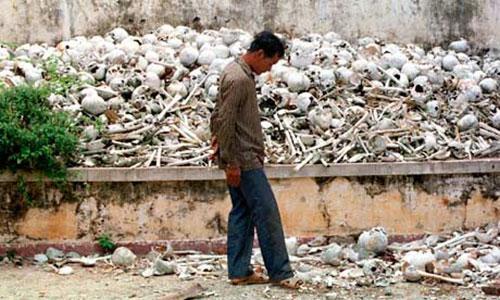
Cambodia killing fieldsv7.jpg
Cambodia
The Vietnam War reached into the Cambodia due to Ho Chi Minh’s stretch of road and Sihanouk’s road building. So, the U.S. had bombed Vietnam and its neighbouring Cambodia from 1969 to 1973. After the coup in Cambodia in 1970, Khmer Rouge with the American support took a power. And then, King Sihanouk supported his ex-enemy Khmer Rouge. Due to the support of King Sihanouk, Khmer Rouge was very powerful and then they captured the Phnom Penh in 1975. Lasting for four years (between 1975 and 1979), the Cambodian Genocide was an explosion of mass violence that saw between 1.5 and 3 million people killed at the hands of the Khmer Rouge, a communist political group. However, People’s Republic of Kampuchea (PRK) which was supported by the Soviet Union in the Cambodia-Vietnam War removed the Khmer Rouge.
Background History
Sihanouk abdicated in 1955 and was succeeded by his father, Suramarit, so as to directly participate in politics. Sihanouk's political organization Sangkum won the general elections that year and he became prime minister of Cambodia. He governed the country under one-party rule and suppressed political dissent. After his father died in 1960, Sihanouk assumed a new position as Head of State of Cambodia.
When the Vietnam War threatened to engulf the region, he tried to carve out a neutral role for Cambodia, siding neither with the Communists nor the United States. With the aim to support the weapons and other supplies to the Vietnamese Communists’ troops in South Vietnam, Sihanouk allowed Vietnamese Communists to use Cambodia as their liberated region. In 1967, Sihanouk told the Journalist from Washington Post that if the American would bomb the Vietnamese shelters without damaging the Cambodians, he didn’t reject. Likewise, he sent this message to the delegate of U.S. President Johnson in January of 1968. However, he denied in front of the public about the American’s air strikes in Cambodia.
Khmer Republic (1970-75)
When Sihanouk was on an oversea visit in Beijing in 1970, a coup led by General Lon Nol and Prince Sirit Matak occurred in the Cambodia. After the coup, the new government demanded the Vietnamese Communists to leave from Cambodia quickly and then they get the American’s support in accordance with the politic. North Vietnamese and Viet Cong troops attacked to the new government aiming to control their supporting routes in North Vietnam. As the King urged his followers to depose the new government, civil war quickly occurred in the Cambodia.
Khmer Rouge rebels had tried to get the support by using Sihanouk. However, the Cambodia conflict occurred among government, Cambodian military and north Vietnam until the early from 1970 to 1972. When Khmer Rouge rebels had controlled the Cambodian region, the Vietnamese communists created the political basic infrastructure that was influenced by the Cambodian Communists which was referred as Khmer rouge.
During 1969 to 1973, South Vietnam and American forces bombed Cambodia in order to disturb Vietcong and Khmer Rouge forces. North Vietnam captured places taken by Cambodia forces and Communist Party of Kampuchea (CPK) increased its attack on communication routes.
In retaliation by the intrusion of North Vietnam, American President Richard Nixon announced that U.S Forces and South Vietnam forces will enter Cambodia to destroy bases of North Vietnam in Cambodia. Although U.S Forces and South Vietnam forces seized many weapons; it was difficult to control North Vietnam forces.
The three main leaders of Khmer Republic were Lon Nol, Sirik Matak who was the cousin of Prince Sihanouk and leader of the national assembly, In Tam. Lon Nol was partly in authority as no one tried to take his place.
In 1972, National Constitution was practiced and Lon Nol became w president. Due to disunity, a military of 30,000 and a nation of 200,000 populations, transformed into forces and corruption caused civil administration weakened.
The uprising of Communist in Cambodia continued to increase while North Vietnam provided food and military assistances. Pol Pot and Ieng Sary influenced on the communists trained in Vietnam. In the meantime, CPK forces were stronger and they could stand separately from the Vietnam forces which assisted them.
In 1973, CPK involved in the attacks with government forces without the assistances from the North Vietnam forces. They controlled 60 percent of Cambodia’s territory and 30 percent of population.
The government tried three times to discuss with the rebels but unable to make it. In 1974, CPK freely acted as regions and some of North Vietnam forces moved to South Vietnam. Lon Nol’s administration was reduced to some parts of regions near cities and main transportation routes. More than 2 million refugees lived in Phnom Penh and other cities.
On 1975 New Year Day, Communist forces started offensive attacks and it became the hardest 117 days which brought the fall of Khmer Republic. Due to the simultaneous attacks in the surrounding Phnom Penh, republican forces were unable to attack, while other CPK forces attacked bases which controlled the transportation routes in lower Mekong areas.
U.S Congress disagreed to provide more assistance to Cambodia and therefore, providing of rice and air strikes assistances were stopped. Within five days of U.S mission leaving Cambodia, Lon Nol administration surrendered on April 17, 1975.
Khmer Republic (1975-1978)
In 1975, Khmer Rouge took Phnom Penh and seized power and changed the nation’s name into Democratic Kampuchea. New government imitated China’s Great Leap Forward during Chinese CCP Chairman Mao Zedong and forced civilians to leave cities quickly and worked at the rural projects. They re-built the agriculture and livestock breeding of the Nation’s into 11 Century and forced to abandon the western medicines. They destroyed churches, libraries and buildings that were built in western style.
The word “Killing Field” was first introduced and the prison Tuol Sleng. It was notorious for mass killings. Hundreds and thousands of people fled to neighbouring Thailand. They mainly targeted on ethnic people. Half of Cham Muslims’ populations were exterminated during Khmer Rouge reign. Pol Pot was determined to keep his power and increased oppression against his enemies and those likely to be his enemies and increased brutality.
The victims of Khemer Rogue were not only ethnic people but also Khmer people. Professionals who were doctors, lawyer and teachers were targeted. Khmer Rouge also targeted religious organizations. As a result, 95 percent of Buddha’s architectural designs were destroyed.
Vietnamese Invasion and Transition Period
In retaliation of Khmer Rogue’s invasion to their border areas in 1978, Vietnam forces captured Cambodia. Kampuchea People’s Revolution Party established in 1951 was led by a group of Khmer Rouge who fled from Cambodia from the assassination attempts by Pol Pot and Tarmot and founded People’s Republic of Kampuchea which favoured Soviet. They are under the guidance of the ambassador of Phnom Penh. Vietnam and Soviet Union provided weapons for them.
As a move against the new nation, Coalition Government of Democratic Kampuchea was founded in 1981 among the three government groups fled to foreign countries. Among them were Khmers, faithful to King Sihanouk and Khmer People’s Liberation Front. United Nations recognized Coalition Government of Democratic Kampuchea. UN remained Chun Prasith as a representative of Khemer Rogue but he had to consult with representatives of Cambodia’s parties who were non-communists. As Vietnam objected to retreat from Cambodia, U.S and its allies sanctioned Vietnam.
Pol Pot
On April 17, 1975, Khamer Rogue seized capital Phnom Penh and formed a government and called the country Democratic Kampuchea. Cambodia’s ruler Prince Norodom Sihanouk was overthrown and Saloth Sar announced himself as Pol Pot. Pol Pot is the nick name called by the French to Chinese communist leaders. After holding cabinet meetings, they announced that Year Zero was started and transformed the nation in accordance with the Party’s policies.
According to the party’s policy, city dwellers were sent to rural areas for farming. Majority of the public were forced to move under the guise of evacuating when the U.S airplanes attack. There were less and less people in the cities. People had to live in the farming projects. Children had to live in the community schools to learn about community lives.
Later, Pol Pot banned all kinds of religions. “If nothing was possessed, no one can destroy” was their ideology and from radio, they distributed propaganda that millions of Khmer people were actively taking part in order to establish the communist country. They oppressed educated people and sent them to torture camps such as S-21. Buddhist monks, Christians, Muslims, politicians, businesses owners, and people linked to Chinese, Vietnam, and Laos were sent to S-21 and killed them. Under the order of “not to waste any bullet”, these people were killed by burning, drowning, hanged and de-skinned them alive, using pliers to pull nails, beating the head with bamboos, and so on. They used the most terrible and inhumane torture methods and so it was later known as Killing Field”.
It is estimated that 1.6 million to 2 million people were died under the Khmer Rouge reign without any documents. A high school was transformed into a killing field during Khmer Rouge reign and it is now opened as Tuol Sleng museum.
Pol Pot later had poor relation with communist countries such as Soviet and Vietnam. Many border disputes were happened especially with Vietnam. In 1978, Vietnam forces launched a full scale invasion in Khmer area where Khmer Rogue faced continuous losses and Pol Pot had to flee to Thai borders. Vietnamese formed a new government led by Heng Samrin and Pol Pot re-strengthened its troops in Thai border.
Thai accepted Pol Pot to prevent Vietnam’s invasion and neglected assistance made by China. U.S and other countries didn’t recognize Heng Samrin government and United Nations didn’t recognize new government. As a result, Khmer Rogue government and Phnom Penh government faced tensions. U.S objected invasion of Vietnam troops into Cambodia.
At the Thai border, Coalition government of Democratic Kampuchea (CGDK) was formed. National Front for the Liberation of the Khmer people was also formed. Later, Kampuchea Communist party was formed. In December, 1985, Vietnamese Army launched a major offensive overrunning Khmer Rogue’s forces. Pol Pot fled to Thailand and remained silent for 6 years. He resigned from the Communist Party and transferred power to Son Sen gradually. It was said that Thai special forces no. (838) had given him protection.
He denied the proposal of Khmer politicians that if he confessed his mass killings and surrender, he would be forgiven. In 1986 when Vietnam forces withdrawn from Cambodia, Pol Pot stayed at his camps in Thai and Cambodia borders. He didn’t accept peace and didn’t surrender and tried to fight current government.
1995, Pol Pot was paralyzed and Khmer Rogue forces weakened. Most of the leaders abandoned arms and changed sides. Government used the strategy of winning one by one as they couldn’t win them all.
He fully transferred his power to Son Sem in 1997. He then fled to his stronghold in northern part but Ta Mok, an officer from Khmer Rogue put him under house arrest. He was unable to move freely due to his illness, He couldn’t move without an aid. On April 15, 1998, Khmer Rogue announced that he will be at the International Tribunal. The next day when preparing for moving, his wife announced that Pol Pot was dead. Ta Mok confirmed that Pol Pot was died of heart failure. When the government asked his remain to be autopsied, his remain was cremated at Anlong, a Khmer Rogue camp.