
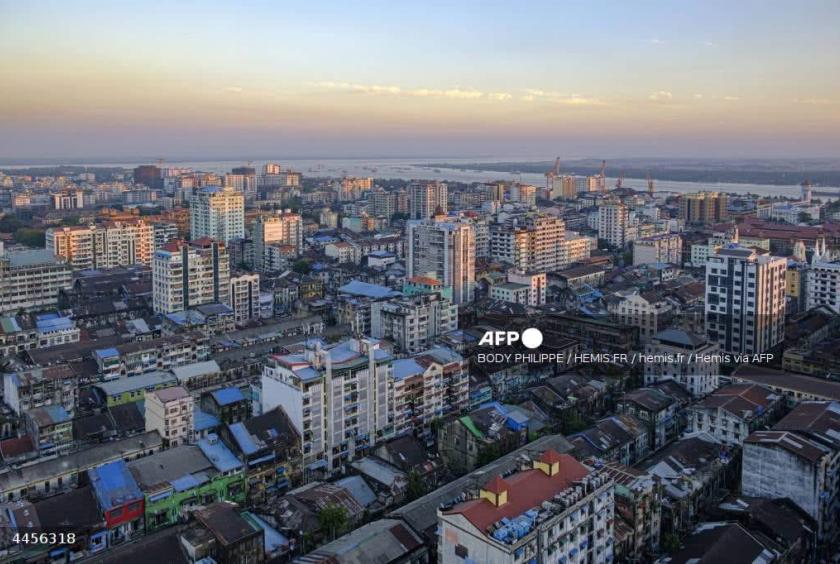
While Myanmar's import, export, and trade sectors continue to struggle, the real estate market stands out as one of the few sectors generating remarkable profits.
Despite weak foreign investment and a sluggish domestic job market, the property sector remains buoyant. Over the past three months alone, some investors who bought and resold properties have reportedly earned profits of at least hundreds of millions to billions of kyats, depending on the location—an unusual trend given the country's broader economic difficulties.
Property prices in some of Yangon’s most sought-after townships, including North Dagon, Bahan, Sanchaung, Kamayut, Mayangone, and Dagon, have risen to levels that reportedly exceed those in neighbouring countries such as Thailand and Malaysia.
Among Yangon’s property hotspots, North Dagon has emerged as the market's standout performer. According to real estate agents, a standard 40-by-60-foot plot now sells for no less than K1.5 billion.
"In North Dagon, even a plot with a simple wooden house in the inner wards costs at least K1.5 billion. Properties along roads connected to Pinlon Road are selling for more than K2 billion. Shortly after Thingyan, a property one street away from PinlonRoad was initially listed at K2.5 billion and eventually sold for over K2.4 billion. The house itself needed to be rebuilt and was not ready for immediate occupancy, but it still found a buyer," said a North Dagon resident.
Market sources also said that a two-story house on a 20-by-60-foot plot in North Dagon is selling for at least K1 billion, with transactions remaining active.
Bahan Township and parts of Kamayut along Pyay Road continue to command some of Yangon’s highest land prices. In upscale neighbourhoods such as Golden Valley in Bahan, land is reportedly selling for between K6 million and K7 million per square foot.
"Bahan has always been expensive. Along major commercial roads such as Kaba Aye Pagoda Road and Shwegondaing Road, land prices start at around K1 million per square foot and can go much higher," a veteran real estate agent said.
Market sources also estimate that land along prime locations such as Kaba Aye Pagoda Road is currently changing hands at K6 million to K7 million per square foot, equivalent to roughly US$1,500 per square foot.
Why Are Property Prices Unusually Rising?
While many businesses in Myanmar are struggling to stay afloat, Yangon’s real estate market continues to move in the opposite direction. In recent months, the property sector has become one of the few businesses capable of generating profits worth hundreds of millions of kyats within a short period.
"A property changed hands only a few months ago. The previous owner sold it and told the tenant to vacate, so the shop relocated. About three months later, the property changed owners again. It was first sold for more than K4 billion, and the new owner resold it for over K5 billion. In just three or four months, the seller made a profit of more than K1 billion," a North Dagon resident said.
According to market experts, Myanmar's real estate market has been on an upward trend since the country's political change. They say the market has been driven by inflation since 2020, migration from conflict-affected regions, and an influx of people relocating to Yangon after the Mandalay earthquake, all of which have revived demand for housing and land.
"Many people have fled conflict areas and taken refuge in Yangon. Most of them sold whatever property they owned and bought at least an apartment here. In neighbourhoods like Kyaukmyaung, there are many people who moved from Rakhine State and purchased apartments. Those with more financial resources tend to buy land in newer townships such as North Dagon and East Dagon, where standard 40-by-60-foot plots are available. That's one of the reasons why property transactions have become more active," a real estate agent said.
Market participants also say that speculative investment has become increasingly common. Many investors focus on buying and selling land held under permit or "slip" ownership documents, which are generally less expensive than grant land with full ownership titles.
"Grant land is expensive. Permit and slip land cost much less, usually in the hundreds of millions of kyats. In places like Thanlyin, most land is held under permit or slip ownership, while grant land is relatively rare. As a result, trading is much more active in permit and slip properties," another real estate agent said.
With many sectors of the economy unable to operate normally, investors with available capital have increasingly turned to real estate, contributing to further price increases.
"Some buyers genuinely want a home, while others are simply speculating. Speculators wait for one transaction to close, then immediately look for the next property to flip," a veteran real estate agent said.
Market observers also believe that proceeds from online scam operations, illegal cybercrime syndicates, illicit natural resource extraction, and organized criminal groups in the region may be flowing into Myanmar's real estate market, potentially fueling speculation and money laundering.
Myanmar Property Prices Surpass Those in Bangkok with a Stronger Economy
Across Asia, Hong Kong remains one of the world's most expensive real estate markets, with land prices ranging from US$4,000 to US$7,000 per square foot. In Tokyo, Japan, prime land typically sells for between US$2,000 and US$5,000 per square foot.
Within ASEAN, economically advanced countries such as Thailand and Singapore also have high property values. However, land prices along Kaba Aye Pagoda Road in Yangon have reportedly surpassed those in Bangkok.
Prime land in Bangkok is estimated to sell for US$700 to US$1,200 per square foot, while land along Kaba Aye Pagoda Road is reportedly for at least US$1,550 per square foot.
Similarly, in Kuala Lumpur, Malaysia—one of Southeast Asia's strongest economies—land prices generally range between US$250 and US$500 per square foot. In land-scarce Singapore, prime areas such as Marina Bay command around US$1,500 to US$3,000 per square foot.
These comparisons suggest that land prices in parts of Yangon now exceed those in several economically stronger ASEAN countries. While Singapore's property market remains expensive, it is supported by significantly greater employment opportunities, stronger economic fundamentals, and higher incomes than Myanmar.
Thailand's condominium market also illustrates the growing overseas investment by Myanmar buyers. Following Myanmar's political change, affluent Myanmar nationals have increasingly purchased condominiums in Thailand. According to Thailand's Real Estate Information Center, Myanmar buyers ranked second only to Chinese purchasers among foreign condominium buyers. During 2025, condominium purchases by Myanmar nationals reportedly increased by more than 41 percent, reaching over 1,900 units.
Most Myanmar buyers purchased condominiums priced between 4 million and 8 million Thai baht (approximately US$150,000 to US$350,000), placing them among the highest-spending groups of foreign buyers in Thailand.
Despite being the second largest buyer of condominiums in Thailand and despite domestic land prices exceeding those in some ASEAN countries, Myanmar's GDP remains in a fragile state.
According to the World Bank's assessment of Myanmar's economy, GDP is expected to recover by around 3 percent in the 2026–2027 fiscal year, while inflation is projected to remain high at 28–30 percent. Myanmar's GDP remains among the lowest in ASEAN and lags far behind those of Thailand and Vietnam. Annual per capita income stands at about US$7,980 in Thailand and US$4,960 in Vietnam—roughly seven times and four times higher, respectively, than in Myanmar. These indicators highlight the widening gap between Myanmar and its regional neighbours.
Is Money Laundering Taking Place in Myanmar’s Real Estate Market?
At a time when many businesses are struggling to survive, some wealthy investors have turned to the real estate sector as an alternative investment channel. However, some business owners and observers believe that illegally obtained funds may also be entering the property market and being laundered through real estate transactions.
The real estate sector is considered an attractive avenue for money laundering because it allows large amounts of money to be transferred in a single transaction. Money obtained from drug sales, money acquired through bribery, tax-evaded funds, and most recently, money illegally earned from online scam businesses, can all enter and manipulate the real estate market. With large amounts of illicit money, properties are purchased under the names of relatives, friends, or other nominees to conceal the true owners, thereby transforming them into legitimate assets.
Another method involves declaring a lower-than-actual transaction price for tax purposes and then reselling the property shortly afterward at a higher price. Through such intermediary buying and selling processes, illegally obtained money can be converted into legitimate funds. These are among the ways illicit money can be transferred and used within the real estate market. At an awareness-raising discussion held at the headquarters of the Union of Myanmar Federation of Chambers of Commerce and Industry (UMFCCI) in Yangon on February 5, 2026, Daw Than Than Swe, who was serving as governor of the Central Bank of Myanmar, said there were cases where a single individual owned multiple plots of land.
"Rental prices have become extremely high. We need to review both taxation and ownership issues. In some cases, one person owns many plots of land. To be frank, there have been complaints made about such cases. Although we did not want to create blacklists, we had to do so because it appeared that there was a lack of public cooperation," Daw Than Than Swe said.
Currently, the government has introduced regulations aimed at preventing money laundering in various sectors, including real estate. Real estate agents are required to be registered with recognized associations in their respective townships and must attend training programs related to anti-money laundering measures. During property transactions, agents are required to verify and record buyers’ identity documents, occupations, and sources of funds. If they encounter unusual transactions, such as buyers paying far above market prices or settling large payments entirely in cash, they must report such cases to the Financial Intelligence Unit.
Meanwhile, Thailand’s real estate market has reportedly slowed as the Thai government intensifies its crackdown on online scams, cybercrime networks, and illegal online gambling operations. Thai media reports indicate that the property market has become more subdued amid these efforts. In contrast, Myanmar’s real estate market continues to see buyers paying unexpectedly high prices for properties that many previously considered impossible to sell at such levels. As a result, property prices in Myanmar remain on an upward trend despite the country’s broader economic challenges.
The Consequences of Rising Real Estate Prices
The sharp increase in real estate prices has had a significant impact on businesses and ordinary people. Rising land rental costs and higher residential rents are among the most visible consequences of the property market boom.
"In areas like North Dagon, it is now impossible to find a detached house for rent at K500,000 per month. As house prices continue to rise, rental prices have also increased. The growing number of people moving to Yangon has also contributed to this. In North Dagon, monthly rent is now at least above K500,000. For a two-story detached house, rents have exceeded K1 million per month," said a North Dagon resident. According to domestic real estate website iMyanmarHouse, as of July, the average monthly rental price for apartments in Yangon is around K800,000. Mini-condominiums average about K1.2 million per month, condominiums can reach K2.5 million, and detached houses average around K4.8 million per month.
For low-income earners with monthly incomes of only around K500,000, such rental prices have become increasingly unaffordable. For a family without their own home earning around K2 million per month, about one-quarter of their income could be spent solely on rent.
"The job market is also not good at the moment. If property prices continue to rise as they are now, rental prices will increase further. The prices from six months ago are already different from today's prices, and the prices six months from now will likely be different again. The rent for our current house increased by K50,000. We now have to pay K550,000 per month," another North Dagon resident said. Commercial rental prices have also increased significantly. According to rental listings on iMyanmarHouse, the average monthly rent for shops and office spaces in Yangon is around K8.3 million.
"In suburban townships, even a small shop unit costs at least K300,000 per month to rent. If you pay K300,000 in rent, that means you need to earn at least K10,000 per day just to cover the shop rental cost. A small grocery shop has to struggle to make even K10,000 profit per day, and that does not include workers' wages. If you cannot make K10,000 a day, you cannot even cover the rent and will operate at a loss. Business is not doing well at the moment," said a shop owner renting a space in Thaketa Township.
Along Pinlon Road in North Dagon, one of the township’s main commercial areas, shop rental prices start at more than K8 million per month. In many cases, tenants must construct their own buildings on the rented land.
"Pinlon Road is the main road of North Dagon. If someone wants to open a shop there, rent starts at more than K8 million. If the space is larger, the price can exceed K10 million," a real estate agent said.
Could Myanmar’s Real Estate Market Face a Bubble Burst?
Market observers are increasingly concerned about whether Myanmar’s real estate market could be heading toward a bubble. A property bubble occurs when prices rise far beyond their normal value, only to collapse suddenly when buyers disappear and demand falls.
A real estate bubble typically develops in three stages. In the first stage, demand rises sharply. People begin buying property as a way to protect themselves against inflation and because they believe real estate provides better returns than other investments. As demand increases, property owners and brokers push prices far above their actual value. At this stage, transactions are often driven not by people seeking homes to live in, but by speculators hoping to resell properties for profit.
In the second stage, property prices reach extremely high levels and become disconnected from ordinary people’s incomes and wages. Prices may even exceed those in economically stronger countries. At this point, genuine homebuyers can no longer afford properties, and the market becomes dominated by speculators buying and selling among themselves.
In the third stage, prices rise beyond sustainable levels, causing buyers to disappear and market activity to slow significantly. Those who purchased properties at inflated prices may be forced to sell at lower prices because they need to recover cash or repay debts. As prices fall, the entire market can collapse, resulting in a property bubble burst. When a real estate bubble bursts, banks that have issued loans backed by property collateral and investors can suffer major financial losses, potentially triggering a broader economic crisis. Globally, two major examples of real estate bubbles causing severe economic damage are Japan’s property collapse in the 1990s and the United States housing market crash in 2008, which contributed to a worldwide financial crisis. Japan’s real estate bubble burst in 1991, leading to one of the country’s most severe economic downturns. The crisis caused Japan’s economy to struggle for more than two decades. The bubble was fueled after the 1985 Plaza Accord between the United States and its allies strengthened the Japanese yen. Concerned that a stronger yen would hurt exports, the Japanese government lowered interest rates. As banks accumulated excess liquidity, people could easily obtain loans by using land as collateral. Borrowers rushed to buy real estate and stocks, causing prices to rise dramatically. To control the rapid increase in property prices, the Bank of Japan suddenly raised interest rates to 6 percent and restricted real estate lending. As bank loans became harder to obtain, the market cooled rapidly. Property prices eventually dropped by 70 to 80 percent, causing the bubble to burst. As borrowers struggled to repay loans, some banks collapsed, and Japan’s economy entered a prolonged period of stagnation. Myanmar’s current situation also shows signs of unusually high property prices. The market has been driven upward by people seeking protection against inflation and investors hoping for large profits through property speculation.
However, unlike countries where real estate purchases are often financed through bank loans, Myanmar’s property market is largely based on cash transactions. Because of this, some real estate agents believe Myanmar may not experience a bubble burst similar to Japan’s. Instead, they warn that the market could face a prolonged period of stagnation, where property owners struggle to sell assets quickly when they need to convert them back into cash. This could result in a frozen real estate market rather than a sudden collapse in prices.
Myanmar’s Real Estate Market May Need Property Tax to Curb Rising Prices
With land prices in Myanmar now exceeding those in countries such as Thailand and Malaysia, there are growing calls for measures to control the real estate market. Experts and business owners argue that introducing a property tax system could help curb speculation and stabilize prices. Currently, when purchasing a condominium or property in Myanmar, buyers are required to pay income tax. If income tax has not been previously paid, the Union Tax Law requires buyers to pay tax on previously undeclared income.
When purchasing a house or condominium, buyers must show proof of legitimate funds for the assessed value of the property. If they cannot provide evidence of legal funds, a purchase tax is imposed based on the assessed value: 3 percent for properties valued below K100 million, 5 percent for properties between K100 million and K500 million, 10 percent for properties between K500 million and K1 billion, 20 percent for properties between K1 billion and K1.5 billion, and 30 percent for properties above K1.5 billion.
After the township valuation committee determines the value of a property, buyers must pay a 4 percent stamp duty and a 3 percent purchase tax through the township tax office and the relevant bank.
"Taxes in the real estate sector include purchase tax, stamp duty, and sales tax. If the rates are reasonable, people are willing to pay. But when taxes were previously as high as 5, 10, 20, or 30 percent, people avoided paying them. Instead, they used Special Power arrangements and transferred ownership informally, meaning there was no tax collected on those transfers," a veteran real estate agent said.
Government-assessed property values vary among Yangon townships. The tax valuation differs depending on location.
"The government tax rate is 3 percent for values up to K300 million, 5 percent up to K600 million, 10 percent from K600.1 million to K1 billion, 15 percent above K1 billion, and 30 percent for properties above K3 billion. The assessed value also depends on the current market price. For example, properties along Pyay Road have different valuations in Dagon Township, Myaynigone, Sanchaung, Kamayut, Hlaing, Mayangone, and Insein. Some areas are assessed close to actual market prices, while others are lower or slightly higher," another veteran real estate agent said.
Money laundering and tax avoidance are considered major issues in Myanmar’s property and condominium transactions. At present, many people are investing in real estate, condominiums, and vehicles as alternative ways to store wealth.
As property prices continue to rise beyond the reach of many ordinary people, some observers argue that a property tax system is needed to control speculative trading.
Among ASEAN countries, property taxes exist in Singapore, Thailand, Malaysia, Indonesia, the Philippines, Cambodia, and Laos, although the systems vary. Countries without property taxes include Myanmar, Brunei, and Vietnam, though Vietnam is reportedly preparing to introduce such a system. Brunei’s situation differs because of its wealthy economy and government subsidies, leaving Myanmar as one of the few remaining countries without a comprehensive property tax system.
In Thailand and Singapore, taxes on primary residences are relatively low, while properties purchased for investment purposes are subject to higher taxation.
A local business owner said:
"Property prices in Myanmar’s most expensive areas are higher than those in Thailand. Real estate loans in Myanmar have also increased, and these need to be reviewed. The main solution is to introduce property tax. It would benefit the country and protect public interests. Among the 10 ASEAN countries, only three countries, including Myanmar, remain without property tax. Myanmar needs to introduce it as soon as possible.”
"In a country where many people earn only K400,000 to K500,000 per month, look at how high rents have become. When property prices rise, rents also rise. In conflict areas, prices are being pushed up dramatically. The government cannot solve everything through enforcement alone. It needs laws to protect people’s living costs. The key solution is taxation and legal regulation. There is no need for arrests or crackdowns. If property tax is introduced, the real estate market will cool down. Speculators may suffer, but ordinary people will benefit. Property tax is not something people should fear. People who own land exist in every country. Higher taxes would mainly affect those who own second, third, fourth, or multiple properties. Real estate prices have become unreasonable compared with national income levels. Income has not increased, GDP has not grown significantly, and per capita income remains low. As a result, living costs for everyone are becoming much higher. Rising property prices will push up rents, and this year rents may increase significantly. Poor people and the middle class will suffer greatly. The government and parliament need to reform the property market quickly by introducing property tax. Unlike gold or foreign currency, there is no need for enforcement actions. The government simply needs to establish a legal property tax system to prevent land speculation."
The business owner added that property taxes are already common in most neighbouring ASEAN countries.
"Only Brunei, Vietnam, and Myanmar do not have it. Vietnam is already preparing reforms, while Brunei does not need it because of government support. Myanmar is the only country left. Property prices cannot continue rising without proper taxation. Sales tax and purchase tax systems are not enough. The price gaps are enormous. For example, prime locations along Pyay Road are trading at around K6 million to K6.5 million per square foot, but the tax rates do not reflect these market values. This allows land speculators to operate freely.
"Money laundering is also a major issue. Funds from online scam operations, illegal resource extraction, and other illegal activities are often invested in land because many people who obtain illegal money do not pay taxes. They hide their wealth by putting it into real estate."
Market observers also expect property transactions and relocations to increase during the upcoming post-Lent period, which could push prices even higher. If rising property prices continue to drive up rents and commercial space costs, the impact could become severe in Myanmar, where average incomes remain low. The burden would affect not only low-income households but also the country’s middle class.
A local business owner said the government should take several steps to address issues in the real estate market, including possible money laundering activities.
"First, the government should strengthen inspections of money laundering activities in the real estate sector. Anti-money laundering units under the Ministry of Home Affairs, the Anti-Corruption Commission, and other relevant agencies should investigate the property market. In Yangon Region, inspections should focus on major townships such as North Dagon, Bahan, Kamayut, Sanchaung, Mayangone, and Dagon. The Internal Revenue Department and the Registration of Deeds Office should review real estate market activities in these areas.”
"This situation has reached a point where it could affect the long-term interests of the public and the future of the country. In the past, Thailand’s real estate market was growing, but it has now slowed down. As Thailand intensifies efforts to combat money laundering, online scam operations, and cybercrime networks, there are signs that some of these activities and funds may be shifting into Myanmar. Regional criminal groups involved in money laundering appear to be aggressively entering Myanmar’s market. These activities should be investigated and exposed. Myanmar already has tax laws aimed at preventing the laundering of illicit funds, but there are many cases where people exploit loopholes to avoid paying the proper amount of tax. Therefore, tax authorities should be subject to closer inspections. Authorities should examine ownership records, sources of wealth, and whether corruption or bribery is involved," the business owner said.
The business owner also called for deeper investigations into property transactions and tax payments.
"The government should review whether real estate prices are accurate and whether taxes have been properly paid based on those prices. Authorities need to examine the transaction histories, including whether purchase taxes were paid.
"They should investigate the backgrounds of people who paid high tax rates of 20 or 30 percent, particularly whether those payments were made using legitimate funds. Authorities need to determine where the money came from and whether money laundering was involved. They should also investigate whether there has been tax evasion within the Internal Revenue Department, whether tax officials have engaged in bribery, and whether relevant parties have been involved in corruption. The Anti-Money Laundering Agency, the Anti-Corruption Commission, and other investigative bodies should carry out these inspections. Furthermore, parliament should consider introducing a Property Tax system. Among ASEAN countries, Vietnam is preparing to introduce one, while seven other countries already have property taxes in place. The only countries remaining without such systems are Myanmar and Brunei, where taxation is generally limited. To prevent money laundering by regional drug networks, criminal groups, online scam operations, and cybercrime syndicates, Myanmar should introduce and enforce a property tax system in the real estate sector," the business owner added.
As property prices continue to rise due to market speculation and attempts to launder illegal funds through real estate, housing costs for ordinary people have also increased. At a time when incomes remain low, rising property prices have made it increasingly difficult for middle-class business owners to find affordable land to expand their businesses. Therefore, stronger measures are needed to control and take action against money laundering and property speculation.
In summary, while other economic sectors in Myanmar are struggling to survive, the continued increase in real estate prices and active transactions are not considered normal market conditions. A developing property market can be expected when a country’s economy is strong. However, it raises serious questions when a country with low per capita income has land prices higher than countries where individual incomes are much higher.
Myanmar must also prevent the real estate market from becoming a channel for laundering money obtained from illegal activities, including drug trafficking, cyber scam operations, online fraud, illegal online gambling, illegal natural resource extraction, armed groups, and regional criminal networks.
According to information obtained through investigations, there have been numerous property purchases involving funds linked to armed organizations in prime areas of Yangon, including major roads such as Pyay Road, Kaba Aye Pagoda Road, and Inya Road. These transactions should also be investigated. If properties are purchased using money obtained from illegal activities such as online scam operations, those transactions would constitute money laundering.
To prevent such activities, the government should take several measures. First, authorities should conduct inspections of the real estate market to determine whether there are cases of tax evasion, whether buyers are purchasing properties for genuine residential purposes, or whether they are entering the market solely to launder money. These transactions need to be systematically investigated.
Second, authorities should investigate property transactions made over the past one or two years in prime locations, major roads, and high-value areas. In townships such as North Dagon, Bahan, Kamayut, Mayangone, Sanchaung, and Dagon, the backgrounds of buyers, transaction histories, and ownership records should be reviewed. If corruption, bribery, or misconduct occurred during property transactions, relevant government departments—including tax offices, registration offices, and other related agencies—should conduct comprehensive investigations and take appropriate action against all parties involved.
Third, parliament should propose and discuss the introduction of a Property Tax system, which is already implemented in many ASEAN countries and other parts of Asia, as a measure to prevent excessive speculation and financial crimes. The government should now consider introducing and enforcing Property Tax as part of broader efforts to control the real estate market, prevent money laundering, and protect the public interest.