
■ Locals, including SSJAC, say MNDAA’s denials contradict the situation on the ground.
The Myanmar National Democratic Alliance Army (MNDAA) has rejected allegations made by the Shan State Joint Action Committee (SSJAC) that it is threatening and undermining the fundamental rights and cultural heritage of ethnic communities in northern Shan State.
In a statement issued on 27 October, the MNDAA Administrative Committee of Special Region 1 described the allegations made by the SSJAC as groundless.
The MNDAA said the allegations contained in the SSJAC statement dated 23 October 2026 were entirely disconnected from the actual situation on the ground. It said it had issued an open letter to clarify the situation, prevent misunderstandings among the public and relevant organisations, and ensure that the SSJAC had an accurate understanding of conditions in the region.
According to the MNDAA, Myanmar is taught as the mother tongue in basic education schools in Special Region 1. English will also be taught from kindergarten, while Chinese will be offered as an optional subject. Schools are additionally permitted to teach the languages of the respective ethnic communities, the statement said.
Regarding land ownership, the MNDAA said the land management regulations of Special Region 1 strictly prohibit foreigners from owning land. Only holders of Special Region 1 registration cards or Myanmar citizens are legally entitled to own land, it said. Applicants for land ownership certificates are also required to undergo verification of their citizenship scrutiny cards or local identification cards in accordance with Chapter III, Article 6(b) of the regulations.
The statement also denied forcibly changing the historical names of towns and villages, saying that the original names remained in use. It said some places in areas administered by the local Kokang population had been given additional names in the Kokang language solely to facilitate administrative operations.
The MNDAA further stated that it had imposed no restrictions or threats on residents exercising their freedom of expression within the law and that it continued to respect and protect their human rights and fundamental freedoms.
It accused the SSJAC statement of undermining regional stability and deliberately provoking misunderstandings among ethnic communities in an attempt to escalate tensions into ethnic conflict.
The MNDAA claimed that northern Shan State, including Special Region 1, remained peaceful and stable, with freedom of religious belief being implemented in practice. It alleged that groups seeking to disrupt the region were deliberately inciting ethnic tensions and that fake accounts on online media platforms were being used to divide ethnic communities and obstruct their efforts to establish equal rights to self-determination.
The MNDAA said it would take firm action in accordance with the law to protect local residents’ interests against any political or social activities or interference intended to undermine regional stability or provoke ethnic conflict under the pretext of false allegations.
In response, Sai Phone Han, a spokesperson for the SSJAC, told The Daily Eleven that the situation should be examined on the ground to establish the facts. He said the committee’s statement had been based on complaints and information provided by local residents.
“They have responded by complaining that the allegations are groundless. They themselves should know whether it is possible for the SSJAC to make allegations without a basis. We issued our statement based on the voices and complaints of local people, and we felt it was necessary to do so. We issued it with constructive intentions. Rather than simply responding through the media by saying that our allegations are groundless, the Kokang MNDAA needs to understand the actual voices of the people and the facts on the ground,” Sai Phone Han said.
Some local residents have also said that the MNDAA’s statement does not reflect conditions on the ground.
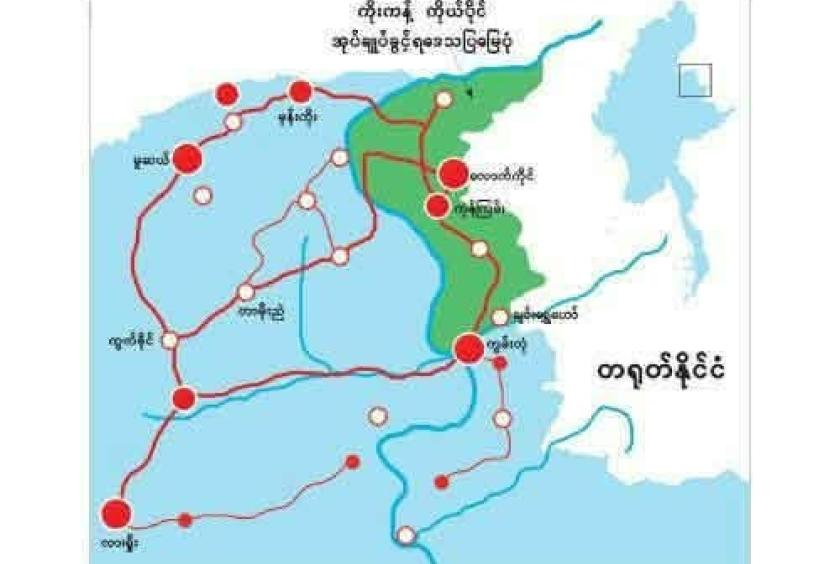
Following its territorial expansion and seizures during the 1027 conflict, the MNDAA began administering towns and villages predominantly inhabited by Shan and other ethnic communities that had not previously been under its control, incorporating them into Special Region 1, a designation used during the former military government’s administration.
Under Myanmar’s 2008 Constitution, the townships of Konkyan and Laukkai in Shan State were designated as the Kokang Self-Administered Zone. Representatives from the zone’s respective constituencies were also elected to the legislatures.
Special Region 1 in Shan State was established for the Kokang area under the former military government. The designation did not include the towns and villages subsequently brought under MNDAA control through territorial expansion.
Lashio, in northern Shan State, was among the areas seized during the 1027 conflict. Following a ceasefire between the Myanmar military and the MNDAA brokered by China, the MNDAA withdrew from Lashio town and handed over its administration to the government. However, the group has continued to operate administrative mechanisms in areas outside the town and in other captured locations.
During the conflict, the MNDAA, together with the Arakan Army (AA) and the Ta’ang National Liberation Army (TNLA), took control of areas including Laukkai, Chinshwehaw, Konkyan, Tar Shwe Htan and Pangseng Kyaw in the Kokang Self-Administered Zone, as well as Mongko, Kyukok, Pangsai, the 105-Mile Trade Zone in Muse and the Chinshwehaw border trade gate.
The areas under MNDAA control include locations east of the Thanlwin River and along the border. The group has also continued to expand its control west of the river, including in Kunlong, Hsenni, Namhpakka, Kutkai, Kaungkha and Tamoenye, as well as villages outside Lashio and areas between Lashio and Hsipaw.
After taking control of Hsenni, a town historically associated with the Shan people and formerly home to the Hsenni saophas, the MNDAA reportedly began replacing the town’s name with “Mu Pan” about two years later, according to local residents and media reports.
From late November 2025, the MNDAA began issuing Special Region 1 local identification cards and household registration documents in Hsenni at an accelerated pace. According to a report published by local media outlet Shan News in February this year, the group was issuing Kokang registration cards, also known as local identification cards, to about 200 people a day in urban wards, charging between K20,000 and K25,000 per person.
BBC Burmese also published an article in March this year entitled “Hsenni Becomes Mu Pan”, examining conditions in the town following its takeover by the MNDAA.
Citing local residents, the BBC Burmese report described how Hsenni had acquired an increasingly Chinese character over the two years following the takeover. Signs at restaurants, pharmacies, shops, massage parlours, karaoke venues and beauty salons were increasingly written in Chinese. Chinese nationals were frequently seen throughout the town, while new buildings associated with Chinese projects had appeared in central and strategically important areas. Restaurants and gambling venues operated by Chinese nationals in the town centre were also reportedly attracting crowds.
A resident of northern Shan State said there had been incidents at the local level involving actions that could contribute to the disappearance of Shan language and cultural traditions in areas under MNDAA control.
“Village signs written in Shan are being removed. There are also cases of land being forcibly seized. The leadership may not necessarily be the one directing these actions, but at the lower levels, it has reached a point where local personnel appear to be required to carry them out.
“The Kokang should remain in their own area. To speak frankly, their population is only around the hundreds of thousands. The indigenous ethnic communities must not be insulted. Even the Bamar ethnic group must not be insulted. The religion, literature, culture and territory of any ethnic group must not be violated, yet these are the very things being targeted.
“Shan-language signs are being removed and replaced with Chinese writing. Chinese characters are also appearing on almost every newly opened shop. In some places, even the Myanmar kyat is no longer accepted. This has happened in places such as Hsenni and Kutkai. Not everywhere, but in many locations, kyat is no longer accepted.
“There is little problem with Chinese signs on businesses operated by Chinese people. However, destroying village signboards, traditional cultural heritage and religious buildings is different. If you want an ethnic group to disappear, its language, literature and culture are among the first things to be destroyed. To speak without taking sides, I believe that is the pattern of what is happening now,” the resident said.
Another resident of northern Shan State said actions intended to erase the cultural heritage of an ethnic community in Myanmar should be opposed.
“If we stand by and watch the destruction of ethnic communities’ literary and cultural heritage, we could become complicit in a historical injustice,” the resident said.
According to the 2024 census, the Kokang population was estimated at between 150,000 and 170,000. Including other ethnic groups living throughout the Kokang area, the total population was estimated at approximately 250,000.