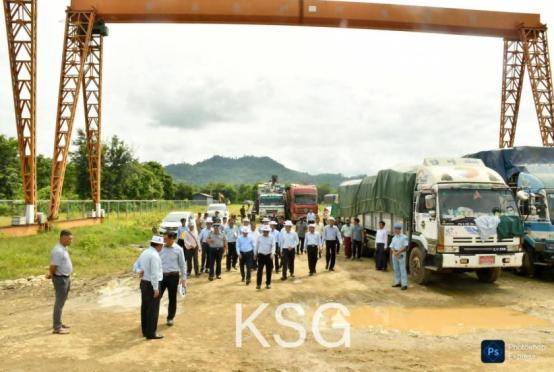

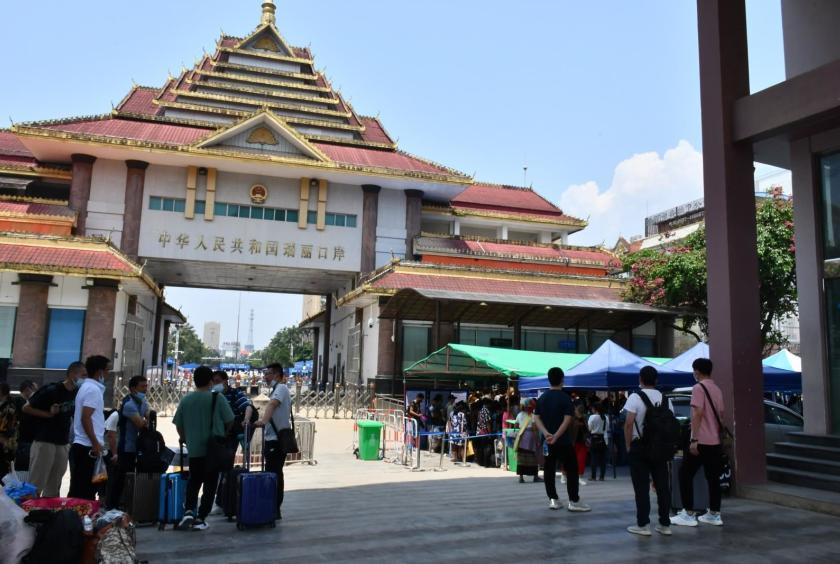
On November 9, the Shweli (Ruili) People's Government Gate Office announced that the Chinese side would suspend the manageable-scale cross-border transportation of goods from the Muse-Kyegaung border gates at the China-Myanmar border, effective from November 11.
The announcement states that the transport of goods into China via the Hsinphyu Gate is no longer allowed using passenger vehicles, motorcycles, tricycles, or hand carts.
Additionally, all import and export goods through Kyegaung must follow designated trade routes, and this policy will be implemented starting November 11, according to the Shweli People's Government Gate Office.
In recent days, the Chinese government has also blocked the importation of goods at all Wa border gates between China and Myanmar.
The Chinese government has restricted the importation of goods through all border gates located in the Wa autonomous region, including goods such as fuel, construction materials, and electrical equipment. However, the movement of people and the importation of vegetables is still permitted.
It has also been reported that China has blocked border gates controlled by the NDAA (National Democratic Alliance Army), which governs parts of the border.
In addition, China closed the Namtit (Mangka) Gate at the China-Wa border in August as part of an effort to effectively restrict goods imports into the Kokang and Ta'ang autonomous regions.
Currently, the Chinese government has indefinitely halted goods importation at the main border gates, including the Namtit (Mangka) Gate, the Monah Gate, the Saufa Gate, and all gates along the Mongla border.
Following the shutdown of all trade entry points at the China-Wa border, the UWSP (United Wa State Party) issued a warning on October 25, urging against unnecessary stockpiling or reselling of goods within the autonomous region and discouraging the spread of misinformation regarding commodity prices among the public.